Blog Flux Directory Subscribe in NewsGator Online Subscribe with Bloglines http://www.wikio.com Blog directory
And, yes, I DO take it personally
Mandy: Great blog!
Mark: Thanks to all the contributors on this blog. When I want to get information on the events that really matter, I come here.
Penny: I'm glad I found your blog (from a comment on Think Progress), it's comprehensive and very insightful.
Eric: Nice site....I enjoyed it and will be back.
nora kelly: I enjoy your site. Keep it up! I particularly like your insights on Latin America.
Alison: Loquacious as ever with a touch of elegance -- & right on target as usual!
"Everybody's worried about stopping terrorism. Well, there's a really easy way: stop participating in it."
- Noam Chomsky
Send tips and other comments to: profmarcus2010@yahoo.com

And, yes, I DO take it personally

Saturday, June 09, 2012

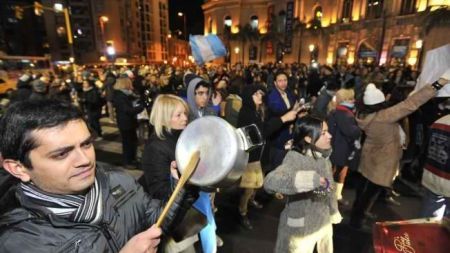
Argentine cacerolazos* join Quebec cacerolazos**

since i gave up my place in buenos aires, i've been grossly negligent in posting on argentina... that doesn't mean, however, that i haven't been keeping up on argentina news... 

the on-going telenovela that is argentina is endlessly fascinating, particularly the exploits of its fashionista president, cristina fernandez de kirchner... cristina is a hoot and would be vastly amusing if she weren't leading a country of nearly 40 million people... she is in her second term following the two terms of her husband, nestor kirchner, who died unexpectedly midway through her first term... she won the last election with 54% of the vote and recently moved to shore up her populist credentials by nationalizing the ypf oil company and kicking out the principal shareholder, spain's repsol... but i've been wondering how long it would take argentines to grow tired of the inflation, corruption and general economic mismanagement that continues to be a hallmark not only of her presidency but of argentina governance in general, stretching back for generations... the straw that broke the camel's back was no doubt cristina's decree limiting u.s. dollar transactions, a decision that led to an enormous increase in capital flight... now, it looks like the good citizens of argentina have had it and have joined their quebecois brethren in making a joyful noise and returned to the street protests that characterized their response to the 2001 economic collapse ...
Photobucket
Pots and pans to protest corruption in Buenos Aires

Middle class Argentines protest with pots and pans against corruption, crime, inflation and the dollar clamp

For the third night in ten days angry Argentines took to the streets of Buenos Aires and other major cities banging pots and pans to protest corruption, rampant crime and insecurity, inflation and the dollar clamp in the midst of an economy that is showing clear signals of exhaustion and growing questions on the current course of affairs.

when i left buenos aires a year ago december, annual inflation was running over 28% and, from everything i've been reading, it hasn't slowed down a bit... i honestly don't know how ordinary argentines make it day-to-day in that economy... i first went there in 2004 and paid 5 pesos for a haircut and the peso-dollar exchange rate was 3-to-1... when i left in 2010, i was paying 25 pesos for a haircut and the exchange rate was 3.8-to-1... i have no idea what i would pay for a haircut today but i do know the exchange rate is now 4.4-to-1... one other thing i do know is that, in an attempt to "make it" financially, argentines cheat, lie, steal and stick it to each other as much as possible and when they're not sticking it to each other, they're REALLY sticking it to the tourists, which usually results in this...

Argentina rapidly becoming too expensive for foreign tourists

Argentina is rapidly becoming an expensive country for tourists and evidence of this is the declining number of tourists arriving in the country in the first months of the year while the number of Argentine travelling overseas is soaring, according to Mario Lielman, chair of the Buenos Aires Tourism and Travel Agencies Association.

i have a very warm spot in my heart for argentina and argentines but, as i've come to learn, argentina is, in many ways, its own worst enemy...

* A cacerolazo or cacerolada is a form of popular protest practised in certain Spanish-speaking countries – in particular Argentina, Chile and Uruguay – which consists in a group of people creating noise by banging pots, pans, and other utensils in order to call for attention. What is peculiar about this type of demonstration is that the people protest from their own homes, thus achieving a high level of support and participation.

** In 2012 in Québec, a province of Canada, citizens are currently using cacerolazo after the adoption on 18 May of Bill 78, an act which severely restricts rights to peacefully assemble. Bill 78 has raised the ire of the Quebec Bar Association, the Quebec Human Rights Commission, Amnesty International, and others. While court challenges are underway, the "Casseroles" or "Pots and Pans Demonstrations" continue nightly in towns and cities across the province, concentrated in Montreal's various neighbourhoods. This joyful Montreal video of Cacerolazo in action has gone viral: http://www.huffingtonpost.ca/2012/05/25/montreal-pots-and-pans-video-bill-78_n_1546694.html

Labels: , , , , , , , , , , , ,

Submit To Propeller


[Permalink] 0 comments

Monday, February 22, 2010

Poor Argentina... If it isn't one thing, it's another...

Photobucket

most of us can't even imagine 30% inflation, but let me give you a small example of what i've experienced in the six years i've been living part-time in buenos aires... when i started coming to argentina in 2004, i paid 5 pesos ($1.50) for a haircut and usually threw in a one peso tip (not something the argentines do, i can tell you)... when i got my hair cut last month, it was up to 20 pesos ($5.50) and i threw in a two peso tip...

for those who are struggling to get by - and there are plenty of them in argentina - i simply don't know how they can make it...

Argentine consumers expect inflation in next 12 months to reach 30%

Argentines with the lowest income expect consumer prices to rise 30% over the coming year, up from the 20% increase they forecast in January, the Buenos Aires-based University said in an e-mailed statement.

[...]

A January survey of 56 economists by Argentina’s central bank forecast inflation of 10.8% over the next 12 months. The gap between the central bank and Di Tella is the result of the “scarce credibility that the official reports have,” the university said in the statement.

Economists and politicians including Vice-President Julio Cobos have questioned the government’s inflation reports since January 2007, when then President Nestor Kirchner began changing personnel at the national statistics agency.

Javier Paz, who tracks inflation at Buenos Aires-based Ecolatina research company said prices rose 2.2% in January from December. The government said prices rose 1% over the same period.

i posted earlier on the torrential rains over the past week in buenos aires... so, imagine dealing with prices rising into the stratosphere and then experiencing this at a railroad crossing...

Tsunami en Palermo Soho
(link to video clip)

Labels: , , , ,

Submit To Propeller


[Permalink] 2 comments

Sunday, August 16, 2009

Stubborn Argentina continues to shoot itself in the foot

Photobucket

honest to god... i LOVE that country but, fercryinoutloud, they desperately need to figure out how to get their ducks in a row... argentina has about as much potential both people and natural resource-wise as any country in the world but they also have this unparalleled ability to screw things up for themselves... here's a few samples of recent mostly unpleasant news... (yes, the post is a bit long but i'm making up for lost time... HA...!)

one year ago, the argentine government decided to re-nationalize the national airline, aerolíneas argentinas... it had been sold a number of years ago to the spanish firm, marsans, which, in typical privatization fashion, had operated it as a cash cow while letting everything deteriorate to unacceptable standards without investing a single peso in modernization, leaving a once proud carrier to become the butt of airline industry jokes...

and now...?

Argentina’s re-nationalized flag air carrier Aerolíneas Argentinas lost in July 48 million US dollars which is “a little bit more” than the same month a year ago when the company belonged to the Spanish tourism group Marsans, according to the company’s current CEO Mariano Recalde.

[...]

“In June 2008 revenue was 90 million US dollars and this year 50 million USD”, said Recalde adding that “June and July are the worst months for airlines in the southern hemisphere”, plus the fact that this year “we had a dramatic drop in winter tourism because of the A/H1N1 virus flu”.

Photobucket
Copyright © Colin Hunter
The July loss “just above 48 million USD” and an average red of “33 million USD” admitted by CEO Recalde, with average revenue of 50 million USD in June, are indicating that income is only covering between 50 and 60% of costs.

Nevertheless Recalde insisted in his optimism in the future of the company since “under government management all indicators of Aerolíneas have improved significantly”. He added that when the crisis “which is hitting all airlines of the world is over, revenue is going to increase considerably”
.
yeah, well, of course the airline was hit by the global economic downturn and the swine flu panic, but let's hope one of these days soon it can at least recover some of its dignity...

another big dynamic in argentina is that people simply do not trust their government... in fact, they don't even trust each other which, in my view, is simply an extension of the former... and is it any wonder...?

Workers at the government's National Institute of Statistics call it crass manipulation: Their agency, under pressure from above, altered socioeconomic data to reflect numbers palatable to the presidency. Inflation and poverty miraculously dropped, they said in interviews, and the economy boomed.

At least officially.

"They just erased the real numbers," said Luciano Belforte, an 18-year veteran at the institute. "Reality did not matter."

The alleged manipulation, which is under investigation by anti-corruption prosecutors, has angered Argentines. But in a globalized world, where a pensioner in Italy might be as likely to invest in Argentina as in Fiat, the suspected modifications are being felt far beyond this city.

[...]

Economists say the official inflation rate of 8.5 percent in 2007 was really about 25 percent. In the 12 months ended this June, the INDEC put the rate at 5.3 percent, but economists say it might be three times higher. Argentina's vaunted economic growth this decade might have been exaggerated, too. Credit Suisse said the 7 percent expansion the government reported last year is likely 2 to 3 percent lower.

[...]

The controversy has raised questions about the government's official poverty figure. The INDEC's calculation is 15.3 percent; the Catholic Church says it is closer to 40 percent. After Pope Benedict XVI called poverty in Argentina a "scandal" this month, the government acknowledged that as many as 23 percent of Argentines might be poor.

so, guess what that massive lack of people's trust in their government has led to... check this out...
Argentina’s flight of capital remains steady having reached 5.5 billion US dollars in the second quarter of the year, 11.2 billion in the first half and 43.1 billion US dollars since the second quarter of 2007, when the first signs of the global crisis, according to the latest data from the Argentine Central Bank.

However it has been below the peaks of the second quarter of 2008, when the farmers’ conflict with the Argentine government was at its highest point and at the end of last year when the Kirchner administration took over the private pensions’ savings funds.

The Central Bank also points out that some of the flight has been into hard currency deposits and “local corporations are using those funds to pay for the running of their businesses but from foreign accounts”.

Local economists point out that the deterioration of fiscal accounts, particularly the budget, and the possibility of a faster devaluation to help compensate the lack of revenue is making savers and companies put their monies in hard currency.

[...]

[E]conomics analyst centre Prefinex also believes that people fear the government will begin printing money to cover the fiscal deficit, which leads to a devaluation of the Peso and capital flight.

Econviews points out that the link between capital flight and a poor fiscal situation also worked inversely: lack of confidence encouraged capital flight which then generated less activity, less revenue and less fiscal abundance.

and it ain't only money that's leaving the country... here's some amazing statistics...
Over 800.000 Argentines left the country following the 2001 economic debacle, according to the latest report from the International Organization for Migration, which in the last decade represents 2.1% of total population.

[...]

Reference data shows that at the beginning of the XXth century an estimated 4.2 million immigrants from Italy, Spain, France and other European countries reached Argentina, but following a few years half of them returned. This means 2.2 million effectively remained in Argentina, which means that the exodus of the beginning of this century is equivalent to almost a third of that early last century massive influx.

However the latest data does not include the Argentines that have been forced to return because of the latest global economic crisis which has hit particularly hard Italy, Spain and the United States.

[...]

The local impact of this qualified emigration has been suffered by the Argentine private sector which has been forced to capacitate personnel and contract staff that can be reconverted.

how sad...

at least there's one bright spot...

Argentina paid creditors a total of 2.25 billion dollars on government-issued debt Monday, as it sought to shed the last vestiges of its 2001 default and return to the financial mainstream. Economy Minister Amado Boudou said the payment, or coupon, had been made to holders of dollar-denominated Boden 2012 bonds—meeting a debt obligation that aims to boost confidence.

"The coupon corresponding to Boden 2012 has been paid," said Boudou, adding that the country would now seek a return to global capital markets before the end of the year.

Argentina has been excluded from these markets since December 2001, when the country suffered an economic collapse wiping out personal savings, shredding government finances and prompting Buenos Aires to default on its debt.

In 2005 Argentina restructured its defaulted debt but there are still an estimated 20 billion dollars in holdouts plus a pending debt to the Paris Club of lenders of 6.5 billion. The country’s debt currently stands at 145 billion US dollars, plus the standing demands.

The Boden 2012 bond was issued in 2002 to compensate creditors who found access to their capital blocked during the 2001 freeze on bank withdrawals. It is estimated 65% of the bond issue is held outside Argentina and 35% locally.

i've been back in the u.s. since the end of may - too long... i'm getting itchy feet and my compass needle is pointing right at buenos aires where there will be signs of spring a'springin' within the next few weeks... unfortunately, it's likely i will be heading east to the balkans and back to afghanistan before i can once again enjoy the company of porteños...

like i say, i love argentina and the argentines but i sure wish they could figure out how to get their act together...

Labels: , , , , ,

Submit To Propeller


[Permalink] 0 comments

Friday, June 20, 2008

34.7% inflation rate in Argentina

Photobucket

holy crap...! and i'm heading back there next month to spend some quality r&r time in my little place... guess i better bring extra money...
Argentines’ inflation expectations for next 12 months: 34.7%

Argentines expect consumer prices to increase on average 34.7% in the coming twelve months, which is slightly lower than the previous report, according to the latest release from the Finance Research Center belonging to the Torcuato Di Tella Univeristy.
“Inflation expectations for the coming twelve months remain above 30% according to the average reply, while dropping 1.8 percentage points compared to the previous average”, indicates the release.

However “inflation expectations are virtually double those of June last year”.

These expectations vary according to the region of Argentina: in the capital Buenos Aires the rate remains high at 36.5%; in the Great (metropolitan) Buenos Aires drops to 33.1% and in the rest of the country climbs to 36.7%.

and what's the "official" inflation rate according to the totally out-of-touch and lying through its teeth government of cristina fernandez de kirchner...?
The Argentine Central Bank monthly survey estimates inflation in the next twelve months to be in the range of 9.7%.

that would be funny if it wasn't so pathetic and if the real rate of inflation wasn't taking such a toll on the folks least able to deal with it...

Labels: , , , ,

Submit To Propeller


[Permalink] 0 comments

Saturday, May 31, 2008

Argentina: inflation always hits those with the least the hardest

Photobucket

i watched this clip this morning on al jazeera... it gives a reasonably good overview on what's really happening there... as usual, it's those who are the most vulnerable who get nailed the hardest...

Labels: , , , , ,

Submit To Propeller


[Permalink] 0 comments

Friday, May 02, 2008

Sovereign debt default, inflation and denial - a long overdue update on Argentina


i've posted extensively on argentina in general and particularly its $95B 2001 bond default (see here)... over seventy percent of the bondholders opted for a 2004 swap deal that offered them 30 cents on the dollar, leaving about $20B outstanding... the remaining bondholders, mostly in the u.s., refused the swap, and continued to hold out past the 25 february 2005 expiration date... they're still trying to get all of their money...
A United States judge granted on Wednesday a request by bondholders suing Argentina to extend a freeze on as much as 16 billion US dollars in sovereign bonds issued by the country and which now held by the Depository Trust Co. in New York.

Argentina claims it no longer has any interest in the bonds and that they are worth only 2 billion US dollars. The order stems from a class-action, or group lawsuit brought by bond holders who claim Argentina wrongly failed to pay interest or principal on its 11 percent global notes due in October 2006. The plaintiffs, who claim the bonds are worth as much 16 billion, are seeking more than a billion US dollars in damages.

[...]


Argentina defaulted on 95 billion in debt in late 2001. In 2005, then-President Nestor Kirchner offered holders of defaulted debt 30 cents on the dollar. Holders of about 20 billion in bonds rejected that deal. Argentina has since refused to re-open negotiations, preventing the country from being able to directly tap international credit markets. The country has also been the subject of lawsuits by individual bondholders.

imho, these primarily u.s. based bondholders are throwing away their attorney fees... argentina, while it would like to get back in the good graces of the international credit markets doesn't feel any great pressure to do so... for one thing, the country's economy has been pushing forward at an amazing 9% since the default... for another, much of latin america, including argentina, has banded together under the financial assistance umbrella of venezuela and hugo chávez (banco del sur) at considerably more favorable, less restrictive and much less ideological terms than offered by the world bank, the imf or the big transnational banks...

besides, argentina has other things to worry about at the moment...

Inflation has become the main concern of a majority of Argentines, leaving aside other issues such as insecurity and poverty according to the latest public opinion polls from Ibarometro and Hugo Haime & Associates, released this week in Buenos Aires and which refers to the second half of April.

According to Ibarometro, 36.9% of respondents consider their main concern “the hike in prices”, while for Haime 50% of Argentines feel that “inflation is what most impacts daily life”. This suggests a radical change from last January.

At the beginning of 2008, for Ibarometro the main issues were insecurity, education, poverty and fourth rated inflation. But in three months inflation climbed to top of the list. Similarly with Haime, the April 50% was only 31% last January.

To make things even more worrisome, last January 37% believed inflation in 2008 was to be higher than in 2007, but in the latest poll the percentage jumped to 71%. That is 71% believe the current Argentine administration is not considered capable of keeping prices at a reasonable level.

Food, clothing and personal hygiene goods were the most volatile according to the opinion polls.

“Inflation, newspaper headlines almost daily and the discredited image of Indec (the office responsible for calculating consumer price indexes) is fueling the negative perception of the economic situation. We also believe that the camp conflict increases that negative perception”, pointed out Ibarometro.

More specifically compared with January “the inflation issue has jumped 200% from 11% to 36.9%, while insecurity falls ten percentage points. Clearly the increase in prices shadows all other concerns. The education issue also virtually has disappeared from the list of ratings”, added Ibarometro.

As to the overall economic situation, a majority of Argentines have a negative view: 56.8% describe it as “bad” or “very bad”. Only 30% considers it “very good” or “reasonably good”. However in spite of these percentages four out of ten respondents considered positive the sacking of the Economy minister Martin Lousteau.

the argentine government officially claims inflation at just under 10%... my finger in the air calculation is closer to 20%, and, if you're a foreign tourist, it's pushing 30%... it's that inflation, not a suit by disgruntled bondholders, that's going to bite cristina in her expensively-clad tush...
S&P said it had downgraded Argentine bonds’ risk rate precisely because the Kirchner administration refuses point blank to apply any cooling policies and insists that inflation is under control. In spite of the fact that the overall consensus is that inflation contrary to the “official” statistics of just below two digits is in the range of 18 to 24%.

as much as i have a very soft spot in my heart for argentina, it's difficult to let the argentine government off the hook when it's still led by those who think denial is a river in egypt...

Labels: , , , , , , , , , , ,

Submit To Propeller


[Permalink] 0 comments

Monday, April 07, 2008

World food shortages may provoke riots

hungry people are desperate people... we're sitting on a powder keg with this one...
A global rice shortage that has seen prices of one of the world's most important staple foods increase by 50 per cent in the past two weeks alone is triggering an international crisis, with countries banning export and threatening serious punishment for hoarders.

With rice stocks at their lowest for 30 years, prices of the grain rose more than 10 per cent on Friday to record highs and are expected to soar further in the coming months. Already China, India, Egypt, Vietnam and Cambodia have imposed tariffs or export bans, as it has become clear that world production of rice this year will decline in real terms by 3.5 per cent. The impact will be felt most keenly by the world's poorest populations, who have become increasingly dependent on the crop as the prices of other grains have become too costly.

it isn't just rice, either... it's wheat, corn, and soy as well... look at what took place in argentina the past few weeks over soy...

but, it isn't until the last third and second to the last paragraphs of the article - paragraphs 14 and 15, to be precise - that you get a picture of what's REALLY going on...

Analysts have cited many factors for the rises, including rising fuel and fertiliser expenses, as well as climate change. But while drought is one factor, another is the switch from food to biofuel production in large areas of the world, in particular to fulfil the US energy demands. A continuing change in the global diet is also putting a further squeeze on rice. In China, for example, 100 million rural migrants to the country's big cities have switched from a staple of wheat to rice as they have become wealthier.

Rapid recent price increases are also likely to have a dangerous secondary effect of stoking further inflation in emerging countries, which are already suffering from record oil prices and surging agricultural commodity prices.

"fulfill u.s. energy demands"... haven't i heard that somewhere before...?

Labels: , , , , , , , ,

Submit To Propeller


[Permalink] 0 comments

Tuesday, January 15, 2008

Here it comes, the next big story - U.S. inflation

i was largely non compos mentis during the last period of serious inflation in the u.s. in the early and mid-70s... yeah, i knew it was going on and, yeah, i knew it was a problem, but i honestly either don't remember or perhaps didn't experience much of a personal impact... contrast that with my more recent experience in argentina, which has been trying to grapple with what government figures declare is a 9% inflation rate, but my first-hand, on-the-street experience of watching prices rise literally before my eyes tells me is at least 12% percent and maybe even as high as 19%... so, if WHOLESALE inflation in the u.s. for ALL of 2007 is 6.3 percent, you have to believe that, with the recent steep rises in food and basic commodity prices, the real personal impact is a minimum of several points higher...

i had an experience with u.s. inflation just this past sunday while i was perusing the menu prices at a down-scale, storefront, strip mall, family-run, mexican restaurant, usually the very best bet for value... the average entree is now 25% more than last year at this time, and a full 60% more than early 2003...

Wholesale inflation shot up in 2007 by the largest amount in 26 years even though falling gasoline costs allowed price pressures to moderate in December.

The Labor Department reported that wholesale inflation was up 6.3 percent for all of 2007, reflecting a huge increase for the year in various types of energy costs ranging from gasoline to home heating oil.

The year ended on a more positive note, with wholesale prices falling by 0.1 percent in December. That reflected decreasing costs at the time for gasoline and other energy products. It was a significant slowdown after prices had soared by 3.2 percent in November, which had been the biggest one-month increase in 34 years.

Meanwhile, the Commerce Department reported that retail sales fell by 0.4 percent in December. It was a worse-than-expected decline and increased worries that the country could topple into a recession.

i've noticed the decrease in gasoline prices and am at a loss to explain why... mexico recently announced that it will cease to ship crude to the u.s. west coast, opec claims it is operating at peak capacity (but george is still asking for more), the u.s. is on the outs with venezuela and iran, and more than 300,000 barrels of oil are missing from the u.s. strategic petroleum reserve, so why are gasoline prices coming down...?

Labels: , , , , , , ,

Submit To Propeller


[Permalink] 0 comments

Sunday, November 11, 2007

Let's talk a little bit about the Federal Reserve, shall we...?

brasscheck tv...


It's been a long time since a US Congressman spoke intelligently about the Fed's role in impoverishing Americans through its currency manipulations.

Keep in mind: the Fed is not a government agency. It is a privately owned and controlled institution that's been given a monopoly over the creation of money for the United States - a violation of the US Constitution.

here's more...


It happened in 1913.

And practically no one noticed.

In 1913, the money-creation function of the US Congress was taken over by a privately-owned banking cartel.

Called the "Federal Reserve," the Federal Reserve is neither federal, nor a reserve. What it is in fact is a privately owned monopoly that controls America's money supply.

Hard to believe, isn't it? And yet it's true. Thanks to video and the Internet this basic fact of American life now finally has a chance to spread to the public.

Labels: , , , , ,

Submit To Propeller


[Permalink] 0 comments

Tuesday, October 30, 2007

Not-so-amazing divergence of opinion on Argentina's presidential election


prompted by Cristina Fernandez de Kirchner's victory in this past sunday's presidential election in argentina, the pundits weigh in, and a fascinating juxtaposition of perspectives it is...

here's one point of view that paints a very positive picture of how argentina's managed its recovery by repudiating the imf and its policies, but neglects to mention anything about the seamy reality that underlies literally everything in the country...

from the la times op-ed page...

[T]he authorities made sure that their currency didn't rise too high and didn't swing wildly as a result of movements in financial markets. (Here in the U.S., where we have shed more than 3 million manufacturing jobs since 2001 -- the bulk of them lost because of an overvalued dollar -- we might take note.) They also kept interest rates low and made growth, rather than the lowest possible inflation, the top priority.

These policies are mostly a no-no among central bankers and economists, and Argentina had a few showdowns with the IMF, including a brief temporary default to the fund in September 2003. But the fund backed down, and most of the defaulted international creditors ended up settling for 35 cents on the dollar in 2005.

Of course, Argentina hasn't gotten a lot of foreign direct investment in the last five years, and it cannot directly borrow in international bond markets. But these handicaps -- which if you read the business press should spell doom -- turned out not to be all that important. Nor are they permanent. In time, foreign investors and lenders will find their way back to a fast-growing economy.

[...]

Getting basic macroeconomic policies right for your own economy is a lot more important than pleasing international financial markets. That goes double for failed international financial institutions like the IMF. The fund not only oversaw the train wreck that collapsed Argentina's economy from 1998 to 2002, it opposed the major policies that drove Argentina's remarkable recovery.

The fact that Argentina's break with the IMF and its policies was key to the country's economic success also has implications for other countries. Over the last quarter of a century, the fund and its allied institutions -- run from Washington -- have presided over Latin America's worst long-term growth performance in more than a century. As a result, most governments in the region have moved away from the IMF. Its loan portfolio in the region has shrunk from $49 billion just four years ago to less than $1 billion today. But it still holds sway in many poor countries.

Argentina's new government will face challenges, the kind brought about by a fast-growing economy: keeping inflation in check and assuring adequate supplies of energy. But these problems are manageable. Of course, there are analysts who argue otherwise, but their forecasts over the last five years have not been very accurate.

so, ya got that...? bad imf, good argentina...

now, let's jump across the country to the wapo op-ed page, where we're offered the standard beltway point of view...

Argentina -- and Ms. Fernandez de Kirchner's Peronist party -- still have not learned the lessons of the country's history. That could make the coming years more turbulent.

[...]

For the last century, Argentina has lived by a cycle of economic boom and bust, driven by prices for its agricultural exports, by the fondness of its governments for populist policies and by its resistance to playing by the usual rules of global financial markets. The boom under Mr. Kirchner, which followed the devastating bust of 2001, follows the usual pattern: It has been fueled by high prices for Argentine beef, wheat and soybeans, and by Mr. Kirchner's stiffing of international creditors, vast government spending, and controls on energy and food prices. The predictable result has been disinvestment in the energy sector that already has caused brownouts and mounting inflation that is probably double the official estimate of 9 percent annually.

The Kirchners managed to get through the election season by manipulating the inflation figures and bullying supermarkets into keeping prices down.

[...]

Ms. Fernandez de Kirchner ... can use her mandate to deliver the tough medicine the economy needs -- including energy price and interest rate increases, a revaluation of the currency and a reconciliation with the International Monetary Fund, which holds the key to renewed foreign investment. Or she can pursue her husband's populist course until it produces another crash.

message from the wapo...? good imf, bad argentina...

even tho' i live there part-time, i am not going to present myself as a fount of argentina truth, but i do know a few things... there's a little truth in both points of view as well as some things left out... imf policies have seriously damaged many countries, although perhaps none as spectacularly as argentina... was it all the imf's fault...? of course not, but the imf does deserve a large portion of the blame... does argentina need to reconcile with the imf...? maybe, and they're trying, but i think they're now smart enough to not ever again let the imf dictate their macroeconomic policies... are price controls a good way to combat inflation...? honestly, i don't know... my guess is, probably not... is inflation higher than the government reports...? my shoe leather analysis says, oh, yeah... when i am now paying almost double cab fare, a 2/3 increase for a bag of bran cereal and a liter of drinkable yogurt, i ain't buyin' the 9% figure...

naturally, the wapo also gets in a dig about hugo chávez, venezuela and the bolivarian revolution, but neither writer talks about argentina's alliance with venezuela, both for economic development loans and energy supplies, an important omission, imho... also, neither article mentions the on-going and seemingly unmanageable corruption at all levels of argentina society... basically, i have found the average argentine to be honest, decent and well-intended, but they have become so jaded and resigned to ever-present corruption that most of them just throw up their hands, a state of mind that leads to this, another fact that neither article deigned to mention...

[O]nly 73 per cent of electors voted, the lowest turnout since 1928 in a country where voting is compulsory.

Labels: , , , , , , , , ,

Submit To Propeller


[Permalink] 0 comments