Blog Flux Directory Subscribe in NewsGator Online Subscribe with Bloglines http://www.wikio.com Blog directory
And, yes, I DO take it personally
Mandy: Great blog!
Mark: Thanks to all the contributors on this blog. When I want to get information on the events that really matter, I come here.
Penny: I'm glad I found your blog (from a comment on Think Progress), it's comprehensive and very insightful.
Eric: Nice site....I enjoyed it and will be back.
nora kelly: I enjoy your site. Keep it up! I particularly like your insights on Latin America.
Alison: Loquacious as ever with a touch of elegance -- & right on target as usual!
"Everybody's worried about stopping terrorism. Well, there's a really easy way: stop participating in it."
- Noam Chomsky
Send tips and other comments to: profmarcus2010@yahoo.com

And, yes, I DO take it personally

Sunday, November 29, 2009

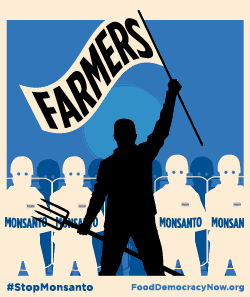
In the U.S. and most of the rest of the world, Monsanto OWNS soybeans and corn

heckuva strategy... genetically modify seeds, patent them, build dominant market share to insure that your seeds are the only ones available and then keep raising the prices... pretty soon, the world's food supply belongs to YOU... it's the same strategy employed by the banksters to keep us servile and productive for our masters...
For plants designed in a lab a little more than a decade ago, they've come a long way: Today, the vast majority of the nation's two primary crops grow from seeds genetically altered according to Monsanto company patents.

Ninety-three percent of soybeans. Eighty percent of corn.

The seeds represent "probably the most revolutionary event in grain crops over the last 30 years," said Geno Lowe, a Salisbury, Md., soybean farmer.

But for farmers such as Lowe, prices of the Monsanto-patented seeds have steadily increased, roughly doubling during the past decade, to about $50 for a 50-pound bag of soybean seed, according to seed dealers.

The revolution, and Monsanto's dominant role in the nation's agriculture, has not unfolded without complaint. Farmers have decried the price increases, and competitors say the company has ruthlessly stifled competition.

Now Monsanto -- like IBM and Google -- has drawn scrutiny from U.S. antitrust investigators, who under the Obama administration have looked more skeptically at the actions of dominant firms.

once again, the wapo manages to publish a story without context... how can a news organization of the supposed reputation of the washington post manage to ignore the on-going global outcry against genetically-modified food production in general and monsanto and its terminator seeds in particular that has been going on for years...? it's stunning... really...

Labels: , , , , , ,

Submit To Propeller


[Permalink] 0 comments

Monday, June 23, 2008

Terrible news for those who need to eat in Afghanistan

Photobucket

from an independent source...
A UN spokesman for WFO stated in a press conference that they have stopped food aid in Afghanistan due to attacks launched by the Taliban militants against logistic convoys in Paktika, Ghazni and Maydan Wardak provinces. He added that last week Taliban militants attacked a convoy of fifty-four trucks carrying logistic supplies and they have stolen a truck laden by approximately forty-five tones of food supplies.

as if the afghan people need any more bad news...

Labels: , , , ,

Submit To Propeller


[Permalink] 0 comments

Friday, June 20, 2008

34.7% inflation rate in Argentina

Photobucket

holy crap...! and i'm heading back there next month to spend some quality r&r time in my little place... guess i better bring extra money...
Argentines’ inflation expectations for next 12 months: 34.7%

Argentines expect consumer prices to increase on average 34.7% in the coming twelve months, which is slightly lower than the previous report, according to the latest release from the Finance Research Center belonging to the Torcuato Di Tella Univeristy.
“Inflation expectations for the coming twelve months remain above 30% according to the average reply, while dropping 1.8 percentage points compared to the previous average”, indicates the release.

However “inflation expectations are virtually double those of June last year”.

These expectations vary according to the region of Argentina: in the capital Buenos Aires the rate remains high at 36.5%; in the Great (metropolitan) Buenos Aires drops to 33.1% and in the rest of the country climbs to 36.7%.

and what's the "official" inflation rate according to the totally out-of-touch and lying through its teeth government of cristina fernandez de kirchner...?
The Argentine Central Bank monthly survey estimates inflation in the next twelve months to be in the range of 9.7%.

that would be funny if it wasn't so pathetic and if the real rate of inflation wasn't taking such a toll on the folks least able to deal with it...

Labels: , , , ,

Submit To Propeller


[Permalink] 0 comments

Sunday, May 25, 2008

Afghanistan - what's happening with the food crisis in a REALLY poor country

Photobucket

i see nothing but trouble ahead for nations around the world as the poor are increasingly unable to afford to feed themselves and their families... a man with an empty stomach, negligible income, with many hungry mouths to feed, who is confronted every day with ever-rising food prices, will, in short order, become a very angry man, and rightly so...

here's the scenario in afghanistan, a scenario i only have to step outside the gate of the project compound to experience...

As the global food crisis deepens, bringing inflation and shortages to many countries, Afghanistan -- already facing a protracted drought, entrenched rural poverty and an ongoing conflict with Islamist insurgents -- finds itself battling the added threat of hunger.

For generations, Afghans have depended on cheap, plentiful bread as their main staple. The country's principal crop is wheat, and its farmers produce more than 5 million tons in a good year. Although that is not enough to feed the entire population, wheat can usually be trucked in from neighboring Pakistan.

Since February, however, a combination of local drought and regional shortages has driven the price of flour here to once-unimaginable levels -- as much as $50 for a 40-pound sack. Pakistan, also worried about how to feed 160 million-plus people, has closed its borders to food exports, as have a number of other largely agricultural countries anxious to stave off domestic hardship and political unrest.

So far, Afghan authorities and international charities have prevented the wheat flour shortage here from reaching crisis proportions by finding emergency sources. The government has trucked in tons of flour from Kazakhstan, and the U.N. World Food Program has raised money to import 85,000 tons from major wheat-producing countries such as Canada and Australia.

In addition, enterprising smugglers have continued to bring in truck after truck piled with sacks of flour from Pakistan. Sacks are said to cross the border surreptitiously on donkey-back, via bribery at official crossing spots and buried deep inside cargo trucks carrying Afghan refugees and their belongings back home.

i don't think anybody, even a lot of the better off people here in kabul, realizes just how potentially explosive this situation is...

Labels: , , , , , , , , ,

Submit To Propeller


[Permalink] 0 comments

Saturday, May 03, 2008

More perspective on Afghanistan: "Since the Americans came here, nothing is cheap"


i've been posting on various perspectives of kabul and afghanistan... here's another one that captures fairly well the experience of driving around the city of kabul...
Getting around in some parts of central Kabul is like driving inside trenches: two lanes of road between high walls made of modern versions of sandbags referred to by their brand name: "Hesco barriers." They consist of 4-foot-tall wire mesh containers lined with heavy plastic and filled with sand, gravel or dirt, all topped by concertina wire. Other streets have classic sandbag structures, high walls and/or concrete-like barricades. Every dozen yards along the roads are heavily armed guards -- dead serious, with sunglasses, earpieces and legs menacingly spread.

yes, it sounds formidable and it is... on the other hand, there are also some relatively nice, wide streets, lined with homes or shops, certainly not like what you would experience in the u.s., but not like what she is describing above either... for instance, here's a lovely sunset picture i took from the hotel on a hill overlooking kabul where two afghan friends took me to dinner on thursday evening...

Photobucket
Kabul, looking west at sunset,
with buildings of Kabul University
in the foreground


but there is no discounting the reality that many afghans are experiencing...
Hungry Afghans looking for their next meal eye bread scraps piled up like heaps of trash at a Kabul market as a vendor weighs out fistfuls of the stale crusts on a scale. A Pashtun woman waits with an empty plastic sack.

She isn't scavenging — she's paying for leftovers that in better times were sold for feeding to sheep and cows. The woman said her household of 14 people had to give up fresh bread a month ago as the price spiraled out of reach.

Rising global food prices have hit few places as hard as Afghanistan, where the cost of wheat flour has shot up 75 percent in three months, fueling anger against the U.S.-backed government of President Hamid Karzai. In the volatile south, officials fear it could boost recruitment for the Taliban insurgency.

[...]

The U.N. World Food Program, or WFP, warns that the situation for the poorest in Afghanistan is dire and deaths from malnutrition are likely to increase. Protests have broken out in at least one city.

Even middle-income professionals are struggling.

"People are not dying of starvation, per se, but that's very rare these days. Usually people die from diseases they never should have died from but their bodies are weakened by hunger," he said.

Even before the food crisis, U.N. data showed 54 percent of children under five in Afghanistan are stunted. An estimated 10,400 people die of nutritional deficiencies each year.

In two of the poorest provinces, Ghor and Badghis, communities are buckling under the double impact of the global food crisis and a drought that wiped out 70 percent of last year's crop, said Mary Kate MacIsaac of the aid group World Vision.

here's the quote of the day...
[A] Pashtun woman, who declined to give her name because of her conservative social code [said,] "Since the Americans came here, nothing is cheap."

Labels: , , , , , , ,

Submit To Propeller


[Permalink] 0 comments

Thursday, April 24, 2008

Hugo Chávez on the world food crisis - a "massacre" of the poor

and it ain't by chance either... it's by design...
Soaring food prices are a "massacre" of the world's poor and are creating a global nutritional crisis, Venezuelan President Hugo Chavez said on Tuesday, calling it a sign that capitalism is in decline.

His comments came only hours after the United Nations' World Food Program called more expensive food a "silent tsunami" that threatens to plunge more than 100 million people on every continent into hunger.

"It is a true massacre what is happening in the world," Chavez said in a televised speech, citing U.N. statistics about deaths caused by hunger and malnourishment.

"The problem is not the production of food ... it is the economic, social and political model of the world. The capitalist model is in crisis."

[...]

Cuban Vice President Carlos Lage, visiting Caracas to meet with Chavez and other allied leaders on Wednesday, accused developed countries of spurring food prices through biofuels.

"Developed countries want to feed the cars of the rich with food -- this is the irrational world we live in today," Lage said, echoing Chavez's frequent accusations that Washington's promotion of biofuel is boosting prices of staples like corn.

don't think for one single second that this wasn't planned...

Labels: , , , , , , , , , ,

Submit To Propeller


[Permalink] 0 comments

Monday, April 21, 2008

"Grain prices are rising to their equivalent level in oil" - more from Al Jazeera English on the food crisis

i just finished watching this al jazeera special, ... without a doubt, it's the clearest, most honest look i've yet seen at what's happening with grain, ethanol and the rapidly worsening global food crisis... i highly recommend watching both parts start to finish...

People & Power - Food Shortages -20 Apr 08 - Part 1


People & Power - Food Shortages -20 Apr 08 - Part 2

Labels: , , , , , ,

Submit To Propeller


[Permalink] 0 comments

Sunday, April 20, 2008

The world food crisis for dummies: food as a weapon

there really isn't any mystery to the rapidly-escalating global food crisis... just like endless war, it's all part of the plan of the global elites to make sure that they, and only they, remain in charge... since they have all the money imaginable, augmented by immense power, they will never have to worry about where their next meal will come from, and then, when all the great unwashed finally kill each other off over a cup of rice or die from starvation, the world will be an ever-so-much-nicer place for them to live...

amy goodman interviewing raj patel...

[I]f you imagine a sort of hourglass, at the top there are the millions of farmers who grow the food that we eat, and at the bottom there are billions of us consumers, and in the middle there are just a handful of corporations that mediate between the people who grow our food and us. And those corporations, in many cases -- it's usually four corporations controlling more than 50 percent of the market. I mean, in tea, for example, one company, Unilever, controls 90 percent of the market.

Now, when you're in that position of market power, you're able to do a great deal. First, you're able to drive prices down for farmers. And of course the irony there is that farmers and farm workers are the poorest people on the planet. So you're paying the poorest people on the planet the least. And then you're processing the food so that what we end up with is food that is rich in salts and fats and sugars, food that tends to make us want to buy more, food that makes us obese. And that's why you're having a situation where there are six billion people in the world, a billion of whom are now overweight.

[I]n the past, it used to be that the people who were overweight were rich ... and the people who were hungry were poor. Today, hunger and obesity are both signs that people are unable to control their diets. They're unable to control, not in a sort of willpower way, but unable to control in terms of being able to access fresh fruits and vegetables, access food that is healthy. I mean, in the United States, for example, it's much harder for communities of poor people and people of color, in particular, to access fresh fruits and vegetables. In West Oakland, for example, near where I live, you have a situation where there's just one supermarket in West Oakland and dozens and dozens of liquor stores where there are no fresh fruits and vegetables, but there are these highly processed industrial foods. Now, that's a sign that in fact -- I mean, it would be wonderful for all of us to be able to access these fresh fruits and vegetables, but at the moment, particularly for people on low incomes, that's pretty tough to do. And so, the environments in which poor people find themselves and which are being built around poor people are more conducive to being overweight and to be unhealthy in the cities, and for poor people in the fields, those kinds of prices that come from the industrial food system are driving them out of business.

if that doesn't put it all in perspective for you, then try this...
Using food as a weapon is as old as the siege but today’s barbarians have upped the anté by several orders of magnitude.

“…There are only two possible ways in which a world of 10 billion people can be averted. Either the current birth rates must come down more quickly. Or the current death rates must go up. There is no other way. There are, of course, many ways in which the death rates can go up. In a thermonuclear age, war can accomplish it very quickly and decisively. Famine and disease are nature’s ancient checks on population growth, and neither one has disappeared from the scene … To put it simply: Excessive population growth is the greatest single obstacle to the economic and social advancement of most of the societies in the developing world.” — Speech to the Club of Rome by Robert McNamara, Oct. 2, 1979

“Overpopulation and rapid demographic growth of Mexico is already today one of the major threats to the national security of the United States. Unless the U.S.-Mexico border is sealed, we will be up to our necks in Mexicans for whom we cannot find jobs.” —Robert McNamara, then World Bank president, March 19, 1982

McNamara’s thinly veiled genocidal utterances took place over thirty years ago, echoing the wealthy and the privileged’s fear of the ’great unwashed’ when ‘over-population’ was the buzzword. So not much has changed has it, we’re hearing the same, tired old messages being rolled out once again by the ruling elites and their spin doctors. McNamara’s cries of fear about being up to his neck in Mexicans is exactly same as the current bogey doing the rounds in Europe, only now they’re Africans.

[...]

[I]t’s the economic and political policies of our governments in cahoots with Big Business that created the crisis in the first place (as it has all previous crises).

The ‘credit-crunch’ /is merely symptomatic of a sick system that needs to be replaced poste haste.

The issue is really quite simple, as long as we have ruling elites joined at the hip to Big Capital, running the show, they will never, not in a million years entertain the idea of doing away with the present economic system—which is the cause of all our miseries—and replacing it with a saner and more modest way of earning a buck, there’s too much at stake and for so few, dammit! Only we, the so-called people can do that, they won’t even begin to change things unless we either force them to or failing that, get rid of them.

didja get all that...? good...!

Labels: , , , , , , ,

Submit To Propeller


[Permalink] 0 comments

Friday, April 18, 2008

Euro hits $1.59, Merril Lynch continues its free fall, oil climbs past $115 a barrel, and rice is now 3x higher than 2007

please note... ALL of these stories are interconnected in very fundamental ways, all of which point to the continuing collapse of the global financial markets... hitting bottom, imho, is a long way off...

is it even possible to comprehend $30B worth of losses in one company in only three quarters...?

Merrill Lynch announces job cuts after $2 billion loss

Merrill Lynch, the investment bank, posted a loss Thursday and announced that it would lay off about 2,900 additional workers. Including about 1,000 jobs already eliminated this year, the company's work force is to shrink by 10 percent, or about 4,000 jobs, over the course of 2008.

The bank reported worst-than-expected earnings for the first quarter, including $6.5 billion in write-downs and adjustments to assets in its mortgage, leveraged finance and other divisions. The write-downs bring the total taken by Merrill Lynch in the last three quarters to more than $30 billion.

i'm working with a gentleman here who lives in france but is an employee of the u.s. company that runs the project... he is paid in dollars which he converts to euros... he has lost nearly HALF the value of his salary over the past year...


The euro retreated from a record high against the dollar in choppy trade Thursday after a top euro zone official called recent euro appreciation "undesirable."

[...]

That sparked concern that G7 officials may be considering coordinated currency intervention to stem the dollar's decline.

it wasn't very long ago, only a matter of six months, that oil over $100 a barrel seemed unimaginable...


Oil prices hit all-time highs above $115 a barrel Thursday as the dollar continued to weaken and on reports that oil and gasoline stocks in the United States were lower than expected.

and look at rice, a food staple for more than 2/3 of the world's population...
The sense of crisis in the rice market showed no signs of easing as prices continued their record climb and a tender from the Philippines, the world's top importer, attracted offers to sell only about two-thirds of the half-a-million tons it had sought, Reuters reported from Bangkok.

In Bangkok, Thai 100 percent B-grade white rice, considered the world's benchmark, hit $950 per ton, three times its price at the start of 2007.

i don't know how anyone can look at the above four items and not sense impending doom...

Labels: , , , , , , , ,

Submit To Propeller


[Permalink] 0 comments

Monday, April 07, 2008

World food shortages may provoke riots

hungry people are desperate people... we're sitting on a powder keg with this one...
A global rice shortage that has seen prices of one of the world's most important staple foods increase by 50 per cent in the past two weeks alone is triggering an international crisis, with countries banning export and threatening serious punishment for hoarders.

With rice stocks at their lowest for 30 years, prices of the grain rose more than 10 per cent on Friday to record highs and are expected to soar further in the coming months. Already China, India, Egypt, Vietnam and Cambodia have imposed tariffs or export bans, as it has become clear that world production of rice this year will decline in real terms by 3.5 per cent. The impact will be felt most keenly by the world's poorest populations, who have become increasingly dependent on the crop as the prices of other grains have become too costly.

it isn't just rice, either... it's wheat, corn, and soy as well... look at what took place in argentina the past few weeks over soy...

but, it isn't until the last third and second to the last paragraphs of the article - paragraphs 14 and 15, to be precise - that you get a picture of what's REALLY going on...

Analysts have cited many factors for the rises, including rising fuel and fertiliser expenses, as well as climate change. But while drought is one factor, another is the switch from food to biofuel production in large areas of the world, in particular to fulfil the US energy demands. A continuing change in the global diet is also putting a further squeeze on rice. In China, for example, 100 million rural migrants to the country's big cities have switched from a staple of wheat to rice as they have become wealthier.

Rapid recent price increases are also likely to have a dangerous secondary effect of stoking further inflation in emerging countries, which are already suffering from record oil prices and surging agricultural commodity prices.

"fulfill u.s. energy demands"... haven't i heard that somewhere before...?

Labels: , , , , , , , ,

Submit To Propeller


[Permalink] 0 comments

Tuesday, April 01, 2008

Argentina's president wants to keep citizens fed but she's between a rock and a hard place


what's happening in argentina is a microcosm of the crisis that's threatening food supplies, particularly for the most vulnerable, throughout the world...

the push to biofuels has caused, in argentina as in many other places, a massive rush to clear uncultivated land (driving through the argentine pampa, there are massive fires every few kilometers where cleared natural vegetation is being burned) for soy production, and an equally massive shift to producing soy in lieu of other food crops... a lot of the big players (most notably cargill, the biggest privately-held company in the world that most people have never heard of) are adding vast chunks of land to their already vast holdings, leaving global agricultural production in ever fewer hands... cargill already owns most of its own world-wide distribution network - ports, storage facilities, ships, barges, railroad cars - and that vertical integration, from seed to soil to harvest to shipment to mill, insures a virtual monopolistic control...

the consequences of this is that world food and agricultural commodity prices are soaring world-wide, and national leaders, like cristina fernandez de kirchner, are acutely aware that their citizens, particularly the poor, are at great risk of not being able to afford to eat... thus the export tax increases on soy and similar taxes on rice that have recently been levied in countries such as thailand and vietnam, and on wheat, corn, rice, and soybeans in china in an effort to keep food in the country instead of being exported...

argentina is an agricultural powerhouse, but its farmers, like the rest of its citizens, are fed up with government interference and have been for some time, and their traditional show of frustration is a strike, usually in the form of blockading roads and interfering with the flow of commerce... that's precisely what we've been seeing in the past few weeks after cristina announced the increase in agricultural export taxes...

Almost three weeks of roadblocks by farmers have caused food shortages, paralyzed grain exports from agricultural powerhouse Argentina and turned into a major political conflict for President Cristina Fernandez de Kirchner.

The center-left government said it would give small farmers a rebate on new, higher taxes for soy and sunflower seed exports, as well as other benefits such as compensation for transportation costs for small farmers far from markets.

[...]

But farm leaders said in a news conference they would continue protests that have blocked highways and held back farm goods since March 13, making beef, dairy, chicken and produce scarce in the capital.

here's cristina's dilemma...
The president said on Monday it was important for Argentina to make sure soy did not crowd out other crops that are important for the domestic market.

She said the higher taxes on soy exports would help control inflation on food items in Argentina and added that unbridled soy production could deplete soil quality and has caused deforestation.

imho, she's trying to do the right thing in an impossible no-win situation...

Labels: , , , , , , , ,

Submit To Propeller


[Permalink] 0 comments