Blog Flux Directory Subscribe in NewsGator Online Subscribe with Bloglines http://www.wikio.com Blog directory
And, yes, I DO take it personally
Mandy: Great blog!
Mark: Thanks to all the contributors on this blog. When I want to get information on the events that really matter, I come here.
Penny: I'm glad I found your blog (from a comment on Think Progress), it's comprehensive and very insightful.
Eric: Nice site....I enjoyed it and will be back.
nora kelly: I enjoy your site. Keep it up! I particularly like your insights on Latin America.
Alison: Loquacious as ever with a touch of elegance -- & right on target as usual!
"Everybody's worried about stopping terrorism. Well, there's a really easy way: stop participating in it."
- Noam Chomsky
Send tips and other comments to: profmarcus2010@yahoo.com

And, yes, I DO take it personally

Saturday, June 16, 2012

The crisis in Europe - in Spain and Greece, the rich get a LOT richer

disaster capitalism continues to run amok...

Who Profits?

Austerity, Greed & the Pain in Spain

Nobel Laureate economist Joseph Stiglitz characterizes the Spanish bank bailout as “voodoo economics” that is certain “to “fail.” New York Times economic analyst Andrew Ross Sorkin agrees: “By now it should be apparent that the bailout has failed—or at least on its way to failing.” And columnist and Nobel Prize-winning economist Paul Krugman bemoans that Europe (and the U.S.) “are repeating ancient mistakes” and asks, “why does no one learn from them?”

[...]

If you work at a regular job, you are in deep trouble. Spanish unemployment is at 25 percent—much higher in the country’s southern regions—and 50 percent among young people. In one way or other, those figures—albeit not quite as high—are replicated across the Euro Zone, particularly in those countries that have sipped from Circe’s bailout cup: Ireland, Portugal, and Greece.

But if you are Josef Ackermann heading up the Deutsche Bank, you earned an 8 million Euro bonus in 2012, because you successfully manipulated the past four years of economic meltdown to make the bank bigger and more powerful than it was before the 2008 crash. In 2009, when people were losing their jobs, their homes, and their pensions, Deutsche Bank’s profits soared 67 percent, eventually raking in almost 8 billion Euros for 2011. The bank took a hit in 2012, but the Spanish bailout will help recoup Deutsche Bank’s losses from its gambling spree in Spanish real estate.

[...]

All over the world, capital is on the march, with the goal of rolling back the social programs of the post-World War II period and returning to the Gilded Age when the rich did pretty much as they pleased.
 
Weakening unions is central to this, as is privatizing everything capital can get its hands on, and the economic crisis is the perfect cover to try an accomplish this.

[...]

So, the answer to Krugman’s question, “why are they repeating ancient mistakes?”

Because they are making out like bandits.

as in spain, so in greece... the rich make out like bandits while the masses suck hind tit...

Greece: What Can be Done?

Greece faces the unenviable choice between accepting the terms of “the Troika” [the European Union, European Central Bank, and International Monetary Fund] and facing the continuation and deepening of a socio-economic crises, which includes five years of negative growth, over 23% unemployment, an astronomical rise in poverty (from less than 15% to over 40%) and mounting suicides, or a rejection of the “memorandum”, and a likely cut-off of Eurozone funding and capital markets with virtually few reserves toc over salaries, pensions or public services.

[...]

Greece, during its 30 year membership in the European Union actually saw its meager and backward manufacturing and agricultural base shrink, in the face of cheap and better imports from developed capitalist countries like Germany, France, Holland and elsewhere. Unlike Argentina, Greece received billions of dollars in “transfers,” compensation funds to upgrade its economy and competitiveness and prepare it for full integration (lowering of tariff barriers). However, the “transfers” were not channeled into productive activity either by the two ruling parties or by the ‘capitalists’ and ‘farmers.’ The ruling parties used the transfers to build extensive electoral patronage machines; they squandered funds for overpriced state contracts to provide builders engaged in non-productive building projects (including the multi-billion dollar swindle around the Olympic Games). Tens of thousands of unemployed graduates and party loyalists bloated the national, regional and local bureaucracy, increasing consumption, blocking any meaningful productive activity.

Capitalists designed “productive projects and then transferred EU loans and handouts to local and overseas real estate investments and luxury purchases. The Greek elite transferred loans to London, Swiss and Cypriot bank accounts – while the government signed off as ultimate guarantor.

[...]

Most important, the economic elite – bankers, ship owners, construction-real estate – politicians, speculators skimmed off billions from the EEC transfers in the form of illicit loans to cronies and in the form of fees, management charges for credit dealings and pension funding.

The European bankers, government officials and exporters were acutely aware that the “transfers” were being pillaged – but they went along, for obvious reasons of economic and political gain: lucrative interest payments flowed into their coffers; exporters took over Greek consumer markets; bankers and investment houses found willing pension fund managers ‘open’ to dubious investments. Even tourists enjoyed the sun and imports which reminded them of home: wiener schnitzel, English ale, Dutch feta. Moreover, Greece spent 15% of its budget on the military, serving NATO goals and bases.

[...]

Any road map out of the Greek crises will be difficult, complex, and arduous – given the “scorched earth” economy which a left government (LG) will inherit. The first and most basic concern of a LG is to end the policies and especially the agreements with the “Troika” that demand further mass firings of public employees, the reduction in social services, the cuts in minimum wages and pensions. A new LG needs to impose a series of emergency measures to avoid economic bankruptcy.

It is absolutely clear that European bankers and regimes want to punish Greece for transgressions of their “austerity pact.” If Greece should succeed in renouncing the austerity pact, the Euro bankers fear that other countries – Spain, Portugal, Italy, Cyprus and Ireland might follow suit.

Greece should suspend debt payments, impose tight capital controls and freeze bank deposits to avoid capital flight, in the face of the Troika cut-off of funding. The LG should convoke a series of emergency commissions to (1) secure alternative sources of emergency financing from several reserve funds with Euro holdings. They must seek loans from Russia, Iran, Venezuela, China and other states not beholden to the Troika and (2) make an inventory of available and potential productive enterprises – bankrupt or troubled firms, indebted enterprises – and convert them into state sponsored worker-employee operated co-operatives (3) investigate public debt to determine what can be classified as ‘legitimate’(loans channeled into productive employment) or illegitimate (loans that enriched speculators, corrupt contractors, political leaders) (4) investigate and attach overseas holdings of wealthy Greeks who were engaged in multi-year multi-million tax evasion and who accumulated illicit income via unpaid loans and money laundering. Greek auditors should proceed to demand that Eurozone creditors should collect debt payments from the bank accounts of wealth Greeks who laundered and deposited in London, Zurich, Frankfurt, New York and elsewhere.

The principle of the LG should be “those who borrowed the loans and profited, should pay them.”

[...]

The LG should repudiate illegal debts (the vast majority) and renegotiate and roll-over the rest over an extended time frame, pending an economic recovery.
What should be recognized is that past Greek governments (despite being formally elected) engaged in illegitimate activity which prejudiced the sovereignty, productive capacity, and livelihood of an entire people.

What is not acceptable is to force an entire people to sacrifice their lives because a minority of Greeks borrowed and didn’t invest or pay their debts to overseas creditors. Currently the kleptocratic millionaires are given “cover,” and their illicit multi-billion Euro bank accounts and real-estate holdings are protected by the banks demanding payments from the Greek government. Their current demands are based on a savage demolition of living standards for a whole people.

it will be very, VERY interesting to see the outcome of the greek election tomorrow...


Labels: , , , , , , , , , , , , ,

Submit To Propeller


[Permalink] 0 comments

Thursday, May 17, 2012

John Pilger: Obama is as reactionary and violent as George W. Bush, and in some ways he is worse

john pilger is right up there with chris hedges in his unvarnished critique of the crap that is piled on our heads daily by our handlers...
The width of a cigarette paper separates the Democratic and Republican parties on economic and foreign policies. Both represent the super rich and the impoverishment of a nation from which trillions of tax dollars have been transferred to a permanent war industry and banks that are little more than criminal enterprises. Obama is as reactionary and violent as George W. Bush, and in some ways he is worse. His personal speciality is the use of Hellfire missile-armed drones against defenceless people. Under cover of a partial withdrawal of troops from Afghanistan, he has sent US special forces to 120 countries where death squads are trained. He has revived the old cold war on two fronts: against China in Asia and with a "shield" of missiles aimed at Russia. The first black president has presided over the incarceration and surveillance of greater numbers of  black people than were enslaved in 1850. He has prosecuted more whistleblowers - truth-tellers - than any of his predecessors.  His vice-president, Joe Biden, a zealous warmonger, has called WikiLeaks editor Julian Assange a "hi-tech terrorist".  Biden has also converted to the cause of gay marriage.

One of America's true heroes is the gay soldier Bradley Manning, the whistleblower alleged to have provided WikiLeaks with the epic evidence of American carnage in Iraq and Afghanistan. It was the Obama administration that smeared his homosexuality as weird, and it was Obama himself who declared a man convicted of no crime to be guilty.

[...]

The truth is that what matters to those who aspire to control our lives is not skin pigment or gender, or whether or not we are gay, but the class we serve. The goals are to ensure that we look inward on ourselves, not outward to others and never comprehend the sheer scale of undemocratic power, and to that we collaborate in isolating those who resist. This attrition of criminalising, brutalising and banning protest can too easily turn western democracies into states of fear.

[...]

That is why the people of Greece ought to be our inspiration. By their own painful experience they know their freedom can only be regained by standing up to the German Central Bank, the International Monetary Fund and their own quislings in Athens. People across Latin America have achieved this: the indignados of Bolivia who saw off the water privateers and the Argentinians who told the IMF what to do with their debt. The courage of disobedience was their weapon. Remember Bradley Manning.

greece is offering us a model and a template for what we should be opting for in the way of resistance to the inexorable takeover by our super-rich elites... i am reasonably sure spain will be next up...

Labels: , , , , , , , , , , , , , ,

Submit To Propeller


[Permalink] 0 comments

Saturday, February 18, 2012

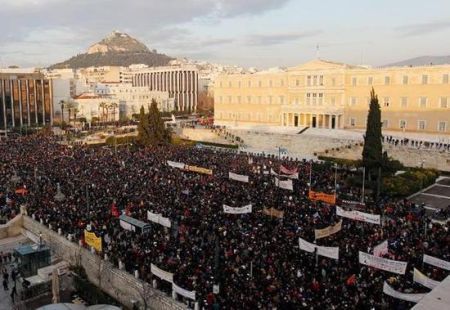
Occupy in Solidarity with the Greeks: "We're all Greeks Now"

what a sad state of affairs... the raping and pillaging continues unabated and we're all at great risk...

Photobucket
Protest, Syntagma Square, Athens
#OWS Joins International Day of Action: We Are All Greeks Now

Tomorrow, the people of Greece will take to the streets again to occupy Syntagma Square in protest of the extreme austerity measures being imposed on the backs of the Greek 99% to the joy and benefit of the European financial elite. The 99% everywhere are under assault by the same global banking interests. Greece is merely the most severe economic crisis yet to be imposed by the International Monetary Fund and other agents of the 1% in the Global North. People all over the world live under the tyranny of policies dictated by the IMF, the World Bank, and the G8. As demonstrated by the wholesale slashing of social services in the name of "debt reduction," New York City and the United States are not immune.

Our resistance to austerity will also be global. This weekend, the people of cities across the world will take to the streets in solidarity with the Greek protesters who have occupied their workplaces and public spaces to resist economic injustice. Demonstrations are planned throughout Germany, Austria, Belgium, Denmark, Spain, Finland, France, Iceland, Ireland, Italy, the Netherlands, Portgual, the United Kingdom, the United States, Sweden, and more. Click here for a partial listing of international rallies on Facebook. Occupy Chicago held a Greece solidarity rally yesterday. There is a rally today in San Francisco and tomorrow in New York City.

i like greece... i like the greeks... i've spent some time there and it's a wonderful country... they don't deserve this shit... nobody does...

Labels: , , , , , , , , , , , ,

Submit To Propeller


[Permalink] 0 comments

Monday, February 13, 2012

Greece's death sentence

mike whitney... here's a teaser...
It’s just corporate pillaging gone haywire. Greece is a big pinata that’s just been cracked open and everyone is pushing and shoving to grab their fistful of candy.

by all means, go read it all, but stay close to the toilet in case of retching...

Labels: , , , , , , ,

Submit To Propeller


[Permalink] 0 comments

Wednesday, January 25, 2012

Hedge funds are not really interested in an actual Greek rescue - only their profit matters

spiegel...
Hedge Funds Bet on Profits from Greek Debt Talks

The negotiations over the Greek debt haircut are becoming increasingly suspenseful, with euro-zone finance ministers and the IMF pushing investors to accept greater losses. Hedge funds, more than any others, stand to profit, and are betting that the voluntary debt rescheduling will fail.

Who will bleed for Greece? For weeks, private creditors like banks and insurers have been trying to negotiate a debt rescheduling with the country without success. Even when they seem close to agreement, it remains unclear if all creditors are on board. In particular, hedge funds that own Greek bonds could have a significant interest in ignoring the results of the negotiations, instead preferring to focus on an official national default.

Bank representatives assume in the meantime that many hedge funds are not really interested in an agreement. With a controversial investment strategy they have assured themselves of profiting with either a low level of Greek bad debts, or a complete Greek bankruptcy.

At issue are Greek bonds with a total volume of about €200 billion. How many are owned by hedge funds is unclear, but the amount is estimated to be about €70 billion (including other funds).

The bondholders are expected to voluntarily give up 50 percent of their claims. Another 15 percent is to be compensated with either cash or secure bonds of the European rescue fund EFSF. The remaining 35 percent should come in the form of new Greek bonds, that will likely reach maturity in 30 years.

The amount of money the creditors will actually have to give up depends on the interest rates on the new bonds. The Institute of International Finance (IIF), which is leading the negotiations with Greece, is insisting on an average of at least four percent. The euro-zone finance ministers and the International Monetary Fund (IMF) have instead insisted on rates lower than four percent, in order to make the burden on Greece more bearable. The banks calculate that this means they would actually lose closer to between 70 and 80 percent of their claims, and they are balking.

'Not Worried About Their Public Image'

For some hedge funds, the fight over interest rates has given them more incentive to push for a breakdown of the proposed plan. Officially, they are in the same boat as the banks and insurance companies. But in reality their interests are vastly opposed. "Hedge funds don't need to worry about their public image," one banker says. Their reputation has already been destroyed. Therefore, they can be relatively cavalier in gambling with the possibility of a Greek bankruptcy.

In an internal analysis of the German Savings Banks Association (DSGV), which represents the public banks, the hedge funds come off fairly badly. Withttp://www.blogger.com/img/blank.gifh the financial investors "only the performance" is most important. There is "hardly a political or economic corrective factor," such as long-term customer or contractual relations, the analysis says. Therefore, "one can conclude that they are not really interested in an actual Greek rescue."

i honestly don't think the hedge funds have EVER been seriously concerned about their reputation... it's always been about money - how much can be grabbed and how fast - and woe to anybody who gets in the way... matt taibbi's metaphor of a giant vampire squid glued firmly to the face of not only humanity but also to the planet is apt... they will suck the life out of anything and everything as long as there is money to be made...

Labels: , , , , , , ,

Submit To Propeller


[Permalink] 0 comments

Wednesday, November 23, 2011

The size of the IMF resources are absolutely not sufficient to bailout Europe which is a slow-motion train wreck


nouriel roubini blog...
Roubini said that the IMF does not have enough resources to save Europe and that now the contagion is spreading to the rest of Europe , the size of the IMF resources are absolutely not sufficient to bailout Europe , Italy and Spain alone are in 3 trillion euro public debt problem equivalent to 4 trillion US Dollars .... money alone is not going to resolve the problems in Europe Roubini explains , Europe is a slow motion train wreck he added ... "The contagion has now gone viral, cross Atlantic and global." Roubini says.

Photobucket

Labels: , , , , , , ,

Submit To Propeller


[Permalink] 2 comments

Tuesday, November 01, 2011

Common equity in Bank of America is either worthless or very close to it and now Greece could be the tipping point

from rt...
European leaders reach a deal on the debt but if politicians decide there is no "credit event" and credit default swaps don't get paid -- it could leave large US banks "naked," according to independent analyst Reggie Middleton of Boom Bust blog. It could be a tipping point for Bank of America which he believes is insolvent and seeing pressure from all sides.


yeah, well, eurozone leaders THOUGHT they had reached a deal on greek debt...

reuters...

Greece risks meltdown after bailout vote bombshell

The Greek government faced possible collapse on Tuesday as ruling party lawmakers demanded Prime Minister George Papandreou resign for throwing the nation's euro membership into jeopardy with a shock call for a referendum.

Caught unawares by his high-risk gamble, the leaders of France and Germany summoned Papandreou to crisis talks in Cannes on Wednesday to push for a quick implehttp://www.blogger.com/img/blank.gifmentation of Greece's new bailout deal ahead of a summit of the G20 major world economies.

The euro and global stocks were pummeled on financial markets after the Greek move threw into question the survival of crucial efforts to contain the euro zone's sovereign debt crisis.

how very interesting - and perhaps even democratic - that papandreou actually thinks the citizens of greece should have a say...

a commentator, writing in spiegel, agrees with papandreou...

Papandreou Is Right to Let the Greeks Decide

It must be said right at the beginning: The Greeks will, for a change, decide for themselves how they and their country will move forward.

They have had no real opportunity to do so for quite some time. For about a year and a half, this once proud country has been under foreign administration; it is de facto no longer a sovereign state. The government's most important task has been dragging the austerity programs and structural reforms though parliament and implementing them. These are dictated by the strict troika of the EU Commission, the European Central Bank (ECB) and the International Monetary Fund. Otherwise there will be no more bailout money, and the country would go bankrupt.

To no longer be the master of their own finances, to be begging for money and ready to do almost anything for it -- this is as humiliating for penniless states as it is for poor people. It injures the soul, stirs up anger and creates desperation. Knowing that the situation is also largely self-inflicted only makes things worse.

That the Greek Premier Georgios Papandreou wants to consult his people on the financial restructuring of the country seems like an act of desperation appropriate to the dramatic principle of 'committing suicide in fear of death.' The voters will decide whether to endorse the decisions made in Brussels or not.

[...]

Until the referendum in Greece, there will be an intense debate about the two alternatives: Brutal rehabilitation within the euro zone or state bankruptcy with a reintroduction of the drachma.

It will demonstrate that it is not about the choice between hell and paradise. Both paths will be difficult and grueling. Each citizen must decide for themselves what they believe to be the better choice. They will consider whether they want to risk their assets with an exit from the common currency -- savings would be worth hardly anything in a return to the drachma.

But at least every Greek gets to decide, and can no longer complain about their government bowing to international demands. And even if the Greeks ultimately say no, and in the worst case scenario the country leaves the euro zone, the consequences seem less dicey than they did a year ago.

let the chips fall where they may... at least the greeks can once again lay claim to being a sovereign state rather than a wholly-owned subsidiary of the global banksters...

Labels: , , , , , , , , , , ,

Submit To Propeller


[Permalink] 2 comments

Thursday, October 06, 2011

In 2-3 weeks, a global meltdown of sovereign debt - MAYBE, says IMF advisor

Labels: , , , , ,

Submit To Propeller


[Permalink] 0 comments

Monday, September 19, 2011

Roubini calls for a Greek default, Argentina-style, and a return to the drachma

i have been a first-hand witness to developments in argentina following the 2001 economic collapse and have posted on it repeatedly here... i've never ceased to admire the guts it took for argentina to unilaterally kiss off the world bank, the imf, the global banks and the super-rich elites that they serve and go its own way... needless to say, the howls of outrage and disbelief from the holders of the world's capital were deafening... but argentina kept on keepin' on and has enjoyed growth rates averaging 9% a year since then, while at the same time accumulating a current accounts surplus that allowed them to totally pay off $10B worth of imf debt THREE YEARS EARLY - IN CASH...

the downside, unfortunately, is that the endemic corruption that is part and parcel of every level of argentine government survives untouched, the rich continue to get richer, the real inflation level hovers at 27% (despite the "official" government figures that peg it at less than 10%) and argentina is in the process of selling its heart and soul (farmland, oil, gas and minerals) to china...

nonetheless, i think roubini is 100% correct... greece should do what's right for greece and its citizens and refuse to be held hostage to those same super-rich elites and their bankster buddies just so they can stay in the eurozone...

roubini in the ft...

Greece is stuck in a vicious cycle of insolvency, low competitiveness and ever-deepening depression. Exacerbated by a draconian fiscal austerity, its public debt is heading towards 200 per cent of gross domestic product. To escape, Greece must now begin an orderly default, voluntarily exit the eurozone and return to the drachma.

The recent debt exchange deal Europe offered Greece was a rip-off, providing much less debt relief than the country needed. If you pick apart the figures, and take into account the large sweeteners the plan gave to creditors, the true debt relief is actually close to zero. The country’s best current option would be to reject this agreement and, under threat of default, renegotiate a better one.

Yet even if Greece were soon to be given real and significant relief on its public debt, it cannot return to growth unless competitiveness is rapidly restored. And without a return to growth, its debts will stay unsustainable. Problematically, however, all of the options that might restore competitiveness require real currency depreciation.

The first of these options, a sharp weakening of the euro, is unlikely while the US is economically weak and Germany über-competitive. A rapid reduction in unit labour costs, through structural reforms that increased productivity growth in excess of wages, is just as unlikely. Germany took 10 years to restore its competitiveness this way; Greece cannot wait in depression for a decade.

The third option is a rapid deflation in prices and wages, known as an “internal devaluation”. But this would lead to five years of ever-deepening depression, while making public debts more unsustainable.

Logically, therefore, if those three options are not possible, the only path left is to leave the eurozone. A return to a national currency and a sharp depreciation would quickly restore competitiveness and growth, as it did in Argentina and many other emerging markets that abandoned their currency pegs.

Of course, this process will be traumatic. The most significant problem would be capital losses for core eurozone financial institutions. Overnight, the foreign euro liabilities of Greece’s government, banks and companies would surge. Yet these problems can be overcome. Argentina did so in 2001, when it “pesified” its dollar debts. America actually did something similar too, in 1933 when it depreciated the dollar by 69 per cent and repealed the gold clause. A similar unilateral “drachmatisation” of euro debts would be necessary and unavoidable.

Major eurozone banks and investors would also suffer large losses in this process, but they would be manageable too – if these institutions are properly and aggressively recapitalised. Avoiding a post-exit implosion of the Greek banking system, however, may unfortunately require the imposition of Argentine-style measures – such as bank holidays and capital controls – to prevent a disorderly fallout.

< wipes away crocodile tears thinking about bank losses >

also, thinking about greece and argentina reminded me that it was only one month and one year ago that i spent nearly two weeks with dear macedonian friends on the beach on the halkidiki peninsula in northern greece... i remember remarking at the time how similar the greek and the argentine mindsets seemed to me... both argentines and greeks, imho, are unequaled champions at living in the moment... when they're enjoying their free time, nothing else - and i mean NOTHING - else gets in the way... at any time of day, every greek family i saw had a large table either outside on the grass or on a terrace or balcony, complete with plenty of chairs, lots of food and drink, and no end of family and friends gathered around and my time in argentina is replete with memories of the same scenes...

Labels: , , , , , , , , , ,

Submit To Propeller


[Permalink] 0 comments

Wednesday, May 18, 2011

DSK resigns from IMF... Good guy...? Creep...? No matter... An erect penis is STILL a tool of power and domination... [UPDATE]

hmmmmmmm...
Strauss-Kahn Resigns From I.M.F. in Wake of His Arrest

Dominique Strauss-Kahn resigned Wednesday as head of the International Monetary Fund after explosive accusations that he had sexually attacked a housekeeper in a Midtown Manhattan hotel room.

i've read a number of things about the whole dsk soap opera, everything from "he totally deserves whatever he's got coming" to this from paul craig roberts...
The Amerikan Police State Strides Forward

The International Monetary Fund’s director, Dominique Strauss-Kahn, was arrested last Sunday in New York City on the allegation of an immigrant hotel maid that he attempted to rape her in his hotel room. A New York judge has denied Strauss-Kahn bail on the grounds that he might flee to France.

President Bill Clinton survived his sexual escapades, because he was a servant to the system, not a threat. But Strauss-Kahn, like former New York Governor Eliot Spitzer, was a threat to the system, and, like Eliot Spitzer, Strauss-Kahn has been deleted from the power ranks.

Strauss-Kahn was the first IMF director in my lifetime, if memory serves, who disavowed the traditional IMF policy of imposing on the poor and ordinary people the cost of bailing out Wall Street and the Western banks. Strauss-Kahn said that regulation had to be reimposed on the greed-driven, fraud-prone financial sector, which, unregulated, destroyed the lives of ordinary people. Strauss-Kahn listened to Nobel economist Joseph Stiglitz, one of a handful of economists who has a social conscience.

Perhaps the most dangerous black mark in Strauss-Kahn’s book is that he was far ahead of America’s French puppet, President Sarkozy, in the upcoming French elections. Strauss-Kahn simply had to be eliminated.

It is possible that Strauss-Kahn eliminated himself and saved Washington the trouble. However, as a well-traveled person who has often stayed in New York hotels and in hotels in cities around the world, I have never experienced a maid entering unannounced into my room, much less when I was in the shower.

In the spun story, Strauss-Kahn is portrayed as so deprived of sex that he attempted to rape a hotel maid. Anyone who ever served on the staff of a powerful public figure knows that this is unlikely. On a senator’s staff on which I served, there were two aides whose job was to make certain that no woman, with the exception of his wife, was ever alone with the senator. This was done to protect the senator both from female power groupies, who lust after celebrities and powerful men, and from women sent by a rival on missions to compromise an opponent. A powerful man such as Strauss-Kahn would not have been starved for women, and as a multi-millionaire he could certainly afford to make his own discreet arrangements.

ok, believe what you want...

could dsk have been the champion of the poor and downtrodden that roberts claims...? hey, i suppose it's possible... could dsk have rubbed our super-rich elite handlers the wrong way because of that view...? sure... but here's where the story comes apart... if dsk was any kind of stand-up guy, he wouldn't have fallen for the "honey trap" and neither, goddamit, would eliot spitzer... if those guys were all that smart, all that committed to doing good and all that focused on what's right, they certainly would have to be smart enough not to fall for such obvious crap...

here's what i think... whether or not dsk's heart was in the right place, i think he was still totally enamored of his own position, his power, his money and his status in the global elite... so enamored, in fact, that he believed he could take what he wanted when he wanted it without suffering any consequences...

what's most interesting to me at this particular point in history is that the cycle for dealing with one's karma is becoming shorter and shorter -- and THAT'S a VERY good thing...!


[UPDATE]

i stumbled across what i think is a very astute article describing exactly the dynamic of unfettered, unaccountable power that i was pointing out above...

a couple of short excerpts...

Where there is shocking news, there must be a conspiracy theory. So it is that the arrest of IMF chief Dominique Strauss-Kahn for sexual assault has spawned its own spate of wild speculation.

[...]

As it turns out, Dominique Strauss-Kahn may not like women very much. He appears instead to be a classic megalomaniac who thinks all women should be at his disposal. Power breeds hubris, both in men and women (See: Indira Gandhi, Jayalalithaa et al). But in a number of men, this arrogance becomes a form of sexual entitlement. Perhaps those simian analogies are indeed apt. Much like an alpha gorilla or chimp, DSK feels he should be allowed to readily take any female who catches his fancy, be it a fellow politician or the daughter of a family friend or a hotel maid.

Power also breeds a sense of immunity. Why did he do it? Because he could. If he got away with attacking a privileged member of the French elite, then why not a semi-literate African immigrant?

yep... that's pretty much the way i see it too...

Labels: , , , , , , , , ,

Submit To Propeller


[Permalink] 2 comments

Saturday, May 14, 2011

A taste of accountability for a heretofore unaccountable member of the elite ruling class

the people who pull our strings and tell us how to live our lives ain't exactly paragons of virtue themselves (as if we didn't already know that)...
I.M.F. Head Is Arrested and Accused of Sexual Attack

The managing director of the International Monetary Fund, Dominique Strauss-Kahn, was taken off an Air France plane at Kennedy International Airport just minutes before it was to take off for Paris on Saturday and arrested in the sexual attack of a maid at a Midtown Manhattan hotel, the authorities said.

Mr. Strauss-Kahn, 62, who was widely expected to become the Socialist candidate for the French presidency, was apprehended by detectives of the Port Authority of New York and New Jersey in the first class section of the jetliner, and immediately turned over to detectives from the Midtown South Precinct, which covers the part of Manhattan where the hotel is, officials said.

“He is in N.Y.P.D. custody, being questioned in connection with sexual assault of a hotel chambermaid earlier this afternoon,” Deputy Commissioner Paul J. Browne, the New York Police Department’s chief spokesman, said Saturday evening.

A spokeswoman for the office of the Manhattan district attorney said that Mr. Strauss-Kahn had not yet been, “formally charged,” in the case, and that he was not expected to be arraigned before a judge until later in the evening.

'bout time some of the "unaccountable" super-rich elites have to face some accountability...

Labels: , , , , ,

Submit To Propeller


[Permalink] 0 comments

Tuesday, April 26, 2011

Understanding the war on the gold dinar as a means of stepping "out of the dark void of brutal exploitation and greed"

john perkins...
According to the IMF, Libya’s Central Bank is 100% state owned. The IMF estimates that the bank has nearly 144 tons of gold in its vaults. It is significant that in the months running up to the UN resolution that allowed the US and its allies to send troops into Libya, Muammar al-Qaddafi was openly advocating the creation of a new currency that would rival the dollar and the euro. In fact, he called upon African and Muslim nations to join an alliance that would make this new currency, the gold dinar, their primary form of money and foreign exchange. They would sell oil and other resources to the US and the rest of the world only for gold dinars.

The US, the other G-8 countries, the World Bank, IMF, BIS, and multinational corporations do not look kindly on leaders who threaten their dominance over world currency markets or who appear to be moving away from the international banking system that favors the corporatocracy. Saddam Hussein had advocated policies similar to those expressed by Qaddafi shortly before the US sent troops into Iraq.

[...]

Understanding the war against Quaddafi as a war in defense of empire is another step in the direction of helping us ask ourselves whether we want to continue along this path of empire-building. Or do we instead want to honor the democratic principles we are taught to believe are the foundations of our country?

History teaches that empires do not endure; they collapse or are overthrown. Wars ensue and another empire fills the vacuum. The past sends a compelling message. We must change. We cannot afford to watch history repeat itself.

Let us not allow this empire to collapse and be replaced by another. Instead, let us all vow to create a new consciousness. Let the grass-roots movements in the Middle East – fostered by the young who must live with the future and are fueled through social networks – inspire us to demand that our country, our financial institutions and the corporations that depend on us to buy their goods and services commit themselves to fashioning a world that is sustainable, just, peaceful, and prosperous for all.

We stand at the threshold. It is time for you and me to step across that threshold, to move out of the dark void of brutal exploitation and greed into the light of compassion and cooperation.

compassion and cooperation... what a concept...!

Labels: , , , , , , , , , , ,

Submit To Propeller


[Permalink] 0 comments

Saturday, March 07, 2009

Was Argentina's 2001 economic collapse a preview of what's happening now worldwide?

Photobucket

this link takes you to a 12-part youtube video series on the 2001 economic collapse in argentina... living there, i of course had heard many of these stories but watching these clips brought it home to me in a way nothing else ever has...

i highly recommend watching these if for nothing else as a backgrounder to what's now taking place world-wide with potentially the same ramifications...

A documentary on the events that led to the economic collapse of Argentina in 2001 which wiped out the middle class and raised the level of poverty to 57.5%. Central to the collapse was the implementation of neo-liberal policies which enabled the swindle of billions of dollars by foreign banks and corporations. Many of Argentina's assets and resources were shamefully plundered. Its financial system was even used for money laundering by Citibank, Credit Suisse, and JP Morgan. The net result was massive wealth transfers and the impoverishment of society which culminated in many deaths due to oppression and malnutrition.

here's part 1 to start you off...


i confess to having tears in my eyes as i watched this and felt the intense passion and anger of the people i've come to know and love holding forth for their country and what they believe in many of the same streets and plazas that i've walked myself...

(note: i've just watched the first 8 parts and i DARE you to watch them yourselves and not make the comparison to what is now happening in the G8 countries, particularly the uk and the u.s...)

Labels: , , , , , ,

Submit To Propeller


[Permalink] 0 comments

Tuesday, February 17, 2009

The transcript of Bill Moyers interview with Simon Johnson, former IMF chief economist

this is critical to a fuller understanding of just exactly what the hell is going on with these so-called "bailouts"...

courtesy of information clearing house...

High Noon: Geithner v. The American Oligarchs

Bill Moyers interviews former chief economist of the International Monetary Fund (IMF), MIT Sloan School of Management professor and senior fellow at the Peterson Institute for International Economics, Simon Johnson examines President Obama's plan for economic recovery.

BILL MOYERS: The battle is joined as they say — and here's the headline that framed it: "High Noon: Geithner v. The American Oligarchs." The headline is in one of the most informative new sites in the blogosphere called: www.baselinescenario.com . Here's the quote that grabbed me:

"There comes a time in every economic crisis, or more specifically, in every struggle to recover from a crisis, when someone steps up to the podium to promise the policies that — they say — will deliver you back to growth. The person has political support, a strong track record, and every incentive to enter the history books. But one nagging question remains. Can this person, your new economic strategist, really break with the vested elites that got you into this much trouble?"

And here's the man who asked that question. Simon Johnson is former chief economist at the International Monetary Fund. He now teaches global economics and management at MIT's Sloan School of Management and is a senior fellow of the Peterson Institute. He is co-founder of that website I quoted — baselinescenario.com — where he analyzes the global economic and financial crisis.

Welcome, Simon Johnson to the Journal.

SIMON JOHNSON: Nice to be here.

BILL MOYERS: What are you signaling with that headline, "Geithner vs. the American Oligarchs"?

SIMON JOHNSON: I think I'm signaling something a little bit shocking to Americans, and to myself, actually. Which is the situation we find ourselves in at this moment, this week, is very strongly reminiscent of the situations we've seen many times in other places.

But they're places we don't like to think of ourselves as being similar to. They're emerging markets. It's Russia or Indonesia or a Thailand type situation, or Korea. That's not comfortable. America is different. America is special. America is rich. And, yet, we've somehow find ourselves in the grip of the same sort of crisis and the same sort of oligarchs.

BILL MOYERS: Oligarchy is an un-American term, as you know. It means a government by a small number of people. We don't like to think of ourselves that way.

SIMON JOHNSON: It's a way of governing. As you said. It comes from, you know, a system they tried out in Greece and Athens from time to time. And it was actually an antithesis to democracy in that context.

But, exactly what you said, it's a small group with a lot of power. A lot of wealth. They don't necessarily - they're not necessarily always the names, the household names that spring to mind, in this kind of context. But they are the people who could pull the strings. Who have the influence. Who call the shots.

BILL MOYERS: Are you saying that the banking industry trumps the president, the Congress and the American government when it comes to this issue so crucial to the survival of American democracy?

SIMON JOHNSON: I don't know. I hope they don't trump it. But the signs that I see this week, the body language, the words, the op-eds, the testimony, the way they're treated by certain Congressional committees, it makes me feel very worried.

I have this feeling in my stomach that I felt in other countries, much poorer countries, countries that were headed into really difficult economic situation. When there's a small group of people who got you into a disaster, and who were still powerful. Disaster even made them more powerful. And you know you need to come in and break that power. And you can't. You're stuck.

BILL MOYERS: Both the "Wall Street Journal" and "The New York Times" reported this week that Obama's top two political aides, Rahm Emanuel and David Axelrod, have pushed for tougher action against the banks. But they didn't prevail. Obama apparently sided with Geithner and the Treasury Department in using a velvet glove.

SIMON JOHNSON: What I read from that is that there is an unnecessary and excessive deference to the experts, or the supposed experts.

And I think the view that a lot of people have in Washington - I live in Washington, I follow this very closely - the view is that you need to rely on the technocrats. And the technocrats are saying, "This is the way to go, and you mustn't be too tough on because banks, because that will have adverse consequences for credits, and for the economy, and for unemployment," and so on and so forth. Those technocrats, if that's what they're saying, are wrong. That is not the right way to deal with this crisis.

There are many find professionals at Treasury with great experience, who have spent their lives working on important issues related to the United States. What we face right now is not a typical U.S. issue. We face a crisis, and the president said this on Monday night, the president said, President Obama said, "We've never seen anything like this since the Great Depression."

Therefore, nobody working now, you know, has any firsthand experience. And he also said, "We may face what we call a lost decade." We've never seen that anywhere other than Japan in the 1990s, right?

And something for Treasury officials to really understand, and to really understand the alternatives - they're not, I mean, with all due respect to them, they're not the ultimate authority. I don't think they're the right people.

The correct people you should be asking this question to are people at the IMF. And I can tell you what they're saying is the policy that we seem to be perusing, of being nice to the banks, is a mistake. The powerful people are the insiders. They're the CEOs of these banks. They're the people who run these banks. They're the people who pay themselves the massive bonuses at the end of the last year. Now, those bonuses are not the essence of the problem, but they are a symptom of an arrogance, and a feeling of invincibility, that tells you a lot about the culture of those organizations, and the attitudes of the people who lead them.

BILL MOYERS: Geithner has hired as his chief-of-staff, the lobbyist from Goldman Sachs. The new deputy secretary of state was, until last year, a CEO of Citigroup. Another CFO from Citigroup is now assistant to the president, and deputy national security advisor for International Economic Affairs. And one of his deputies also came from Citigroup. One new member of the president's Economic Recovery Advisory Board comes from UBS, which is being investigated for helping rich clients evade taxes.

You're probably too young to remember that old song, "Sounds like the Mack the Knife is back in town." I mean, is that what you're talking about with this web of relationships?

SIMON JOHNSON: Absolutely. I don't think you have enough time on your show to go through the full list of people and all the positions they've taken. I'm sure these are good people. Don't get me wrong. These are find upstanding citizens who have a certain perspective, and a certain kind of interest, and they see the world a certain way.

And it's exactly a web of interest, I think, is what you said. And that's exactly the right way to think about it. That web of interest is not my interest, or your interest, or the interest of the taxpayer. It's the interest, first and foremost, of the financial industry in this country.

BILL MOYERS: Do you think that Obama understands how these guys play the game? Let me play you the recording of a conference call "Huffington Post" released this week. One of the top officials of Morgan Stanley is speaking to his colleagues. Here it is.

JAMES GORMAN: I'm going to turn to a topic that I suspect is near and dear to everybody's hearts, which is retention. There will be a retention award. Please do not call it a bonus, it is not a bonus it is an award. The award will be based on '08 full year production. Clearly it would have been cheaper to do it off '09 but we think it's the right thing to do and we've made that decision.

SIMON JOHNSON: What he's basically saying is business as usual. Go about your daily lives. Get the bonuses. Re-brand them as awards. But it really shows you the arrogance, and I think these people think that they've won. They think it's over. They think it's won. They think that we're going to pay out ten or 20 percent of GDP to basically make them whole. It's astonishing.

BILL MOYERS: Why wouldn't they believe that? I mean, when I watched the eight CEOs testify before Congress at the House Financial Services Committee earlier this week, I had just finished reading a report that almost every member of that Committee had received contributions from those banks last year. I mean in a way that's like paying the cop on the beat not to arrest you, right?

SIMON JOHNSON: I called up one of my friends on Capitol Hill after that testimony, and that session. I said, "What happened? This was your moment. Why did they pull their punches like that?" And my friend said, "They, the Committee members, know the bankers too well."

BILL MOYERS: Last year, the securities and investment industry made $146 million in campaign contributions. Commercial banks, another $34 million. I mean, American taxpayers don't have a flea's chance on a dog like that, do they?

SIMON JOHNSON: It a massive problem, obviously. And I do think, though, the good news there are people in the White House - I think the president himself, is aware of this broader issue. And, obviously, the campaign, the Obama campaign was very good at getting small contributions, and trying to minimize the impact of major donors like that.

But, at the same time, these people are throughout the system of government. They are very much at the forefront of the Treasury. The Treasury is apparently calling the shots on their economic policies. This is a decisive moment. Either you break the power or we're stuck for a long time with this arrangement.

BILL MOYERS: When Tim Geithner said, earlier in the week, that the American people have lost faith in some financial institutions and the government, did it occur to you that this was the same man who was president of the New York Fed through much of this debacle?

SIMON JOHNSON: I have no problem with poachers turning gamekeeper, right? So if you know where the bodies are buried maybe you can help us sort out the problem. And I did think the first three or four minutes of what Mr. Geithner said were very good.

As a definition of a problem, and pointing the finger clearly at the bankers, and saying that the government had been slow to react, and, of course, that included himself. I liked that. And then he started to talk about the specifics. And he said, "The compensation caps we've put in place, for the executives of these banks, are strong." And at that point I just fell out of my chair. That is not true. That is factually inaccurate, in my opinion.

BILL MOYERS: That?

SIMON JOHNSON: That this $500,000 limit, and deferred stock, is some kind of restriction on what they do? It's deferred stock, Bill. It's not restricted. You can get as much stock as you want, as soon as you pay back the government, you can cash out of that. That's one.

Second, you can, sorry to get technical, but reset the strike price. This is something you and your and your viewers, you need to hear this one out. Just look for these words, okay, follow them through the press. When you get into trouble, when your company goes down, and you have massive amounts of stock options that aren't worth much anymore, because the stock price has gone down, you say, "Oh, well, we're going to reset our option prices."

And, basically, it means that, at the end of the day, these people are going to walk away with tens if not hundreds of millions of dollars paid for by basically, insurance policy that you and I are providing.

Think of it like this, our taxpayer money is ensuring their bonuses. We're making sure that companies, that banks survive. And eventually, of course, the economy will turn around. Things will get better. The banks will be worth a lot of money. And they will cash out. And we will be paying higher taxes, we and our children, will be paying higher taxes so those people could have those bonuses. That's not fair. It's not acceptable. It's not even good economics.

BILL MOYERS: Are we chumps?

SIMON JOHNSON: We'll find out. Yes, we may be. Okay. It depends on how we play this politically. It depends on what our political system does. It depends, I think, on the level of reaction. The financial system is playing us for chumps, okay? The bankers think we're chumps. We'll find out. We have leadership that can handle this. We'll find out what they do.

BILL MOYERS: There was a moment in the hearings this week, when Senator Bernie Sanders, an independent, the independent senator from Vermont, almost lost his cool. Watch this.

SENATOR BERNARD SANDERS: In 2006 and 2007, Lloyd Blankfein, the CEO of Goldman Sachs, was the highest paid executive on Wall Street, making over 125 million in total compensation. Due to its risky investments, Goldman Sachs now has over 168 billion in total outstanding debt. It's laid off over 10 percent of its workforce. Late last year, the financial situation at Goldman was so dire that the taxpayers of this country provided Goldman Sachs with a $10 billion bailout.

Very simple question that I think the American people want to know. Yes or no, should Mr. Blankfein be fired from his job and new leadership be brought in?

SECRETARY GEITHNER: Senator, that's a judgment his board of directors have to make.

I want to say one thing which is very important. Everything we do going forward has to be judged against the impact we're going to have on the American people and the prospects for recovery. And every dollar we spend will have to be measured against the benefits we bring in terms of-

SENATOR SANDERS: Mr. Secretary, you're not answering my question. You have a person who made hundreds of millions for himself as he led his institution that helped cause a great financial crisis. We have put, as taxpayers, $10 billion to bail him out and we have no say about whether or not he should stay on the job?

SECRETARY GEITHNER: No, I didn't say that. I think there will be circumstances, as there have been already, where the government intervention will have to come with very tough conditions, including changes in management and leadership of institutions. And where we believe that makes sense, we will do that.

BILL MOYERS: Geithner says that's something "his" board of directors, the board of Goldman Sachs, will have to decide. But aren't we all ipso facto stock holders now?

SIMON JOHNSON: We should certainly have a big say over critical matters like this. Like the CEO. Because, two things. First of all, it's our money that kept these banks in business. Not just the treasury recapitalization money, that's relatively small.

It's the financial support provided by the Federal Reserve. Make no mistake about it, if the Federal Reserve hadn't stepped in late September, in dramatic fashion, to prop up organizations like Goldman Sachs, they would be out of business, okay?

It was our money that did that. The Federal Reserve acting on behalf of the American taxpayer. And secondly, Senator Sanders is exactly right. That a CEO, like Lloyd Blankfein, made mistakes, and led his company into deep trouble.

Now, other companies are in deeper trouble. His company was in deep trouble and had to be rescued at that moment. It's absolutely the right way to pose the question. And the answer to Senator Sanders' question is, in my opinion, yes. We should change the leadership of these major banks.

BILL MOYERS: And, yet, Secretary Geithner's chief-of-staff is the former lobbyist for Goldman Sachs. How - serious question - how do they make a dispassionate judgment about how to deal with Goldman Sachs when they're so intertwined with Goldman Sachs' mindset?

SIMON JOHNSON: I have no idea. Of course, the administration, the new administration, has a lot of rules about lobbying. And they have rules that basically say, I think, as understood the rules, when they were first presented, I was very impressed. They basically said, "We're not going to hire lobbyists into the administration. There has to be some sort of cooling off period."

BILL MOYERS: And the next day Obama exempted a number of people from that very rule that he had just proclaimed.

SIMON JOHNSON: Yes. It's a problem. It's a huge problem.

BILL MOYERS: So here's the trillion dollar question that I take from your blog, that I read at the beginning, quote, "Can this person," your new economic strategist, in this case Geithner, "really break with the vested elite that got you into this much trouble?" Have you seen any evidence this week that he's going to be tough with these guys?

SIMON JOHNSON: I'm trying to be positive. I'm trying to be supportive. I like the administration. I voted for the president. The answer to your question is, no, I haven't seen anything. But you know, perhaps next week I will. But right now, as we speak, I have a bad feeling in my stomach.

My intuition, from crises, from situations that have improved, the situations that got worse, my intuition is that this is going to get a lot worse. It's going to cost us a lot more money. And we are going down a long, dark, blind alley.

BILL MOYERS: Let's not leave our public in despair, here at end, Simon. I've read everything you wrote this week, and it comes down to this. We must break the power of the banks and their lobbies. How do we do that?

SIMON JOHNSON: I think it's quite straightforward, in technical or economic terms. At the same time I recognize it's very hard politically, okay? What you need to do is the stress test that, actually, Secretary Geithner outlined in his speech on Tuesday.

BILL MOYERS: Which is?

SIMON JOHNSON: That's where you go and you check the bank's books, and you say, okay, not only do we use market prices, not pretend prices, not what you wished things were worth, what they're really worth, okay, in the market today. We use that to value your loans and the securities that you have, your assets, right?

And we also assess what will happen to the value of the things you own if there's a severe recession. So that's the idea, it's a stress test, like when you go to see the doctor, they put you on a treadmill, and make you run to see how your heart is going to behave under stress.

So you're looking at how the bank's balance sheets will look under stress. And then you say to them, "This is our assessment of the amount of capital you need to cover your losses, and to stay in business, and be able to make loans, through what appears to be a severe recession."

And, as the president said, we may lose a decade. So we've got to be very hard headed, and all the officials forecasters are still too optimistic on that. This is the amount of capital you need. Now you have a month, or two, to raise this amount of capital privately.

And when this was done in Sweden, by the way, in the early 1990s, they did it to three big banks. One of the three was able to go to its shareholders, raise a lot more capital, and stay in business as a private bank, same shareholders. That's an option. Totally fine. However, the ones that can't raise the capital are in violation of the terms of their banking license, if you like.

We have no problem in this country shutting down small banks. In fact, the FDIC is world class at shutting down and managing the handover of deposits, for example, from small banks. They managed IndyMac, the closure of IndyMac, beautifully. People didn't lose touch with their money for even a moment. But they can't do it to big banks, because they don't have the political power. Nobody has the political will to do it.

So you need to take an FDIC-type process. You scale it up. You say, "You haven't raised the capital privately. The government is taking over your bank. You guys are out of business. Your bonuses are wiped out. Your golden parachutes are gone." Okay? Because the bank has failed.

This is a government-supervised bankruptcy process. It's called, in the terminology of the business, it's called an intervention. The bank is intervened. You don't go into Chapter 11 because in that's too messy. Too complicated. There's an intervention, you lose the right to operate as a bank. The FDIC takes you over. I think we agree, everyone agrees, we don't want the government to run banks in this country.

BILL MOYERS: Never done it before.

SIMON JOHNSON: Never done it before. It's not gone well anywhere in the world. And the idea of getting your money out of the bank being like visiting the DMV to get your driver's license, it's not appealing, okay?

That's not what we're going to do. That's not what the Swedes did. That's not the state of the art - it's not what the real banking experts are going to tell you to do. They're going to say, you set it up, you set up the government intervention, and there's various technical ways to do this, so that you re-privatize very quickly.

Now, it might take three months, it might take six months. It'll depend on the overall macro economy turning around. But there's a lot of private money out there. Let's call it private equity.

These people would like to come in and buy these re-privatized banks. You would attach antitrust provisions to this, so the banks are broken up as part of this transaction. Senator Sanders has a great saying. He says, "Any bank that is too big to fail is too big to exist."

And he's exactly right. So, in this transformation, you're bringing in private equity. You're using, I think this is, to me, the right idea, and what we've learned in our country, is you're using part of the powerful financial lobby against another part. You're using private equity, that would do very well in this, against the inbred insider big bankers. And you're doing this in a way so that the taxpayer decides who the new owners are.

The new owners come in and do a lot of the restructuring. They're going to fire all of these managers. I can honestly assure you that. They're going to put in new risk management systems. They're going to have to make the banks smaller. And the taxpayer is going to retain a substantial equity interest. So as these banks recover the value of our investment goes up. And that's how we get upside participation.

BILL MOYERS: So you're not talking about nationalization, are you?

SIMON JOHNSON: I'm talking about a scaled up FDIC intervention. I think we need the FDIC to be empowered. And to have the political support necessary to get this job done.

BILL MOYERS: Splitting this one powerful interest group into competing factions, and taking them on one by one.

SIMON JOHNSON: That is classic oligarchy breaking strategy. Now I do admit that once you've done that, you have to worry about the new oligarchs. That's why you're breaking up the banks. You don't want to just change the owners of banks that are too big to fail, because they'll be coming around in five years for another handout.

The structure or banking system, the concentration of power in big financial institutions has to change. There's a lot of appeal to FDR and what he did in the Great Depression.

I would go back to Teddy Roosevelt 100 years ago, and think about trust busting. Okay? Now, the banks don't violate existing antitrust laws. That's 'cause our antitrust laws are 100 years old and need to be changed, okay? We need to break them up for exactly the same reason that Rockefeller and the oil interests, standard oil, at the end of the 19th century, was too powerful, economically and politically. And it had to be broken up. And breaking it up was the right thing to do. That's where we are with the banks today.

BILL MOYERS: Simon Johnson, thank you for being with me on the Journal.

SIMON JOHNSON: My pleasure.

BILL MOYERS: And if you want to find out even more about how we got into this predicament, let me recommend a documentary running this Tuesday night on public television's premier investigative series, "Frontline." It's called "Inside the Meltdown."

NARRATOR: On September 16th, 2008, all around the world money stopped.

PAUL KRUGMAN: Basically we had a complete shutdown of the world capital markets.

SENATOR CHRISTOPHER DODD: Unless we act within days, the financial system will melt down.

MARK LANDLER: Forces have been unleashed that we couldn't control.

JON HILSENRATH: The entire investment banking model was blown up in a week.

NARRATOR: How did it happen?

BILL BAMBER: Regulators have basically been outgunned and outmanned.

NARRATOR:Who is responsible?

DAVID FABER: Oh my God, these guys don't know what they are doing.

NARRATOR: And what happens next?

SENATOR CHRISTOPHER DODD: It's the economic equivalence of 9/11.

and there you have it...

Labels: , , , , , , , ,

Submit To Propeller


[Permalink] 0 comments

Friday, September 19, 2008

The view of the U.S./first world financial crisis from Latin America

i think one word captures it nicely - schadenfreude...

from mercopress...

brazil's lula da silva...

Brazilian President Lula da Silva said on Thursday he has watched with “sadness” the collapse of Wall Street firms that made economic policy recommendations in emerging markets “as if they were the super intelligent and we were the poor souls”, according to Spanish news agency EFE.
“Important banks, very important banks, that spent their lives giving advice about Brazil and what we should or shouldn't do are now broke”, EFE quoted Lula da Silva as saying in a speech in southern Brazil.

Lula criticized Wall Street firms for treating financial markets like a “casino” and for relying on “speculation” to make money. He said the Brazilian economy is well-equipped to weather the global crisis and would suffer “very little” even if the US sinks into a deep recession, according to EFE.

argentina's cristina fernandez de kirchner...
Earlier in the week Argentina’s Cristina Fernandez de Kirchner adopted a similar stance during a political rally: “while the First World collapses” because of the international crisis, Argentina remains “firm”.

“The First World, to which we had been repeatedly told we must reach, is crumbling like a bubble”, she underlined. “In the midst of the swelling sea” Argentina remains strong. “It’s time many of those institutions instead of telling us what to do, should look around and do something for themselves”.

after years and years and years of having their noses rubbed in it by the u.s., the imf and the world bank, it has to be at least a little bit gratifying to watch the greedy bastards who kept telling you if you would only do things THEIR way all would be just fine, having to lie in the bed they themselves made...

Labels: , , , , , , , , , , ,

Submit To Propeller


[Permalink] 0 comments

Friday, May 02, 2008

Sovereign debt default, inflation and denial - a long overdue update on Argentina


i've posted extensively on argentina in general and particularly its $95B 2001 bond default (see here)... over seventy percent of the bondholders opted for a 2004 swap deal that offered them 30 cents on the dollar, leaving about $20B outstanding... the remaining bondholders, mostly in the u.s., refused the swap, and continued to hold out past the 25 february 2005 expiration date... they're still trying to get all of their money...
A United States judge granted on Wednesday a request by bondholders suing Argentina to extend a freeze on as much as 16 billion US dollars in sovereign bonds issued by the country and which now held by the Depository Trust Co. in New York.

Argentina claims it no longer has any interest in the bonds and that they are worth only 2 billion US dollars. The order stems from a class-action, or group lawsuit brought by bond holders who claim Argentina wrongly failed to pay interest or principal on its 11 percent global notes due in October 2006. The plaintiffs, who claim the bonds are worth as much 16 billion, are seeking more than a billion US dollars in damages.

[...]


Argentina defaulted on 95 billion in debt in late 2001. In 2005, then-President Nestor Kirchner offered holders of defaulted debt 30 cents on the dollar. Holders of about 20 billion in bonds rejected that deal. Argentina has since refused to re-open negotiations, preventing the country from being able to directly tap international credit markets. The country has also been the subject of lawsuits by individual bondholders.

imho, these primarily u.s. based bondholders are throwing away their attorney fees... argentina, while it would like to get back in the good graces of the international credit markets doesn't feel any great pressure to do so... for one thing, the country's economy has been pushing forward at an amazing 9% since the default... for another, much of latin america, including argentina, has banded together under the financial assistance umbrella of venezuela and hugo chávez (banco del sur) at considerably more favorable, less restrictive and much less ideological terms than offered by the world bank, the imf or the big transnational banks...

besides, argentina has other things to worry about at the moment...

Inflation has become the main concern of a majority of Argentines, leaving aside other issues such as insecurity and poverty according to the latest public opinion polls from Ibarometro and Hugo Haime & Associates, released this week in Buenos Aires and which refers to the second half of April.

According to Ibarometro, 36.9% of respondents consider their main concern “the hike in prices”, while for Haime 50% of Argentines feel that “inflation is what most impacts daily life”. This suggests a radical change from last January.

At the beginning of 2008, for Ibarometro the main issues were insecurity, education, poverty and fourth rated inflation. But in three months inflation climbed to top of the list. Similarly with Haime, the April 50% was only 31% last January.

To make things even more worrisome, last January 37% believed inflation in 2008 was to be higher than in 2007, but in the latest poll the percentage jumped to 71%. That is 71% believe the current Argentine administration is not considered capable of keeping prices at a reasonable level.

Food, clothing and personal hygiene goods were the most volatile according to the opinion polls.

“Inflation, newspaper headlines almost daily and the discredited image of Indec (the office responsible for calculating consumer price indexes) is fueling the negative perception of the economic situation. We also believe that the camp conflict increases that negative perception”, pointed out Ibarometro.

More specifically compared with January “the inflation issue has jumped 200% from 11% to 36.9%, while insecurity falls ten percentage points. Clearly the increase in prices shadows all other concerns. The education issue also virtually has disappeared from the list of ratings”, added Ibarometro.

As to the overall economic situation, a majority of Argentines have a negative view: 56.8% describe it as “bad” or “very bad”. Only 30% considers it “very good” or “reasonably good”. However in spite of these percentages four out of ten respondents considered positive the sacking of the Economy minister Martin Lousteau.

the argentine government officially claims inflation at just under 10%... my finger in the air calculation is closer to 20%, and, if you're a foreign tourist, it's pushing 30%... it's that inflation, not a suit by disgruntled bondholders, that's going to bite cristina in her expensively-clad tush...
S&P said it had downgraded Argentine bonds’ risk rate precisely because the Kirchner administration refuses point blank to apply any cooling policies and insists that inflation is under control. In spite of the fact that the overall consensus is that inflation contrary to the “official” statistics of just below two digits is in the range of 18 to 24%.

as much as i have a very soft spot in my heart for argentina, it's difficult to let the argentine government off the hook when it's still led by those who think denial is a river in egypt...

Labels: , , , , , , , , , , ,

Submit To Propeller


[Permalink] 0 comments

Monday, April 07, 2008

It looks like Argentina is going to re-pay its Paris Club debt, finally closing the door on 2001


i've posted extensively (see here) on the gripping telenovela that world observers were treated to as argentina struggled to deal with the imf and argentine bond-holders following argentina's 2001 economic collapse, where argentina basically told the world financial community to take their loan conditions and stick 'em where the sun don't shine, that argentina's first obligation was to the welfare of its citizens... needless to say, that didn't play well among the super-rich elites who consider their debtors' promises to repay as a sacred obligation... and, sadly, it didn't play well either with elderly pensioners in places like italy and japan who were forced to accept a 75% haircut on their investments...

there's a $6+ billion debt still to be re-paid to the paris club of nations and the imf has been pressuring argentina to cough up for some time... it looks like argentina, with $50B in reserves, is ready to do that but only if the imf keeps their collective noses out of it... believe me, no love is lost between argentina and the imf...


A meeting of Argentina's president with her French counterpart may provide new stimulus to talks with the Paris Club over Argentina's $6.3 billion debt, Argentina's finance minister said on Sunday.

Argentina defaulted in late 2001 and made an early repayment of about $10 billion owed to the International Monetary Fund in 2005. It is still in talks over the remaining debt with the Paris Club of 19 creditor countries, including France, Germany and the United States.

[...]

Since the default, Argentina's economy has boomed and the country has been facing increasing pressures to pay its debt as it has accumulated more than $50 billion in reserves.

The [Argentina's finance minister, Martin Lousteau] said that any deal with the Paris Club would have to respect Argentina's sovereignty and give the country time to pay the debt.

Lousteau ruled out any involvement of the IMF as part the negotiations. "That's non-negotiable", he said.

you tell 'em, martin...

Labels: , , , ,

Submit To Propeller


[Permalink] 0 comments

Tuesday, February 05, 2008

The myth of free trade and neoliberalism, special to "The Mustache of Understanding"

a somewhat lengthy but quite informative article in alternet via truthdig by chalmers johnson, reviewing Bad Samaritans: The Myth of Free Trade and the Secret History of Capitalism, by cambridge economist ha-joon chang that, besides debunking neoliberal economic policies and the so-called "washington consensus," excoriates tom friedman...
[The] book is a discursive, well-written account of what [Chang] calls the "Bad Samaritan," "people in the rich countries who preach free markets and free trade to the poor countries in order to capture larger shares of the latter's markets and preempt the emergence of possible competitors. They are saying 'do as we say, not as we did' and act as Bad Samaritans, taking advantage of others who are in trouble."

[...]

[Neoliberal policies include] privatizing state-owned enterprises, maintaining low inflation, shrinking the size of the state bureaucracy, balancing the national budget, liberalizing trade, deregulating foreign investment, making the currency freely convertible, reducing corruption, and privatizing pensions. It is called neoliberalism because of its acceptance of rich-country monopolies over intellectual property rights (patents, copyrights, etc.), the granting to a country's central bank of a monopoly to issue bank notes, and its assertion that political democracy is conducive to economic growth, none of which were parts of classical liberalism.

chang's - and johnson's - bottom line...
[F]ree trade, privatization, and [neoliberal] policies are ahistorical, self-serving economic nonsense...

[...]

It is time to recognize, particularly in the English-language economic press, that a "level playing field" leads to unfair competition when the players are unequal.

i spend a great deal of time outside the united states... i have worked on economic development projects in so-called "emerging economies," principally in former socialist countries, i reside part-time in argentina, i have traveled extensively throughout latin america, eastern and southeastern europe, and i have seen first-hand the devastation wreaked by neoliberal, world bank and imf policies... following those policies, it is virtually impossible for a country's producers and manufacturers to prosper... how could they when transnational corporations flood the national markets with goods and services, establish a country-wide presence, and operate with an economy of scale that home-grown businesses find it impossible to match...

every time i go to shop, i always look at the fine-print on the labels of the items i purchase because i want to see what corporation is behind the product... 9 times out of ten it is a transnational corporation, unilever, nestle, proctor and gamble, pepsico, coca cola, danone, bayer, etc., etc... sure, if the country is a big enough market, those corporations may license local companies to produce their products in-country which is at least somewhat better than importing everything, but the money still largely flows out of the country... and, if the market is small - macedonia, for instance - most brand-name products on store shelves are 100% imported... (and, yes, there are plenty of knock-offs, but that's a whole 'nother story...)

anyone who espouses free trade and neoliberal economic policies is either grossly ignorant of the realities those policies have created in the developing world or committed to serving his or her own economic interests at the expense of others...

Labels: , , , , , , , ,

Submit To Propeller


[Permalink] 0 comments

Friday, December 28, 2007

Palast on Ecuador's Correa: "No one - NO ONE - has made such a threat to Bush and Big Oil and lived to carry it out"


greg palast interviews ecuador's president rafael correa, the new latin american president (january 2007) who's turning the tables on the omnipotent united states...
Professor Doctor Correa is one tough character. He told George Bush to take the US military base and stick it where the equatorial sun don't shine. He told the International Monetary Fund and the World Bank, which held Ecuador's finances by the throat, to go to hell. He ripped up the "agreements" which his predecessors had signed at financial gun point. He told the Miami bond vultures that were charging Ecuador usurious interest, to eat their bonds. He said 'We are not going to pay off this debt with the hunger of our people. " Food first, interest later. Much later. And he meant it.

It was a stunning performance. I'd met two years ago with his predecessor, President Alfredo Palacio, a man of good heart, who told me, looking at the secret IMF agreements I showed him, "We cannot pay this level of debt. If we do, we are DEAD. And if we are dead, how can we pay?" Palacio told me that he would explain this to George Bush and Condoleezza Rice and the World Bank, then headed by Paul Wolfowitz. He was sure they would understand. They didn't. They cut off Ecuador at the knees.

But Ecuador didn't fall to the floor. Correa, then Economics Minister, secretly went to Hugo Chavez Venezuela's president and obtained emergency financing. Ecuador survived.

And thrived. But Correa was not done.

Elected President, one of his first acts was to establish a fund for the Ecuadoran refugees in America - to give them loans to return to Ecuador with a little cash and lot of dignity. And there were other dragons to slay. He and Palacio kicked US oil giant Occidental Petroleum out of the country.

Correa STILL wasn't done.

I'd returned from a very wet visit to the rainforest - by canoe to a Cofan Indian village in the Amazon where there was an epidemic of childhood cancers. The indigenous folk related this to the hundreds of open pits of oil sludge left to them by Texaco Oil, now part of Chevron, and its partners. I met the Cofan's chief. His three year old son swam in what appeared to be contaminated water then came out Cofan Leader Criollo vomiting blood and died.

Correa had gone there too, to the rainforest, though probably in something sturdier than a canoe. And President Correa announced that the company that left these filthy pits would pay to clean them up.

But it's not just any company he was challenging. Chevron's largest oil tanker was named after a long-serving member of its Board of Directors, the Condoleezza. Our Secretary of State.

The Cofan have sued Condi's corporation, demanding the oil company clean up the crap it left in the jungle. The cost would be roughly $12 billion. Correa won't comment on the suit itself, a private legal action. But if there's a verdict in favor of Ecuador's citizens, Correa told me, he will make sure Chevron pays up.

Is he kidding? No one has ever made an oil company pay for their slop. Even in the USA, the Exxon Valdez case drags on to its 18th year. Correa is not deterred.

He told me he would create an international tribunal to collect, if necessary. In retaliation, he could hold up payments to US companies who sue Ecuador in US courts.

This is hard core. No one - NO ONE - has made such a threat to Bush and Big Oil and lived to carry it out.

cool...

Labels: , , , , , , , , ,

Submit To Propeller


[Permalink] 0 comments

Tuesday, October 30, 2007

Not-so-amazing divergence of opinion on Argentina's presidential election


prompted by Cristina Fernandez de Kirchner's victory in this past sunday's presidential election in argentina, the pundits weigh in, and a fascinating juxtaposition of perspectives it is...

here's one point of view that paints a very positive picture of how argentina's managed its recovery by repudiating the imf and its policies, but neglects to mention anything about the seamy reality that underlies literally everything in the country...

from the la times op-ed page...

[T]he authorities made sure that their currency didn't rise too high and didn't swing wildly as a result of movements in financial markets. (Here in the U.S., where we have shed more than 3 million manufacturing jobs since 2001 -- the bulk of them lost because of an overvalued dollar -- we might take note.) They also kept interest rates low and made growth, rather than the lowest possible inflation, the top priority.

These policies are mostly a no-no among central bankers and economists, and Argentina had a few showdowns with the IMF, including a brief temporary default to the fund in September 2003. But the fund backed down, and most of the defaulted international creditors ended up settling for 35 cents on the dollar in 2005.

Of course, Argentina hasn't gotten a lot of foreign direct investment in the last five years, and it cannot directly borrow in international bond markets. But these handicaps -- which if you read the business press should spell doom -- turned out not to be all that important. Nor are they permanent. In time, foreign investors and lenders will find their way back to a fast-growing economy.

[...]

Getting basic macroeconomic policies right for your own economy is a lot more important than pleasing international financial markets. That goes double for failed international financial institutions like the IMF. The fund not only oversaw the train wreck that collapsed Argentina's economy from 1998 to 2002, it opposed the major policies that drove Argentina's remarkable recovery.

The fact that Argentina's break with the IMF and its policies was key to the country's economic success also has implications for other countries. Over the last quarter of a century, the fund and its allied institutions -- run from Washington -- have presided over Latin America's worst long-term growth performance in more than a century. As a result, most governments in the region have moved away from the IMF. Its loan portfolio in the region has shrunk from $49 billion just four years ago to less than $1 billion today. But it still holds sway in many poor countries.

Argentina's new government will face challenges, the kind brought about by a fast-growing economy: keeping inflation in check and assuring adequate supplies of energy. But these problems are manageable. Of course, there are analysts who argue otherwise, but their forecasts over the last five years have not been very accurate.

so, ya got that...? bad imf, good argentina...

now, let's jump across the country to the wapo op-ed page, where we're offered the standard beltway point of view...

Argentina -- and Ms. Fernandez de Kirchner's Peronist party -- still have not learned the lessons of the country's history. That could make the coming years more turbulent.

[...]

For the last century, Argentina has lived by a cycle of economic boom and bust, driven by prices for its agricultural exports, by the fondness of its governments for populist policies and by its resistance to playing by the usual rules of global financial markets. The boom under Mr. Kirchner, which followed the devastating bust of 2001, follows the usual pattern: It has been fueled by high prices for Argentine beef, wheat and soybeans, and by Mr. Kirchner's stiffing of international creditors, vast government spending, and controls on energy and food prices. The predictable result has been disinvestment in the energy sector that already has caused brownouts and mounting inflation that is probably double the official estimate of 9 percent annually.

The Kirchners managed to get through the election season by manipulating the inflation figures and bullying supermarkets into keeping prices down.

[...]

Ms. Fernandez de Kirchner ... can use her mandate to deliver the tough medicine the economy needs -- including energy price and interest rate increases, a revaluation of the currency and a reconciliation with the International Monetary Fund, which holds the key to renewed foreign investment. Or she can pursue her husband's populist course until it produces another crash.

message from the wapo...? good imf, bad argentina...

even tho' i live there part-time, i am not going to present myself as a fount of argentina truth, but i do know a few things... there's a little truth in both points of view as well as some things left out... imf policies have seriously damaged many countries, although perhaps none as spectacularly as argentina... was it all the imf's fault...? of course not, but the imf does deserve a large portion of the blame... does argentina need to reconcile with the imf...? maybe, and they're trying, but i think they're now smart enough to not ever again let the imf dictate their macroeconomic policies... are price controls a good way to combat inflation...? honestly, i don't know... my guess is, probably not... is inflation higher than the government reports...? my shoe leather analysis says, oh, yeah... when i am now paying almost double cab fare, a 2/3 increase for a bag of bran cereal and a liter of drinkable yogurt, i ain't buyin' the 9% figure...

naturally, the wapo also gets in a dig about hugo chávez, venezuela and the bolivarian revolution, but neither writer talks about argentina's alliance with venezuela, both for economic development loans and energy supplies, an important omission, imho... also, neither article mentions the on-going and seemingly unmanageable corruption at all levels of argentina society... basically, i have found the average argentine to be honest, decent and well-intended, but they have become so jaded and resigned to ever-present corruption that most of them just throw up their hands, a state of mind that leads to this, another fact that neither article deigned to mention...

[O]nly 73 per cent of electors voted, the lowest turnout since 1928 in a country where voting is compulsory.

Labels: , , , , , , , , ,

Submit To Propeller


[Permalink] 0 comments