Nobel Laureate economist Joseph Stiglitz characterizes
the Spanish bank bailout as
“voodoo economics” that is certain “to “fail.”
New York Times economic analyst Andrew Ross Sorkin
agrees: “By now it should be apparent that the bailout has
failed—or at least on its way to failing.” And columnist and
Nobel Prize-winning economist Paul Krugman bemoans that Europe
(and the U.S.) “are repeating
ancient mistakes” and asks, “why does no one learn from
them?”
[...]
If you
work at a regular job, you are in deep trouble. Spanish
unemployment is at 25 percent—much higher in the country’s
southern regions—and 50 percent among young people. In one way
or other, those figures—albeit not quite as high—are replicated
across the Euro Zone, particularly in those countries that have
sipped from Circe’s bailout cup: Ireland, Portugal, and Greece.
But if you
are Josef Ackermann heading up the Deutsche Bank, you earned an
8 million Euro
bonus
in 2012, because you successfully manipulated the past four
years of economic meltdown to make the bank bigger and more
powerful than it was before the 2008 crash. In 2009, when people
were losing their jobs, their homes, and their pensions,
Deutsche Bank’s profits soared 67 percent, eventually raking in
almost
8 billion Euros for 2011. The bank took a hit in 2012, but
the Spanish bailout will help recoup Deutsche Bank’s losses from
its gambling spree in Spanish real estate.
[...]
All over the world, capital is on the march, with
the goal of rolling back the social programs of the post-World
War II period and returning to the Gilded Age when the rich did
pretty much as they pleased.
Weakening
unions is central to this, as is privatizing everything capital
can get its hands on, and the economic crisis is the perfect
cover to try an accomplish this.
[...]
So, the
answer to Krugman’s question, “why are they repeating ancient
mistakes?”
Because
they are making out like bandits.
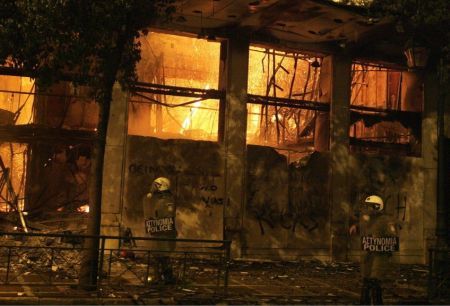
Greece faces the unenviable choice between accepting the
terms of “the Troika” [the European Union, European
Central Bank, and International Monetary Fund] and facing the continuation and deepening
of a socio-economic crises, which includes five years of
negative growth, over 23% unemployment, an astronomical rise in
poverty (from less than 15% to over 40%) and mounting suicides,
or a rejection of the “memorandum”, and a likely cut-off of
Eurozone funding and capital markets with virtually few reserves
toc over salaries, pensions or public services.
[...]
Greece,
during its 30 year membership in the European Union actually saw
its meager and backward manufacturing and agricultural base
shrink, in the face of cheap and better imports from developed
capitalist countries like Germany, France, Holland and
elsewhere. Unlike Argentina, Greece received billions of dollars
in “transfers,” compensation funds to upgrade its economy and
competitiveness and prepare it for full integration (lowering of
tariff barriers). However, the “transfers” were not channeled
into productive activity either by the two ruling parties or by
the ‘capitalists’ and ‘farmers.’ The ruling parties used the
transfers to build extensive electoral patronage machines; they
squandered funds for overpriced state contracts to provide
builders engaged in non-productive building projects (including
the multi-billion dollar swindle around the Olympic Games). Tens
of thousands of unemployed graduates and party loyalists bloated
the national, regional and local bureaucracy, increasing
consumption, blocking any meaningful productive activity.
Capitalists designed “productive projects and then transferred
EU loans and handouts to local and overseas real estate
investments and luxury purchases. The Greek elite transferred
loans to London, Swiss and Cypriot bank accounts – while the
government signed off as ultimate guarantor.
[...]
Most
important, the economic elite – bankers, ship owners,
construction-real estate – politicians, speculators skimmed off
billions from the EEC transfers in the form of illicit loans to
cronies and in the form of fees, management charges for credit
dealings and pension funding.
The
European bankers, government officials and exporters were
acutely aware that the “transfers” were being pillaged – but
they went along, for obvious reasons of economic and political
gain: lucrative interest payments flowed into their coffers;
exporters took over Greek consumer markets; bankers and
investment houses found willing pension fund managers ‘open’ to
dubious investments. Even tourists enjoyed the sun and imports
which reminded them of home: wiener schnitzel, English ale,
Dutch feta. Moreover, Greece spent 15% of its budget on the
military, serving NATO goals and bases.
[...]
Any road
map out of the Greek crises will be difficult, complex, and
arduous – given the “scorched earth” economy which a left
government (LG) will inherit. The first and most basic concern
of a LG is to end the policies and especially the agreements
with the “Troika” that demand further mass firings of public
employees, the reduction in social services, the cuts in minimum
wages and pensions. A new LG needs to impose a series of
emergency measures to avoid economic bankruptcy.
It is
absolutely clear that European bankers and regimes want to
punish Greece for transgressions of their “austerity pact.” If
Greece should succeed in renouncing the austerity pact, the Euro
bankers fear that other countries – Spain, Portugal, Italy,
Cyprus and Ireland might follow suit.
Greece
should suspend debt payments, impose tight capital controls and
freeze bank deposits to avoid capital flight, in the face of the
Troika cut-off of funding. The LG should convoke a series of
emergency commissions to (1) secure alternative sources of
emergency financing from several reserve funds with Euro
holdings. They must seek loans from Russia, Iran, Venezuela,
China and other states not beholden to the Troika and (2) make
an inventory of available and potential productive enterprises –
bankrupt or troubled firms, indebted enterprises – and convert
them into state sponsored worker-employee operated co-operatives
(3) investigate public debt to determine what can be classified
as ‘legitimate’(loans channeled into productive employment) or
illegitimate (loans that enriched speculators, corrupt
contractors, political leaders) (4) investigate and attach
overseas holdings of wealthy Greeks who were engaged in
multi-year multi-million tax evasion and who accumulated illicit
income via unpaid loans and money laundering. Greek auditors
should proceed to demand that Eurozone creditors should collect
debt payments from the bank accounts of wealth Greeks who
laundered and deposited in London, Zurich, Frankfurt, New York
and elsewhere.
The
principle of the LG should be “those who borrowed the loans and
profited, should pay them.”
[...]
The LG
should repudiate illegal debts (the vast majority) and
renegotiate and roll-over the rest over an extended time frame,
pending an economic recovery.
What
should be recognized is that past Greek governments (despite
being formally elected) engaged in illegitimate activity which
prejudiced the sovereignty, productive capacity, and livelihood
of an entire people.
What is
not acceptable is to force an entire people to sacrifice their
lives because a minority of Greeks borrowed and didn’t invest or
pay their debts to overseas creditors. Currently the
kleptocratic millionaires are given “cover,” and their illicit
multi-billion Euro bank accounts and real-estate holdings are
protected by the banks demanding payments from the Greek
government. Their current demands are based on a savage
demolition of living standards for a whole people.