My view of Hillary and the way, WAY too early 2016 presidential race
Labels: 2016 election, corporate media, elites, endless elections, Goldman Sachs, Hillary Clinton, screw the poor
Submit To PropellerTweet
[Permalink] 0 comments
Labels: 2016 election, corporate media, elites, endless elections, Goldman Sachs, Hillary Clinton, screw the poor
Submit To Propeller

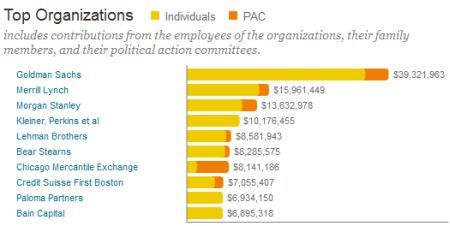
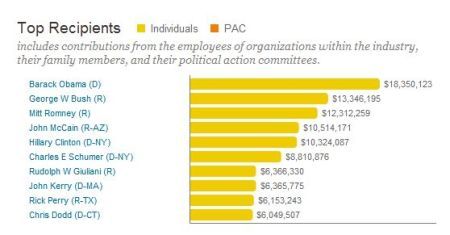
Labels: Barack Obama, Democrats, financial services industry, Glenn Greenwald, Goldman Sachs, Influence Explorer, influence industry, lobbying, Republicans
Submit To PropellerLabels: bank fraud, corruption, Fannie Mae, Financial Times, Goldman Sachs, James Johnson
Submit To PropellerA list of the most charitable companies in America shows some of the biggest tax evaders in the country. These include heavyweights such as Goldman, Wells Fargo, BoA and Exxon Mobil; a company which made $41.1 billion in profits last year and paid only 17 percent in effective taxes, a far lower rate than the average U.S. citizen. The savings here vastly outweigh any donation which is subsequently offered in the spirit of “social responsibility”. The result of this neglect of public duty has been spending cuts across all areas of government, resulting in layoffs to teachers, the closing of hospitals and the slashing of benefits to the most vulnerable sections of society including children and the elderly. That these same corporate citizens turn around and give back a fraction of what they owe in the form of charitable donations (for which they of course can claim further tax benefits) is a cynical attempt to manage their public image in the face of the increasingly angry public backlash against their policies.
The private social safety net, provided by corporate donors as compensation for the public one which their tax avoidance helps shred, is a poor substitute for democratically accountable public spending. Besides being poorer, free of public oversight, and geared primarily towards public relations efforts, the private safety net is a rug that can and will be pulled out from under its beneficiaries at the slightest notice. Goldman Sachs, which generously gave $320M in charitable contributions in 2010 and $500M in 2009, drastically cut its charitable budget to $78M a year in 2011 in response to reduced profits while making minimal cuts to employee bonuses and other compensation. “Doing God’s work”, as Goldman CEO Lloyd Blankfein famously described the companies activities is apparently an elective commitment based on market conditions. Whereas as a strong public safety net is managed democratically by its beneficiaries, corporate charity can and will disappear the moment it is deemed necessary which exemplifies clearly why it is no substitute for government spending.
Labels: common good, corporate social responsibility, Goldman Sachs, Lloyd Blankfein, Murtaza Hussain, taxes
Submit To PropellerThis is from the WSJ on Monday:
Some of the biggest names on Wall Street are lining up to become landlords to cash-strapped Americans by bidding on pools of foreclosed properties being sold by Fannie Mae...
While the current approach of selling homes one-by-one has its own high costs and is sometimes inefficient, selling properties in bulk to large investors could require Fannie Mae to sell at a big discount, leading to larger initial costs.
In con artistry parlance, they call this the "reload." That's when you hit the same mark twice – typically with a second scam designed to "fix" the damage caused by the first scam. Someone robs your house, then comes by the next day and sells you a fancy alarm system, that's the reload.
In this case, banks pumped up the real estate market by creating huge volumes of subprime loans, then dumped a lot of them on, among others, Fannie and Freddie, the ever-ready enthusiastic state customer. Now the loans have crashed in value, yet the GSEs (Government Sponsored Enterprises) are still out there feeding the banks money through two continuous bailouts.
One, they continue to buy mortgages from the big banks (until recently, even from Bank of America, whom the GSEs were already suing for sales of toxic MBS), giving the banks a permanent market for home loans.
And secondly, they conduct these quiet bulk sales of mortgages, in which huge packets of home loans are sold to banks at a "big discount."
By now we've come full circle. Banks create the loans, make money selling them off on the market at high prices, then come back and buy them again when they're low. When the GSEs are in the middle of this transaction, it makes mortgage lending a basically risk-free proposition: Banks get paid for creating home loans and they end up owning valuable property on the cheap, but in between, they offshore the market risk to a government entity and/or to the idiot individual who bought the home mortgage in the first place.
Even better, many of the banks/investors who buy these home loans back from Fannie/Freddie will rent out their properties instead of reselling them, which can vastly increase their revenue streams. From the WSJ:
Economists at Goldman Sachs estimate the annual yield on an investment on rental property nationwide averages about 6.3%, but can exceed 8% in cities that were hit hard during the housing bust, including Las Vegas, Detroit and Tampa. By contrast, mortgage bonds have average yields of just over 3%, and investment-grade corporate bonds are yielding about 3.5%, according the Barclays Capital U.S. Investment-Grade Index.
It gets better:
Warren Buffett, considered a sage investor and chief executive of Berkshire Hathaway Inc., said in an interview with CNBC-TV last month that he would buy up "a couple hundred thousand" single-family homes if he could do so easily, given the high yields on rental investments.
Another potential buyer, according to the article, is John Paulson, the pillaging hedge-fund billionaire who was behind Goldman's notorious "Abacus" deal (in which Goldman allowed Paulson to pack a portfolio full of loser mortgages he was shorting before those same mortgages were dumped on a pair of Euro banks).
So congratulations, America, your quasi-governmental housing entity is about to subcontract out mass-landlording/slumlording jobs to the likes of John Paulson and Warren Buffett, so that they can add to their bottom lines collecting rent payments in the middle of a nationwide housing slump.
Labels: banksters, Berkshire Hathaway, elites, financial terrorists, Goldman Sachs, GSEs, John Paulson, Matt Taibbi, Rolling Stone, super-rich, Warren Buffet
Submit To PropellerSince at least 1989, incredibly talented, hardworking men and women have been leaving high paying positions at major Wall Street institutions and alerting the public in meticulously crafted, first-hand narratives released by venerable publishing houses that Wall Street wants to rip off its clients’ faces.
On Wednesday, March 14, Greg Smith – following in the proud lineage of Micheal Lewis, Frank Partnoy and Nomi Prins – simply bypassed the tedious route of galleys and nit-picking editors and went straight to the OpEd page of the New York Times with his resignation letter decrying Goldman Sachs for abusing its clients. “It makes me ill how callously people talk about ripping their clients off. Over the last 12 months I have seen five different managing directors refer to their own clients as ‘muppets,’ sometimes over internal e-mail,” Smith said. He called the current environment at Goldman “as toxic and destructive as I have ever seen it.”
Each day since then, corporate media pundits have frenetically struggled to characterize the motives of this 33-year old earning $500,000 a year. The defining moment in this debate came in this video where Evan Newmark, Wall Street Journal columnist and a former Managing Director of Goldman Sachs, asks MarketWatch writer Jon Friedman the following question in reference to the 3 million page hits Smith’s OpEd had received on line: “Do you think Greg Smith will have an easy time monetizing his popularity?” I had to play the tape three times to be sure I wasn’t hallucinating.
A young man throws both caution and his career to the wind in a virtual scream for the leadership of this country to wake up to what’s still transpiring on Wall Street and a journalist for the newspaper covering Wall Street can only relate the selfless act to dollar signs. The Wall Street culture of greed is metastasizing into the larger society at a gut churning pace. The assumption by Newmark is that there is no one earning $500,000 who might love his country, its future, the next generation’s future more than his love of money.
Labels: corporate greed, Counterpunch, elites, Goldman Sachs, Greg Smith, Pam Martens, super-rich, Wall Street, whistleblowers
Submit To PropellerComment for Public Information Collection 77 FR 8817
From: Z A N
Organization(s):
JPMorgan Chase
Comment No: 57019
Date: 3/14/2012
Comment Text:
Dear CFTC Staff,
Hello, I am a current JPMorgan Chase employee. This is an open letter to all commissioners and regulators. I am emailing you today b/c I know of insider information that will be damning at best for JPMorgan Chase. I have decided to play the role of whistleblower b/c I no longer have faith and belief that what we are doing for society is bringing value to people. I am now under the opinion that we are actually putting hard working Americans unaware of what lays ahead at extreme market risk. This risk is unnecessary and will lead to wide-scale market collapse if not handled properly. With the release of Mr. Smith’s open letter to Goldman, I too would like to set the record straight for JPM as well. I have seen the disruptive behavior of superiors and no longer can say that I look up to employees at the ED/MD level here at JPM. Their smug exuberance and arrogance permeates the air just as pungently as rotting vegetables. They all know too well of the backdoor crony connections they share intimately with elected officials and with other institutions. It is apparent in everything they do, from the meager attempts to manipulate LIBOR, therefore controlling how almost all derivatives are priced to the inherit and fraudulent commodities manipulation. They too may have one day stood for something in the past in the client-employee relationship. Does anyone in today’s market really care about the protection of their client? From the ruthless and scandalous treatment of MF Global client asset funds to the excessive bonuses paid by companies with burgeoning liabilities. Yes, we at JPMorgan that are in the know are fearful of a cascading credit event being triggered in Greece as they have hidden derivatives in excess of $1 Trillion USD. We at JPMorgan own enough of these through counterparty risk and outright prop trading that our entire IB EDG space could be annihilated within a few short days.
[...]
It is rather surprising that what should be well known liabilities on our balance sheet have not erupted into wider scale scrutinization. I call all honest and courageous JPMorgan employees to step up and fight the cronyism and wide-scale manipulation by reporting the truth. We are only helping reality come to light therefore allowing a real valuation of our banking industry which will give investors a chance to properly adjust without being totally wiped out. I will be contacting a lawyer shortly about this matter, as I believe no other whistleblower at JPMorgan has come forward yet. Our deepest secrets lie within the hands of honest employees and can be revealed through honest regulators that are willing to take a look inside one of America's best kept secrets. Please do not allow this to turn into another Enron.
Labels: arrogance, Commodity Futures Trading Commission, derivatives, Enron, Goldman Sachs, JPMorgan Chase, LIBOR, MF Global, whistleblowers
Submit To PropellerWhether Goldman Sachs is or isn’t an organization gripped by a toxic culture isn’t all that important when one considers the destructive impact that derivatives have had, and continue to have upon society. Capitalism as it functions today is completely dependent upon derivatives. Interest rates swaps are the single largest type of derivative, measured by notional amount, because they achieve an integration of different national, regional, and sectoral financial markets into one global financial system. It’s in the genetics of the project of financial globalization, fueled by derivatives, that the real problem lies, not in the internal culture of Goldman Sachs, or the illegal behaviors of some bankers across many firms. The real crime lies in perfectly legal and legitimated activities whereby a few powerful corporations design a system that puts the welfare of the world’s vast majority at grave risk. It’s the system that’s toxic. Goldman Sachs merely operates well within the toxicity.
Labels: broken system, derivatives, Goldman Sachs, interest rate swaps, systemic, toxic assets
Submit To PropellerWhen the history books are written about Goldman Sachs, they may reflect that the current chief executive officer, Lloyd C. Blankfein, and the president, Gary D. Cohn, lost hold of the firm’s culture on their watch. I truly believe that this decline in the firm’s moral fiber represents the single most serious threat to its long-run survival.
[...]
It makes me ill how callously people talk about ripping their clients off. Over the last 12 months I have seen five different managing directors refer to their own clients as “muppets,” sometimes over internal e-mail. Even after the S.E.C., Fabulous Fab, Abacus, God’s work, Carl Levin, Vampire Squids? No humility? I mean, come on. Integrity? It is eroding. I don’t know of any illegal behavior, but will people push the envelope and pitch lucrative and complicated products to clients even if they are not the simplest investments or the ones most directly aligned with the client’s goals? Absolutely. Every day, in fact.
Labels: elites, ethics, financial services industry, Goldman Sachs, greed, super-rich, vampire squid
Submit To PropellerIt was strange to see a large police response for such relatively tame acts of civil disobedience, but that's become a theme of Occupy Wall Street. The 30:1 police-to-protester ratio is a familiar theme of these kinds of protests, but only, of course, if the protest target has something to do with the financial district in New York City or major companies' import-export practices. When activists in New York City chose East New York as the site of their protest, very few police officers turned out to monitor the event. Those who did show up allowed protesters to march down the middle of the street, disrupt traffic, and block the roadways outside of homes.
If Occupiers attempted similar behavior in the financial district, police would arrest them en masse. That's not mere speculation. That exact scenario occurs every time protesters stray into Manhattan streets, and I've personally witnesses an NYPD officer tear the press pass off a foreign cameraman's neck when he went into the street to film police activity.
It almost seems as though there are parallel police manuals: one for how to protect the rich and the other detailing how to deal with the poor.
Labels: 1%, 99%, Allison Kilkenny, Goldman Sachs, New York City, Occupy Wall Street, police brutality
Submit To PropellerHow Goldman Sachs Helped Greece to Mask its True Debt
Goldman Sachs helped the Greek government to mask the true extent of its deficit with the help of a derivatives deal that legally circumvented the EU Maastricht deficit rules.
In 2002, Goldman Sachs secretly bought up €2.3 billion in Greek government debt, converted it all into yen and dollars, then immediately sold it back to Greece.
[...]
Goldman had cut a secret deal with the Greek government in power then. Their game: to conceal a massive budget deficit. Goldman's fake loss was the Greek government's fake gain.
Goldman would get repayment of its “loss” from the government at loan-shark rates.
The point is, through this crazy and costly legerdemain, Greece's right-wing free-market government was able to pretend its deficits never exceeded 3 percent of GDP.
[...]
In 2007, at the same time banks were selling suspect CDS's and CDOs (packaged sub-prime mortgage securities), Goldman held a “net short” position against these securities. That is, Goldman was betting their financial "products" would end up in the toilet. Goldman picked up another half a billion dollars on their "net short" scam.
But, instead of cuffing Goldman's CEO Lloyd Blankfein and parading him in a cage through the streets of Athens, we have the victims of the frauds, the Greek people, blamed. Blamed and soaked for the cost of it. The "spread" on Greek bonds (the term used for the risk premium paid on Greece's corrupted debt) has now risen to — get ready for this––$14,000 per family per year.
Labels: accountability, bank fraud, banksters, cover-up, criminal banks, Goldman Sachs, Greece, Greg Palast, Lloyd Blankfein, NPR
Submit To PropellerWashington is Wall Street, Wall Street is Washington
Occupy protesters demonstrate resilience to crackdowns and cynicism in the media but it is still unclear what lies ahead for the movement. While camping out and singing songs is one thing, getting the right politicians elected quite another. The movement is unified and people are waking up to the two-party dictatorship, and realizing that the political system does not represent them anymore.
Labels: Barack Obama, corporate military industrial government complex, Gerald Celente, Goldman Sachs, Occupy Wall Street, Russia Today
Submit To PropellerLabels: arrests, banksters, Chris Hedges, Goldman Sachs, Occupy Wall Street, protestors
Submit To PropellerToday’s Goldman Sachs earning reports provides a valuable lesson on how things really work inside Wall Street’s largest investment houses. Goldmhttp://www.blogger.com/img/blank.gifan Sachs had an awful three months, losing $428 million in the third quarter of 2011, and yet it continued to shovel billions into the bonus pool it will share with its employees at year’s end.
Through the first nine months of 2011, Goldman set aside $10 billion in its compensation fund. If Goldman’s 30,000 employees split that bounty evenly, that would work out to $333,000 per person—plus the billions more Goldman will no doubt set aside in the last few months of the year.
[...]
But that’s the beauty of working at a major investment bank. Performance doesn’t matter nearly as much as just showing up. Goldman booked $13 billion in pre-tax profits in 2010—a steep drop from the $20 billion the bank booked in 2009. Despite a precipitous drop in profits between 2009 and 2010 and a stock stuck in neutral throughout the year, the Goldman board of directors raised Blankfein’s base salary to $2 million, up from $600,000, and showered an extra $13 million in stock grants on Blankfein and his executive team.
Not bad for the executives of a bank forced to pay a $550 million fine after being accused by the SEC of duping its clients by selling them shares of a morhttp://www.blogger.com/img/blank.giftgage-backed security they allowed a hedge firm to secretly hand-pick. Still, this is hardly like the fat and happy subprime mortgage days, when Goldman was buying toxic subprime mortgages and selling them to unsuspecting clients. In 2007, the year before the economic collapse, Blankfein made $68 million in stock and bonus money.
Is it any wonder the Occupy Wall Street crowd might think there’s something rotten about the system?

"Our results were significantly impacted by the environment and we were disappointed to record a loss in the quarter,” said Lloyd Blankfein, the chairman and chief executive, in a statement.
Labels: banksters, elites, executive bonuses, Goldman Sachs, Lloyd Blankfein, Occupy Wall Street, subprime mortgage crisis, super-rich
Submit To PropellerIn an interview on BBC News this morning that left the hosts gob-smacked (google it... it is the BBC after all), Alessio Rastani outlines in a mere three-and-a-half-minutes what we all know and most ignore. While the whole interview is worth watching, the money shot for us was "This economic crisis is like a cancer, if you just wait and wait hoping it is going to go away, just like a cancer it is going to grow and it will be too late!". While he dreams of recessions, sees Goldman ruling the world, and urges people to prepare, it is hard to disagree with much (or actually anything) of what he says and obviously interventions and machinations means we will have days like this (in Silver for instance), there is only one endgame here and we hope there is less hopeful euphoria (and more preparedness) as we pull back the curtain further and further.
While we do not know who this trader is, one thing we can be 100% certain of is that he will never appear on CNBC.
Labels: BBC, CNBC, Euro Zone, financial collapse, Goldman Sachs, recession, stock market, tradesters, Zero Hedge
Submit To PropellerU.S. Is Set to Sue a Dozen Big Banks Over Mortgages
The federal agency that oversees the mortgage giants Fannie Mae and Freddie Mac is set to file suits against more than a dozen big banks, accusing them of misrepresenting the quality of mortgage securities they assembled and sold at the height of the housing bubble, and seeking billions of dollars in compensation.
The Federal Housing Finance Agency suits, which are expected to be filed in the coming days in federal court, are aimed at Bank of America, JPMorgan Chase, Goldman Sachs and Deutsche Bank, among others, according to three individuals briefed on the matter.
The suits stem from subpoenas the finance agency issued to banks a year ago. If the case is not filed Friday, they said, it will come Tuesday, shortly before a deadline expires for the housing agency to file claims.
Labels: accountability, Bank of America, banksters, Deutsche Bank, Fannie Mae, Federal Housing Finance Agency, Freddie Mac, Goldman Sachs, JPMorgan Chase, Mortgage Lenders
Submit To PropellerLabels: bank fraud, banksters, Goldman Sachs, Greece, Jamie Dimon, Lloyd Blankfein, Max Keiser, terrorism
Submit To PropellerLie #1: 'Putting our Customers First'
Lie #2: 'Our interests are aligned with our customer’s interests'
Lie #3: 'Honest, we didn’t try to rig the market'
Lie #4: 'We’re only doing all this to make markets'
Labels: bank fraud, banksters, Goldman Sachs, lies, toxic assets, Wall Street
Submit To PropellerFiscal Scandals: Goldman Sachs May Have Misled Investors, Banks Investigated for CollusionAt this point, news of big banks engaging in illegal and unethical activities is no real shocker, but that doesn't make it any less infuriating. And today, there are not one but two gems for you to gnaw on, via Daily Beast.
First, a two-year Senate Panel inquiry into Goldman Sachs has shown the firm may have misled both Congress and investors about housing market securities. Senator Carl Levin, D-MI, wants the Justice Department and the SEC to investigate 'whether Goldman Sachs violated the law by misleading clients who bought the complex securities known as collateralized debt obligations without knowing the firm would benefit if they fell in value,' reports Bloomberg.
Last year, Sachs employees -- including CEO Lloyd Blankfein -- testified under oath that Goldman Sachs did not bet against the mortgage market for profit -- and if the probe finds otherwise, they could be indicted for perjury, as well. “In my judgment,” said Senator Levin in a press briefing, “Goldman clearly misled their clients and they misled the Congress.”
And in a separate matter, US investigators are looking into whether big banks worked together to alter interest rates during the financial crisis, reports the WSJ. The DoJ and the SEC suspect institutions such as Bank of America and Citigroup colluded to manipulate the London Interbank Offered Rate (Libor), by understating their borrowing costs and keeping the global loan rate artificially low -- knowingly affecting trillions of dollars around the world and putting global finances in peril.
The Comp Problem at Big Banks
This paper shines a spotlight on billions of dollars’ worth of stock trades made by the CEOs of some of the top financial institutions in the U.S. in the years leading up to the 2008 economic crisis. Highly lucrative compensation programs encouraged many of the CEOs to sell their company stock for large short-term gains, researchers found, raising the possibility that they took their eyes off the long-term needs of their shareholders and embraced excessive risk.
The researchers studied the executive compensation structures between 2000 and 2008 at the 14 largest U.S. financial institutions at that time: AIG, Bank of America, Bank of New York, Bear Stearns, Citigroup, Countrywide Financial, Goldman Sachs, JPMorgan Chase, Lehman Brothers, Mellon Financial, Merrill Lynch, Morgan Stanley, State Street, and Wells Fargo.
Drawing on trading data from the Thomson Financial Insider database (nowhttp://www.blogger.com/img/blank.gif called Thomson Reuters Insider) and information from the U.S. Securities and Exchange Commission, the study focused on the CEOs’ buys and sells of company stock in the eight years before the downturn. During this period, the CEOs collectively exercised stock options 470 times, purchasing a total of US$1.66 billion in shares. They made direct purchases on their own 73 times, for $36 million. But they sold their shares nearly 30 times as often — on 2,048 occasions. Overall, the sales came to $3.47 billion, netting them $1.77 billion after the cost of their options and direct purchases was subtracted. That works out to almost $16 million per year, on average, for each of the CEOs. They also received cash compensation of $891 million during these years, or another $8 million annually, on average.
The two-tiered justice system: an illustration
Of all the topics on which I've focused, I've likely written most about America's two-tiered justice system -- the way in which political and financial elites now enjoy virtually full-scale legal immunity for even the most egregious lawbreaking, while ordinary Americans, especially the poor and racial and ethnic minorities, are subjected to exactly the opposite treatment: the world's largest prison state and most merciless justice system.
[...]
The New York Times this morning has a long article so perfectly illustrating what I mean by "two-tiered justice system" -- and the way in which it obliterates the core covenant of the American Founding: equality before the law -- that it's impossible for me not to highlight it.The article's headline tells most of the story: "In Financial Crisis, No Prosecutions of Top Figures." It asks: "why, in the aftermath of a financial mess that generated hundreds of billions in losses, have no high-profile participants in the disaster been prosecuted?" And it recounts that not only have no high-level culprits been indicted (or even subjected to meaningful criminal investigations), but few have suffered any financial repercussions in the form of civil enforcements or other lawsuits. The evidence of rampant criminality that led to the 2008 financial crisis is overwhelming, but perhaps the clearest and most compelling such evidence comes from long-time Wall-Street-servant Alan Greenspan; even he was forced to acknowledge that much of the precipitating conduct was "certainly illegal and clearly criminal" and that "a lot of that stuff was just plain fraud."
Despite that clarity and abundance of the evidence proving pervasive criminality, it's entirely unsurprising that there have been no real criminal investigations or prosecutions. That's because the overarching "principle" of our justice system is that criminal prosecutions are only for ordinary rabble, not for those who are most politically and financially empowered. We have thus created precisely the two-tiered justice system against which the Founders most stridently warned and which contemporary legal scholars all agree is the hallmark of a lawless political culture.
Labels: accountability, bank fraud, banksters, Booz, Glenn Greenwald, Goldman Sachs, hypocrisy, Lloyd Blankfein, rule of law, two-tiered justice system, U.S. foreign policy
Submit To Propeller