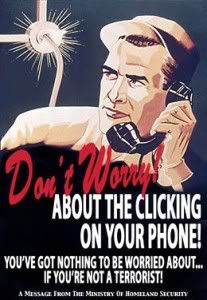
I think I may be done
Labels: blogging, Civil liberties, due process, extrajudicial executions, Failed Foreign Policy, National Security State, surveillance society, U.S. Constitution
Submit To PropellerTweet
[Permalink] 5 comments
Labels: blogging, Civil liberties, due process, extrajudicial executions, Failed Foreign Policy, National Security State, surveillance society, U.S. Constitution
Submit To PropellerNSA whistleblower William Binney was interviewed by internet journalist Geoff Shively at the HOPE Number 9 hackers conference in New York on Friday.
Binney, who resigned from the NSA in 2001 over its domestic surveillance program, had just delivered a keynote speech in which he revealed what Shively called “evidence which we have not seen until this point.”
“They’re pulling together all the data about virtually every U.S. citizen in the country … and assembling that information,” Binney explained. “So government is accumulating that kind of information about every individual person and it’s a very dangerous process.” He estimated that something like 1.6 billion logs have been processed since 2001.
Labels: Cryptogon, domestic surveillance, facial recognition, National Security State, NSA, social control, social engineering, surveillance society, warrantless domestic wiretapping, William Binney
Submit To PropellerIf you even go into any normal American city or even, increasingly, small or mid-sized towns, there are all kinds of instruments of surveillance everywhere that you probably don’t even notice. If you wake up in the morning and drive to your local convenience store, you’ve undoubtedly been photographed by all sorts of surveillance cameras on the street. If you go to the ATM to take out money to buy things, that will be then recorded. If you go into a convenience store to buy things you want to buy, you’ll have your photograph taken and will be reported.
An article in Popular Mechanics in 2004 reported on a study of American surveillance and this is what it said: “There are an estimated 30 million surveillance cameras now deployed in the United States shooting 4 billion hours of footage a week. Americans are being watched. All of us, almost everywhere.” There is a study in 2006 that estimated that that number would quadruple to 100 million cameras -- surveillance cameras -- in the United States within five years largely because of the bonanza of post-9/11 surveilling.[...]The principle being that there can be no human interaction, especially no human communication, not just for international between foreign nations but by America citizens on American soils that is beyond the reach of the U.S. government.
If you take what has been happening in the post-9/11 security world, what you’re see is the establishment of a surveillance society – the establishment of a surveillance network. People don’t realize the extent to which we’re surveilled in many, many ways. The extent to which vast amounts of our transactional data in all forms – electronic forms, your emails, your tweets, bank records and everything else – are all subject or suspect in terms of surveillance. It raises the specter of the rise of so-called “soft tyranny.” It raises the specter of you being automatically suspicious until you prove that you’re not; the specter of a universal and persistent wiretap on every single person. If not – they can create one. Because what happens if they don’t like you? What if you speak ill will against the government? What if you say something they consider disloyal? That is not the country I took an oath to defend four times in my government career.
There is also a fear element. Fear in itself is control. What would people do when they are fearful is they would begin to censor themselves. It sends an extraordinary chilling message that if you speak out – they are going to hammer you hard. Our security has become our state religion, you don’t question it. And if you question it – your loyalty is questioned.
Labels: domestic spying, Glenn Greenwald, National Security State, NSA, secrecy, surveillance society, Thomas Drake, transparency
Submit To PropellerThis Monday, Twitter released it's first ever transparency report. It revealed that just in the first six months of 2012, they've received more demands from governments for user data, than all of last year. And surprise, surprise, the United States made up the majority of the 849 requests, with a whopping 679. Alyona talks to Salon's Glenn Greenwald about the growing surveillance state and what can be done about it.
Labels: Alyona, Glenn Greenwald, National Security State, NSA, Russia Today, surveillance society, With Liberty and Justice for Some
Submit To PropellerThe ubiquitous fantasy of “homeland security,” pushed hard by the federal government in the wake of 9/11, has been widely embraced by the public. It has also excited intense weapons- and techno-envy among police departments and municipalities vying for the latest in armor and spy equipment.
In such a world, deadly gadgetry is just a grant request away, so why shouldn’t the 14,000 at-risk souls in Scottsbluff, Nebraska, have a closed-circuit-digital-camera-and-monitor system (cost: $180,000, courtesy of the Homeland Security Department) identical to the one up and running in New York’s Times Square?
So much money has gone into armoring and arming local law-enforcement since 9/11 that the federal government could have rebuilt post-Katrina New Orleans five times over and had enough money left in the kitty to provide job training and housing for every one of the record 41,000-plus homeless people in New York City. It could have added in the growing population of 15,000 homeless in Philadelphia, my hometown, and still have had money to spare. Add disintegrating Detroit, Newark, and Camden to the list. Throw in some crumbling bridges and roads, too.
[...]
All told, the federal government has appropriated about $635 billion, accounting for inflation, for homeland security-related activities and equipment since the 9/11 attacks. To conclude, though, that “the police” have become increasingly militarized casts too narrow a net. The truth is that virtually the entire apparatus of government has been mobilized and militarized right down to the university campus.
[...]
Government budgets at every level now include allocations aimed at fighting an ephemeral “War on Terror” in the United States. A vast surveillance and military buildup has taken place nationwide to conduct a pseudo-war against what can be imagined, not what we actually face. The costs of this effort, started by the Bush administration and promoted faithfully by the Obama administration, have been, and continue to be, virtually incalculable. In the process, public service and the public imagination have been weaponized.
We’re not just talking money eagerly squandered. That may prove the least of it. More importantly, the fundamental values of American democracy -- particularly the right to lead an autonomous private life -- have been compromised with grim efficiency. The weaponry and tactics now routinely employed by police are visible evidence of this.
[...]
The chances of an American dying in a terrorist incident in a given year are 1 in 3.5 million. To reduce that risk, to make something minuscule even more minuscule, what has the nation spent? What has it cost us? Instead of rebuilding a ravaged American city in a timely fashion or making Americans more secure in their “underwater” homes and their disappearing jobs, we have created militarized police forces, visible evidence of police-state-style funding.
Labels: 9/11, Bush Administration, democracy, Homeland Security, National Security State, Obama administration, Police State, Stephen Salisbury, surveillance society, terrorism, Tom Dispatch
Submit To Propeller“The government does not pursue every leak,” said Mark Corallo, who served as the Justice Department’s spokesman in Mr. Bush’s administration. “On balance, it is more important that the media have the ability to report. It’s important to our democracy.”
That does not seem to be the view of the Obama administration, which has brought more prosecutions against current or former government officials for providing classified information to the media than every previous administration combined.
“It increases the level of paranoia,” Steven Aftergood, an expert on government secrecy at the Federation of American Scientists, said of recent trends. “As security has been ratcheted up, so has the anxiety of many government officials about dealing with the press and the public.”
Mr. Corallo, who served under Mr. Bush’s attorney general John D. Ashcroft, said he was “sort of shocked” by the volume of leak prosecutions under President Obama. “We would have gotten hammered for it,” he said.
[...]
[Lucy Dalglish, executive director of the Reporters Committee for Freedom of the Press] ... described a conference in June organized by the Aspen Institute that brought together lawyers, journalists and intelligence officials to talk about government secrecy.
[...]
“I was told in a rather cocky manner” by a national security representative, Ms. Dalglish recalled, that “the Risen subpoena is one of the last you’ll see.”
She continued, paraphrasing the official: “We don’t need to ask who you’re talking to. We know.”
The solution for reporters, Ms. Dalglish said, is to adopt Mr. Woodward’s methods from the 1970s. “For God’s sake, get off of e-mail,” she said. “Get off of your cellphone. Watch your credit cards. Watch your plane tickets. These guys in the N.S.A. know everything”.
Mr. Corallo, the former Justice Department spokesman, provided corresponding advice to government officials. “Don’t be stupid and use e-mail,” he said. “You have to meet a reporter face to face, hand him an envelope and walk away quickly.”
Labels: Bush Administration, Espionage Act, National Security State, NSA, Obama administration, Reporters Committee for Freedom of the Press, Steven Aftergood, surveillance society, whistleblowers
Submit To PropellerFBI seeking social media monitoring tool
The US Federal Bureau of Investigation is looking for a tool to mine social media for intelligence tips.
The US domestic law enforcement agency is asking information technology contractors about the feasibility of building a tool that would “enhance its techniques for collecting and sharing ‘open source’ actionable intelligence.”
The January 19 open request was published on a website offering federal business opportunities and was first reported by New Scientist magazine.
The FBI said it is seeking an “open source and social media alert, mapping and analysis application solution” for its Strategic Information and Operations Center (SIOC).
“Social media has become a primary source of intelligence because it has become the premier first response to key events and the primal alert to possible developing situations,” the FBI request said.
“Intelligence analysts will often use social media to receive the first tip-off that a crisis has occurred,” it said.
The FBI said the tool “must have the ability to rapidly assemble critical open source information and intelligence that will allow SIOC to quickly vet, identity, and geo-locate breaking events, incidents and emerging threats.”
It would need to be able to “instantly search and monitor key words and strings in all ‘publicly available’ tweets across the Twitter site and any other ‘publicly available’ social networking sites/forums.”
It would also need the ability to “search the data across a myriad of parameters and view terrorist activities by location, terrorist group, and type of attack and see trends and analytics.”
Labels: FBI, internet surveillance, National Security State, Obama administration, SIOC, social media, surveillance society
Submit To PropellerOur electoral system, already hostage to corporate money and corporate lobbyists, gasped its last two years ago. It died on Jan. 21, 2010, when the Supreme Court in Citizens United v. Federal Election Commission granted to corporations the right to spend unlimited amounts on independent political campaigns. The ruling turned politicians into corporate employees. If any politician steps out of line, dares to defy corporate demands, this ruling hands to our corporate overlords the ability to pump massive amounts of anonymous money into campaigns to make sure the wayward are defeated and silenced. Politicians like Obama are hostages. They jump when corporations say jump. They beg when corporations say beg.
[...]
Turn off your televisions. Ignore the Newt-Mitt-Rick-Barack reality show. It is as relevant to your life as the gossip on “Jersey Shore.” The real debate, the debate raised by the Occupy movement about inequality, corporate malfeasance, the destruction of the ecosystem, and the security and surveillance state, is the only debate that matters. You won’t hear it on the corporate-owned airwaves and cable networks, including MSNBC, which has become to the Democratic Party what Fox News is to the lunatic fringe of the Republican Party. You won’t hear it on NPR or PBS. You won’t read about it in our major newspapers.
[...]
Voting will not alter the corporate systems of power. Voting is an act of political theater. Voting in the United States is as futile and sterile as in the elections I covered as a reporter in dictatorships like Syria, Iran and Iraq. There were always opposition candidates offered up by these dictatorships. Give the people the illusion of choice. Throw up the pretense of debate. Let the power elite hold public celebrations to exalt the triumph of popular will. We can vote for Romney or Obama, but Goldman Sachs and ExxonMobil and Bank of America and the defense contractors always win.
[...]
[V]oting is nothing more than a brief chance to register our disgust with the corporate state. It will not alter the configurations of power. The campaign is not worth our emotional, physical or intellectual energy.
[...]
Our efforts must be directed toward acts of civil disobedience, to chipping away, through nonviolent protest, at the pillars of established, corporate power. The corporate state is so unfair, so corrupt and so rotten that the institutions tasked with holding it up—the police, the press, the banking system, the civil service and the judiciary—have become vulnerable. It is becoming harder and harder for the corporations to convince its foot soldiers to hold the system in place.
Labels: Chris Hedges, Citizens United, corporate media, corporatocracy, Democrats, Federal Election Commission, Occupy, Republicans, Supreme Court, surveillance society, The buying of the President 2012
Submit To PropellerThe basic idea behind setting up this incredibly invasive system, if you listen to its advocates, is that security is paramount in the aftermath of 9/11. There were plenty of people, after the Towers came down, who were very happy to surrender their liberties in the name of security, despite Benjamin Franklin's warning about deserving neither and losing both.
[...]
The advent of the Occupy movement, the length of time that movement has been able to hang fire, and the vast number of cities in which it is taking place, has led to an astonishingly violent reaction from the very state we are supposedly trusting to watch over our every move. There have been a dozen incidents of gruesome official violence against peaceful, non-violent protesters, including the near-murder of an Iraq war veteran by police in Oakland...violence the likes of which has not been seen in America since the dogs and firehoses days of Birmingham, Alabama.
Last Friday, students at UC Davis in California were subjected to an attack by police that beggars likeness.
[...]
Memo to the police and the surveillance state you represent: you are not working in the dark anymore. You may have your own system of surveillance, but We The People are watching you just as closely, and we have our own system of surveillance. It's called exposing your vicious, anti-American and thoroughly unnecessary strong-arm tactics for all to see.
[...]
You may be watching us, but by God and sonny Jesus, we are watching you.
Labels: domestic spying, National Security State, Occupy Davis, OWS, surveillance society, We the People
Submit To PropellerHundreds of state, local and federal databases clog our nation's digital infrastructure, collecting, sharing and hoarding inconceivable amounts of information about ordinary people. From DHS to the DOJ to the DOE, from the state and local police all the way up to the military and CIA, our government is increasingly relying on a data-driven model of social control. Below is only a tiny sampling of the many hundreds of government databases containing personally identifiable information about hundreds of millions of people. Many of these databases are exempt from the Privacy Act. Some of them remain so secret we don't know all of the kinds of data kept and shared, or how many records they contain. For more information about data collection and sharing, visit www.privacySOS.org/data.

Labels: CIA, DHS, DOE, DOJ, domestic surveillance, National Security State, privacy, Privacy Act, surveillance society
Submit To PropellerA research arm of the intelligence community wants to sweep up public data on everything from Twitter to public webcams in the hopes of predicting the future.The project is the brainchild of the Intelligence Advanced Research Projects Activity, or Iarpa, a relatively new part of the spy community that’s supposed to help investigate breakthrough technologies. While other projects exist for predicting political events, the Open Source Indicators program would be perhaps the first that mines data from social media websites.
The idea is to use automated analysis to sift through the deluge of publicly available data to help predict significant societal events, like a popular revolution. The nascent project, called “Open Source Indicators,” is just the latest move by the national security community to come to grips with the flood of information now available on social media. As Danger Room’s Lena Groeger has reported, it’s also intended to predict natural disasters or economic disruptions.
The science underlying the project is the notion that early indicators of major social upheavals might be hidden in plain, socially-networked sight. “Some of these changes may be indirectly observable from publicly available data, such as web search queries, blogs, micro-blogs, internet traffic, financial markets, traffic webcams, Wikipedia edits, and many others,” the announcement, published August 25, says. “Published research has found that some of these data sources are individually useful in the early detection of events such as disease outbreaks, political crises, and macroeconomic trends.”
Indeed, social media sites, such as Twitter and Facebook, garnered major attention during recent events like the Arab Spring, and have been credited with helping to organize protesters and even foment revolution. Authoritarian governments trying to hold on to power noted the trend, and attempted at times to shut down access to those sites — and occasionally the Internet as a whole — in the hopes of stymieing efforts to organize protests.
The idea of the U.S. intelligence community culling data from social media is still a new one, and is likely to raise a number of questions. For example: what constitutes public data?
Iarpa, for its part, defines public data as “lawfully obtained data available to any member of the general public, to include by purchase, subscription or registration.” That raises its own host of questions, like whether the intelligence community could register a fake profile on Facebook, in order to “friend” people and obtain more information.
For those who fear the all-seeing surveillance state, Iarpa says there are some things the program won’t do. It won’t be used to predict events in the United States, for instance. Nor will it be used to track specific individuals.
Labels: Cryptogon, Narus Intercept Suite, social control, social engineering, surveillance society
Submit To PropellerTen years ago, we could not have imagined our country would engage in systematic policies of torture and targeted killing, extraordinary rendition and warrantless wiretaps, military commissions and indefinite detention, political surveillance and religious discrimination. Not only were these policies completely at odds with our values, but by engaging in them, we strained relations with our allies, handed a propaganda tool to our enemies, undermined the trust of communities whose cooperation is essential in the fight against terrorism, and diverted scarce law enforcement resources. Some of these policies have been stopped. Torture and extraordinary rendition are no longer officially condoned. But most other policies—indefinite detention, targeted killing, trial by military commissions, warrantless surveillance, and racial profiling—remain core elements of our national security strategy today.
[S]o entrenched is this institutional militarism, secrecy, surveillance and authoritarianism that even if there were greater public debate over it like there was during the Bush presidency, this system would hardly be affected, let alone threatened. Governments and other power factions -- especially ones threatened by the prospect of social unrest and upheaval -- do not relinquish this sort of authority unless compelled to do so.
Labels: 9/11, ACLU, Barack Obama, Civil liberties, extrajudicial executions, George Bush, Glenn Greenwald, militarism, National Security State, racial profiling, surveillance society
Submit To PropellerThe government is planning emergency powers to forcibly relocate terror suspects, months after pledging to scrap the existing measure.
Launching the terrorism prevention and investigation measures (Tpim) bill in May, the Home Office said "relocation to another part of the country without consent will be scrapped". But it has now brought back the powers, reserving them for "exceptional circumstances".
The emergency legislation would enable the home secretary to specify more stringent restrictions on suspected terrorists in exceptional circumstances, the Home Office said.
These would include the power to relocate the individual without their consent to a different part of the country and tighter restrictions on association and communications, it said.
The enhanced Tpim bill will be put before parliament should exceptional circumstances arise. Under the measures, the home secretary "may impose restrictions on the individual leaving a specified area or travelling outside that area", the draft bill said. A suspect under such an order may also be forced to hand in their passport.
The home secretary could also impose restrictions on the individual's possession or use of electronic communication devices, including both computers and telephones. Further restrictions could also be imposed to limit who the suspect communicates or associates with, where the suspect works or what he or she studies. The restrictions imposed under the Tpim were an "imperfect but necessary step", the Home Office said.
It also rejected a recommendation from the joint committee on human rights that an alternative system of restrictions linked to an ongoing criminal investigation, such as that proposed by the former director of public prosecutions Lord Macdonald, was appropriate.
"Tpim notices, like the control orders they will replace, are intended to be used in such cases – where there is no realistic prospect of a prosecution, and there is no imminent prospect that further investigation will yield evidence that could be used to prosecute," the Home Office said.
Labels: Civil liberties, concentration camps, due process, fear-mongering, forced relocation, islamophobia, Japanese American Internment, surveillance society, United Kingdom
Submit To Propeller
Amidst the inevitable 9-11 retrospectives, I feel like only the Los Angeles Times is putting the past ten years in the proper perspective. Because the longest-lasting legacy of the 9-11 attacks is clearly the terror industry it spawned. Over the weekend the LAT looked at the hundreds of billions of dollars being spent on absurd “security” projects, filling the pockets of contractors, and for little benefit:
“The number of people worldwide who are killed by Muslim-type terrorists, Al Qaeda wannabes, is maybe a few hundred outside of war zones. It’s basically the same number of people who die drowning in the bathtub each year,” said John Mueller, an Ohio State University professor who has written extensively about the balance between threat and expenditures in fighting terrorism.
Today’s entry from the LAT is even better, and something I feel we pay too little attention to. In the decade since 9-11, this has become a surveillance state, and the government collects enormous amounts of data on every man, woman and child in America, in all likelihood too much to process. We all know about this, but it’s important to see all that surveillance together in one package:
…the secret domestic intelligence gathering [...] is one of the most significant legacies of Sept. 11. U.S. law enforcement and intelligence agencies now collect, store and analyze vast quantities of digital data produced by law-abiding Americans. The data mining receives limited congressional oversight, rare judicial review and almost no public scrutiny.
Thanks to new laws and technologies, authorities track and eavesdrop on Americans as they never could before, hauling in billions of bank records, travel receipts and other information. In several cases, they have wiretapped conversations between lawyers and defendants, challenging the legal principle that attorney-client communication is inviolate.
We had one moment where this was subject to any debate at all, during the fight over the FISA amnesty legislation. But that was really about a small portion of the total data collection. Most of the surveillance remains a secret. Ron Wyden and Mark Udall tried to tease out a little more this summer, when they tried to get the intelligence community to admit to how they were misinterpreting the Patriot Act to allow for more data collection. But that never went anywhere. From NSA surveillance to national security letters to the AT&T room on Folsom Street in San Francisco, what bits and pieces we do know about point to a giant network Hoovering up every piece of information you let out into the world digitally.
I appreciate the LA Times highlighting this legacy. Nobody really questions why we’ve deprived American civil liberties to this degree, to protect the homeland from a threat that mirrors the threat posed by full bathtubs. Read the whole story for yourself. This has been an inexorable slide downward for ten years, and it shows no sign whatsoever of letting up.
Labels: ATT, domestic surveillance, Firedoglake, FISA, LA Times, NSA, Patriot Act, surveillance society, warrantless domestic wiretapping
Submit To PropellerAmericans do seem to have turned the page on Bush and his cronies. (President Obama called it looking forward, not backward.) Still, glance over your shoulder and, if you’re being honest, you'll have to admit that one thing didn’t happen: they didn’t turn the page on us.
They may have disappeared from our lives, but the post-9/11 world they had such a mad hand in creating hasn’t. It’s not just the Department of Homeland Security or that un-American word “homeland,” both of which are undoubtedly embedded in our lives forever; or the Patriot Act, now as American as apple pie; or Guantanamo which, despite a presidential promise, may never close; or all the wild, overblown fears of terrorism and the new security world that goes with them, neither of which shows the slightest sign of abating; or the National Security Agency’s surveillance and spying on Americans which, as far as we can tell, is ongoing. No, it's scores of Bush policies and positions that will clearly be with us until hell freezes over. Among them all, consider the Obama administration’s updated version of that signature Bush invention, the Global War on Terror.
Yes, Obama’s national security officials threw that term to the dogs back in 2009, and now pursue a no-name global strategy that’s meant not to remind you of the Bush era. Recently, the White House released an unclassified summary of its 2011 “National Strategy for Counterterrorism,” a 19-page document in prose only a giant bureaucracy with a desire to be impenetrable could produce. (Don’t bother to read it. I read it for you.) If it makes a feeble attempt to put a little rhetorical space between Obama-style counterterrorism and what the Bush administration was doing, it still manages to send one overwhelming message: George W. Bush, Dick Cheney, et al., are still striding amongst us, carrying big sticks and with that same crazed look in their eyes.
Labels: Barack Obama, Dick Cheney, George Bush, NSA, surveillance society, Tom Engelhardt, war on terror
Submit To PropellerIn just the past two months alone (all subsequent to the kihttp://www.blogger.com/img/blank.giflling of Osama bin Laden), the U.S. Government has taken the following steps in the name of battling the Terrorist menace: extended the Patriot Act by four years without a single reform; begun a new CIA drone attack campaign in Yemen; launched drone attacks in Somalia; slaughtered more civilians in Pakistan; attempted to assassinate U.S. citizen Anwar Awlaki far from any battlefield and without a whiff of due process; invoked secrecy doctrines to conceal legal memos setting forth its views of its own domestic warrantless surveillance powers; announced a "withdrawal"plan for Afghanistan that entails double the number of troops in that country as were there when Obama was inaugurated; and invoked a very expansive view of its detention powers under the 2001 AUMF by detaining an alleged member of al-Shabab on a floating prison, without charges, Miranda warnings, or access to due process. That's all independent of a whole slew of drastically expanded surveillance powers seized over the past two years in the name of the same threat.
[...]
I long believed that the most patently irrational American policy -- the one that would cause future generations to look back in baffled disgust -- was the Drug War: imprisoning huge numbers of citizens for years and years for nothing more than possessing or selling banned substances to consenting adults. But now I think it's this: that the U.S. Government is able to persuade the populace to continue to support and pay for blood-spilling and liberty-destroying policies in the name of Terrorism when nothing sustains and exacerbates the threat of Terrorism more than those very policies. Just like the FBI continues to manufacture its own Terrorist plots that it then flamboyantly boasts of thwarting, the U.S. continues to generate the threat that justifies its National Security and Surveillance State.
Labels: elites, endless war, National Security State, super-rich, surveillance society, terrorism, The buying of the President 2012, war on drugs
Submit To Propeller

This winter, the Air Force is set to deploy to Afghanistan what it says is a revolutionary airborne surveillance system called Gorgon Stare, which will be able to transmit live video images of physical movement across an entire town.
The system, made up of nine video cameras mounted on a remotely piloted aircraft, can transmit live images to soldiers on the ground or to analysts tracking enemy movements. It can send up to 65 different images to different users; by contrast, Air Force drones today shoot video from a single camera over a "soda straw" area the size of a building or two.
The Panopticon is a type of prison building designed by English philosopher and social theorist Jeremy Bentham in 1785. The concept of the design is to allow an observer to observe (-opticon) all (pan-) prisoners without the incarcerated being able to tell whether they are being watched, thereby conveying what one architect has called the "sentiment of an invisible omniscience."
Bentham himself described the Panopticon as "a new mode of obtaining power of mind over mind, in a quantity hitherto without example."
Labels: Afghanistan, military drones, New Year, optimism, Panopticon, Reaper, surveillance society, unmanned aerial vehicle
Submit To PropellerThe country is drowning in a severe and worsening unemployment crisis. People are losing their homes by the millions. Income inequality continues to explode while the last vestiges of middle class security continue to erode. The Obama civil liberties record has been nothing short of a disgrace, usually equaling and sometimes surpassing the worst of the Bush/Cheney abuses. We have to stand by and watch the Commander-in-Chief fire one gay service member after the next for their sexual orientation. The major bills touted by Obama supporters were the by-product of the very corporatist/lobbyist dominance which Obama the candidate repeatedly railed against. Rather than take responsibility for any of this, they instead dismiss criticisms and objections as petulant, childish, "irresponsible whining" -- signaling rather clearly that they think they're doing the right thing and that these criticisms are fundamentally unfair.
Labels: bipartisanship, Bush Administration, Civil liberties, Democrats, elites, leftists, Obama administration, Republicans, super-rich, surveillance society
Submit To Propeller[O]fficials want Congress to require all services that enable communications — including encrypted e-mail transmitters like BlackBerry, social networking Web sites like Facebook and software that allows direct “peer to peer” messaging like Skype — to be technically capable of complying if served with a wiretap order. The mandate would include being able to intercept and unscramble encrypted messages.
¶ Communications services that encrypt messages must have a way to unscramble them.
¶ Foreign-based providers that do business inside the United States must install a domestic office capable of performing intercepts.
¶ Developers of software that enables peer-to-peer communication must redesign their service to allow interception.
Labels: internet surveillance, Paul Craig Roberts, Police State, surveillance society, warrantless domestic wiretapping
Submit To PropellerLabels: Immigration and Customs Enforcement, San Francisco, surveillance society, warrantless search and seizure
Submit To Propeller