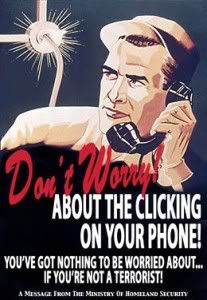
AT&T, the NSA and Mark Klein
Labels: ATT, domestic surveillance, Edward Snowden, Mark Klein, NSA, phone companies, whistleblowers
Submit To PropellerTweet
[Permalink] 0 comments
Labels: ATT, domestic surveillance, Edward Snowden, Mark Klein, NSA, phone companies, whistleblowers
Submit To PropellerNSA whistleblower William Binney was interviewed by internet journalist Geoff Shively at the HOPE Number 9 hackers conference in New York on Friday.
Binney, who resigned from the NSA in 2001 over its domestic surveillance program, had just delivered a keynote speech in which he revealed what Shively called “evidence which we have not seen until this point.”
“They’re pulling together all the data about virtually every U.S. citizen in the country … and assembling that information,” Binney explained. “So government is accumulating that kind of information about every individual person and it’s a very dangerous process.” He estimated that something like 1.6 billion logs have been processed since 2001.
Labels: Cryptogon, domestic surveillance, facial recognition, National Security State, NSA, social control, social engineering, surveillance society, warrantless domestic wiretapping, William Binney
Submit To PropellerUnder construction by contractors with top-secret clearances, the blandly named Utah Data Center is being built for the National Security Agency. A project of immense secrecy, it is the final piece in a complex puzzle assembled over the past decade. Its purpose: to intercept, decipher, analyze, and store vast swaths of the world’s communications as they zap down from satellites and zip through the underground and undersea cables of international, foreign, and domestic networks. The heavily fortified $2 billion center should be up and running in September 2013. Flowing through its servers and routers and stored in near-bottomless databases will be all forms of communication, including the complete contents of private emails, cell phone calls, and Google searches, as well as all sorts of personal data trails—parking receipts, travel itineraries, bookstore purchases, and other digital “pocket litter.” It is, in some measure, the realization of the “total information awareness” program created during the first term of the Bush administration—an effort that was killed by Congress in 2003 after it caused an outcry over its potential for invading Americans’ privacy.
But “this is more than just a data center,” says one senior intelligence official who until recently was involved with the program. The mammoth Bluffdale center will have another important and far more secret role that until now has gone unrevealed. It is also critical, he says, for breaking codes. And code-breaking is crucial, because much of the data that the center will handle—financial information, stock transactions, business deals, foreign military and diplomatic secrets, legal documents, confidential personal communications—will be heavily encrypted. According to another top official also involved with the program, the NSA made an enormous breakthrough several years ago in its ability to cryptanalyze, or break, unfathomably complex encryption systems employed by not only governments around the world but also many average computer users in the US. The upshot, according to this official: “Everybody’s a target; everybody with communication is a target.”
Labels: Bluffdale Utah, domestic surveillance, James Bamford, National Security State, NSA, privacy, Russia Today, Thom Hartmann, Total Information Awareness, Utah Data Center
Submit To Propeller[I]ssuing subpoenas to journalists to force them to reveal their sources is now obsolete — unnecessary — because the U.S. Government’s Surveillance State is so vast, so comprehensive, that it already knows who is talking to whom. It now subpoenas and harasses reporters simply to force them to confirm in court what they have already learned through surveillance, but the limitless Surveillance State it has created has rendered undetected whistleblowing — or undetected anything — virtually impossible.
[...]
[I]t’s just as necessary for a government to shield its own actions from any transparency and scrutiny as it is to know everything which citizens are doing and saying. That’s the one-way mirror which all authoritarian regimes attempt to construct: those in power know everything about the conduct of those who are ruled, while those who are ruled know nothing about the conduct of those in power. That’s what keeps the power dynamic so imbalanced in one direction. But this unprecedented attack on whistleblowers, as obviously significant as it is, also enjoys full bipartisan support (as well as the indifference of a supremely passive media), and so it, too, will be completely ignored by the grand Election-Year clash of America’s two great and oh-so-fundamentally-different political parties.
Even for those issues that are actually significant and receive election-year attention — such as, say, America’s oligarchy and the economic policies that sustain it — the differences are largely symbolic, just substantive enough to keep tribal loyalties high and to maintain the illusion of real choices (watch how often Obama supporters defend him from GOP attacks not by rejecting their premises but by insisting that he’s adopting conservative policies). The differences which are genuinely stark — Supreme Court choices, reproductive rights, marriage equality — are relegated to mere sideshows, exploited as tactics for maintaining acute cultural divisions and keeping certain base factions loyal, invested, and energized.
Labels: 2012 election, Barack Obama, domestic surveillance, Glenn Greenwald, National Security State, news media, NSA, oligarchy, two-party system, whistleblowers
Submit To Propeller[F]or anyone who defends the Obama administration ... and insists that the U.S. Government simply must have access to all forms of human communication: does that also apply to in-person communication? Should home and apartment builders be required to install monitors in every room they build to ensure that the Government can surveil all human communications in order to prevent threats to national security and public safety? I believe someone once wrote a book about where this mindset inevitably leads. The very idea that no human communication should ever be allowed to take place beyond the reach of the Government is definitive authoritarianism, which is why Saudi Arabia and the UAE — and their American patron-ally — have so vigorously embraced it.
Labels: authoritarianism, domestic surveillance, FBI, George Orwell, Glenn Greenwald, internet, National Security State, Obama administration
Submit To PropellerAs it heads toward a House vote, critics say the Cyber Intelligence Sharing and Protection Act (CISPA) would allow private internet companies like Google, Facebook and Microsoft to hand over troves of confidential customer records and communications to the National Security Agency, FBI and Department of Homeland Security, effectively legalizing a secret domestic surveillance program already run by the NSA. Backers say the measure is needed to help private firms crackdown on foreign entities — including the Chinese and Russian governments — committing online economic espionage. The bill has faced widespread opposition from online privacy advocates and even the Obama administration, which has threatened a veto. "CISPA … will create an exception to all existing privacy laws so that companies can share very sensitive and personal information directly with the government, including military agencies like the National Security Agency," says Michelle Richardson, legislative counsel for the American Civil Liberties Union. "Once the government has it, they can repurpose it and use it for a number of things, including an undefined national security use."
Computer security researcher Jacob Appelbaum argues the measures included in the proposed Cyber Intelligence Sharing and Protection Act (CISPA) would essentially legalize military surveillance of U.S. citizens. "When they want to dramatically expand their ability to do these things in a so-called legal manner, it’s important to note what they’re trying to do is to legalize what they have already been doing," Appelbaum says. He is a developer and advocate for the Tor Project, a network enabling its users to communicate anonymously on the internet, and has volunteered with WikiLeaks.
Labels: ACLU, ACTA, CISPA, domestic military surveillance, domestic surveillance, FBI, Homeland Security, Jacob Appelbaum, Michelle Richardson, NSA, PIPA, privacy, PTB, SOPA
Submit To PropellerWe love to tell ourselves that there is a robust freedom and a thriving free political press in the U.S. because you’re allowed to have an MSNBC show or blog in order to proclaim every day how awesome and magnanimous the President of the United States is and how terrible his GOP political adversaries are — cutting and edgy! — or to go on Fox News and do the opposite. But people who are engaged in actual dissent, outside the tiny and narrow permissible boundaries of pom-pom waving for one of the two political parties — those who are focused on the truly significant acts which the government and its owners are doing in secret — are subjected to this type of intimidation, threats, surveillance, and climate of fear, all without a whiff of illegal conduct (as even The New York Times‘ most celebrated investigative reporter, James Risen, will tell you).
Whether a country is actually free is determined not by how well-rewarded its convention-affirming media elites are and how ignored its passive citizens are but by how it treats its dissidents, those posing authentic challenges to what the government does. The stories of the three Democracy Now guests — and so many others — provide that answer loudly and clearly.
[...]
Two Democratic Senators — Ron Wyden of Oregon and Mark Udall of Colorado — have spent two full years warning that the Obama administration is “interpreting” its spying powers under the Patriot Act in ways so “twisted” and broad that it would shock the American public if it learned of what was being done, and have even been accusing the DOJ and Attorney General Holder of actively misleading the public in material ways about its spying powers.
Labels: Democracy Now, domestic surveillance, Glenn Greenwald, Mark Udall, National Security State, Patriot Act, Ron Wyden, William Binney
Submit To PropellerNational Security Agency Whistleblower William Binney on Growing State Surveillance
In his first television interview since he resigned from the National Security Agency over its domestic surveillance program, William Binney discusses the NSA’s massive power to spy on Americans and why the FBI raided his home after he became a whistleblower.
Binney was a key source for investigative journalist James Bamford’s recent exposé in Wired Magazine about how the NSA is quietly building the largest spy center in the country in Bluffdale, Utah. The Utah spy center will contain near-bottomless databases to store all forms of communication collected by the agency, including private emails, cell phone calls, Google searches and other personal data.
Labels: Bluffdale Utah, Democracy Now, domestic surveillance, Information Clearing House, James Bamford, National Security State, NSA, William Binney, Wired
Submit To PropellerPolice employ Predator drone spy planes on home front
For those dismissing concerns about drones by claiming (falsely) that they are the equivalent of police helicopters, won’t those same people dismiss concerns over weaponized drones by arguing: there’s no difference between allowing the police to Taser you or shoot you themselves and allowing them to do that by drone? This is always how creeping police state powers are entrenched: one step at a time. For those who are perfectly content with having stealth, hovering drones over U.S. soil for sustained surveillance purposes — based on the reasoning that the police can already engage in surveillance so why not let them do it more efficiently? — what possible objections will there be to having the police use weaponized drones? After all, the police can already Taser, pepper spray and shoot people: why not let them do it with drones?
[...]
The fact is that drones vest vast new powers that police helicopters and existing weapons do not vest: and that’s true not just for weaponization but for surveillance. Drones enable a Surveillance State unlike anything we’ve seen. Because small drones are so much cheaper than police helicopters, many more of them can be deployed at once, ensuring far greater surveillance over a much larger area. Their small size and stealth capability means they can hover without any detection, and they can remain in the air for far longer than police helicopters. Their hovering capability also means they can surveil a single spot for much longer than military satellites, which move with the earth’s rotation... .
[...]
It’s beyond obvious that policy planners and law enforcement officials expect serious social unrest. Why wouldn’t they: when has sustained, severe economic suffering and anxiety of the sort we are now seeing — along with pervasive, deep anger at the political class and its institutions — not produced that type of unrest? Drones are the ultimate tool for invasive, sustained surveillance and control, and one would have to be historically ignorant and pathologically naive not to understand its capacity for abuse.
[...]
No matter one’s views, the escalating addition of drones — weaponized or even just surveillance — to the vast arsenal of domestic weapons that already exist is a serious, consequential development. The fact that it has happened with almost no debate and no real legal authorization is itself highly significant. One thing is for certain: this is a development that is going to continue and increase rapidly. It needs far more attention than it has thus far received.
Labels: civilian law enforcement, domestic drones, domestic surveillance, Glenn Greenwald, militarization, National Security State
Submit To PropellerNPR’s domestic drone commercial
[...]Even leaving aside the issue of weaponization (police officials now openly talk about equipping drones with “nonlethal weapons such as Tasers or a bean-bag gun”), the use of drones for domestic surveillance raises all sorts of extremely serious privacy concerns and other issues of potential abuse. Their ability to hover in the air undetected for long periods of time along with their comparatively cheap cost enables a type of broad, sustained societal surveillance that is now impractical, while equipping them with infra-red or heat-seeking detectors and high-powered cameras can provide extremely invasive imagery. The holes eaten into the Fourth Amendment’s search and seizure protections by the Drug War and the War on Terror means there are few Constitutional limits on how this technology can be used, and there are no real statutory or regulatory restrictions limiting their use. In sum, the potential for abuse is vast, the escalation in surveillance they ensure is substantial, and the effect they have on the culture of personal privacy — having the state employ hovering, high-tech, stealth video cameras that invade homes and other private spaces — is simply creepy.
But listeners of NPR would know about virtually none of that. On its All Things Considered program yesterday, NPR broadcast a five-minute report (audio below) from Brian Naylor that purported to be a news story on the domestic use of drones but was, in fact, much more akin to a commercial for the drone industry.
Labels: domestic surveillance, Glenn Greenwald, military drones, news, NPR, propaganda, spin
Submit To PropellerHundreds of state, local and federal databases clog our nation's digital infrastructure, collecting, sharing and hoarding inconceivable amounts of information about ordinary people. From DHS to the DOJ to the DOE, from the state and local police all the way up to the military and CIA, our government is increasingly relying on a data-driven model of social control. Below is only a tiny sampling of the many hundreds of government databases containing personally identifiable information about hundreds of millions of people. Many of these databases are exempt from the Privacy Act. Some of them remain so secret we don't know all of the kinds of data kept and shared, or how many records they contain. For more information about data collection and sharing, visit www.privacySOS.org/data.

Labels: CIA, DHS, DOE, DOJ, domestic surveillance, National Security State, privacy, Privacy Act, surveillance society
Submit To PropellerThe recent dramatic expansion of intelligence collection at the federal, state and local level raises profound civil liberties concerns regarding freedoms and protections we have long taken for granted. If people generally appear unaware of "change in the air," a large part of the reason is the unparalleled resort to secrecy used by the government to keep its actions from public scrutiny. According to the new American Civil Liberties Union (ACLU) report, "Drastic Measures Required," under President Obama (who had vowed to create "an unprecedented level of openness in Government" when he first took office), there were no fewer than 76,795,945 decisions made to classify information in 2010 - eight times the number made in 2001.
There are layers of secrecy that cannot even be penetrated by most members of Congress. In the recent debate over the re-authorization of three sections of the USA Patriot Act with sunset provisions, Sen. Ron Wyden (D-Oregon), who is a member of the Joint Intelligence Committee, declared in the Senate in May 2011 that there was a secret interpretation of Patriot Act powers that he could not even tell them about without disclosing classified information. [2] "When the American people find out how their government has secretly interpreted the Patriot Act, they will be stunned and they will be angry," said Wyden. The determination of the Obama administration to imitate its predecessor and maintain a wall of secrecy around anything that could be connected (however tenuously) with "national security" is evident in the zeal with which it has pursued whistleblowers and its use of the state secrets privilege in judicial proceedings, including in the recent court challenge to the FBI use of the informant Craig Monteilh to spy on mosques in Orange County, California.
During a decade of relentless fearmongering about the terrorist threat, most Americans appear to have accommodated themselves to the visible signs of change without questioning their broad implications. If searches on the subway, body scans at the airport and a Special Operations military drill targeting a Boston neighborhood are presented as necessary to keep the nation safe, they are for them.
But what would they make of the largely invisible architecture of surveillance that treats everyone as a potential suspect? Anyone who has a bank account and makes a financial transaction, or uses a phone or a computer to send emails or browse web sites, or visits a library, books a rental car, or purchases a airline ticket is within the surveillance net.
Labels: ACLU, Civil liberties, classified information, domestic surveillance, fear-mongering, Joint Intelligence Committee, National Security State, Obama administration, Patriot Act, Ron Wyden
Submit To Propeller
Amidst the inevitable 9-11 retrospectives, I feel like only the Los Angeles Times is putting the past ten years in the proper perspective. Because the longest-lasting legacy of the 9-11 attacks is clearly the terror industry it spawned. Over the weekend the LAT looked at the hundreds of billions of dollars being spent on absurd “security” projects, filling the pockets of contractors, and for little benefit:
“The number of people worldwide who are killed by Muslim-type terrorists, Al Qaeda wannabes, is maybe a few hundred outside of war zones. It’s basically the same number of people who die drowning in the bathtub each year,” said John Mueller, an Ohio State University professor who has written extensively about the balance between threat and expenditures in fighting terrorism.
Today’s entry from the LAT is even better, and something I feel we pay too little attention to. In the decade since 9-11, this has become a surveillance state, and the government collects enormous amounts of data on every man, woman and child in America, in all likelihood too much to process. We all know about this, but it’s important to see all that surveillance together in one package:
…the secret domestic intelligence gathering [...] is one of the most significant legacies of Sept. 11. U.S. law enforcement and intelligence agencies now collect, store and analyze vast quantities of digital data produced by law-abiding Americans. The data mining receives limited congressional oversight, rare judicial review and almost no public scrutiny.
Thanks to new laws and technologies, authorities track and eavesdrop on Americans as they never could before, hauling in billions of bank records, travel receipts and other information. In several cases, they have wiretapped conversations between lawyers and defendants, challenging the legal principle that attorney-client communication is inviolate.
We had one moment where this was subject to any debate at all, during the fight over the FISA amnesty legislation. But that was really about a small portion of the total data collection. Most of the surveillance remains a secret. Ron Wyden and Mark Udall tried to tease out a little more this summer, when they tried to get the intelligence community to admit to how they were misinterpreting the Patriot Act to allow for more data collection. But that never went anywhere. From NSA surveillance to national security letters to the AT&T room on Folsom Street in San Francisco, what bits and pieces we do know about point to a giant network Hoovering up every piece of information you let out into the world digitally.
I appreciate the LA Times highlighting this legacy. Nobody really questions why we’ve deprived American civil liberties to this degree, to protect the homeland from a threat that mirrors the threat posed by full bathtubs. Read the whole story for yourself. This has been an inexorable slide downward for ten years, and it shows no sign whatsoever of letting up.
Labels: ATT, domestic surveillance, Firedoglake, FISA, LA Times, NSA, Patriot Act, surveillance society, warrantless domestic wiretapping
Submit To Propeller[F]or anyone who is engaged in meaningful dissent from and challenge to government officials -- the Jim Risens and other real investigative reporters, the Thomas Drakes and other whistleblowers, the WikiLeaks supporters, the Midwest peace activists -- these prosecutions and these ever-expanding surveillance, detention and even assassination powers are inevitably intimidating. Regardless of how those powers are used or even whether they are, they will, as Risen put it, have "a chilling effect" on the exercise of core freedoms. As Risen explained in his Affidavit, even if Brian Ross' story turned out to be false, the mere claim by anonymous officials that the phone records of journalists are being monitored -- combined with threats of prison for their sources and even for reporters who are subpoenaed -- means "the Government further contributed to creating an atmosphere of fear for journalists who publish stories about national security and intelligence issues."The most odious aspect of this Climate of Fear is that it fundamentally changes how the citizenry thinks of itself and its relationship to the Government. A state can offer all the theoretical guarantees of freedom in the world, but those become meaningless if citizens are afraid to exercise them. In that climate, the Government need not even act to abridge rights; a fearful populace will voluntarily refrain on its own from exercising those rights.
Nobody wants to believe that they have been put in a state of fear, that they are intimidated, so rationalizations are often contrived: I don't perceive any violations of my rights because there's nothing I want to do that I'm not able to do. Inducing a fearful population to refrain from exercising rights -- as it convinces itself no such thing is happening -- is a far more effective, and far more pernicious, means of suppressing freedoms. That's what a Climate of Fear uniquely enables. The vast National Security and Surveillance State has for decades been compiling powers -- and eroding safeguards and checks -- devoted to the strengthening of this climate, and the past two-and-a-half years have seen as rapid and concerted intensification as any other period one can recall. Read Jim Risen's Affidavit if you doubt that.
Labels: activists, domestic surveillance, Glenn Greenwald, investigative journalism, James Risen, National Security State, NYT, Obama administration, U.S. Constitution, whistleblowers, Wikileaks
Submit To PropellerLabels: Andrew Breitbart, Anthony Weiner, Congress, Darwin Awards, domestic surveillance, FBI, NSA, scandals, sexual indiscretion
Submit To PropellerLabels: domestic surveillance, internet surveillance, Mark Fiore, National Security State, warrantless domestic wiretapping
Submit To PropellerU.S. Pushes to Ease Technical Obstacles to Wiretapping
Law enforcement and counterterrorism officials, citing lapses in compliance with surveillance orders, are pushing to overhaul a federal law that requires phone and broadband carriers to ensure that their networks can be wiretapped, federal officials say.
The officials say tougher legislation is needed because some telecommunications companies in recent years have begun new services and made system upgrades that create technical obstacles to surveillance. They want to increase legal incentives and penalties aimed at pushing carriers like Verizon, AT&T, and Comcast to ensure that any network changes will not disrupt their ability to conduct wiretaps.
Labels: domestic spying, domestic surveillance, National Security State, privacy, warrantless domestic wiretapping
Submit To PropellerLabels: 2010 election, Cenk Uygur, Democrats, detainee rights, domestic surveillance, Rahm Emanuel, state secrets privilege
Submit To PropellerNYC officials push for dramatic expansion of electronic surveillance
New York officials say they could stop attacks like the attempted Times Square car bomb by expanding a controversial surveillance system so sensitive that it will pick up even suspicious behavior.
New York is already a heavily policed city, with 35,000 officers and a counterterrorism bureau -- the first of its kind in the country -- partnering the FBI.
But Saturday's failed terrorist bomb in the Times Square tourist hot spot has provided the authorities with a new argument for expanding a sometimes controversial security blanket of cameras, sensors and analytical software.
Labels: car bomb, Civil liberties, domestic surveillance, New York City, surveillance society, terrorism, Times Square
Submit To PropellerObama gives Patriot Act another year with no privacy protections
If the Patriot Act hadn't been approved for another year, Sunday would have looked much different.Sunday could have meant the government was no longer given permission to wiretap the phones of Americans and seize their records and property.
But since the bill was approved by Congressional Democrats earlier this week and signed into law by President Obama on Saturday, this Sunday is just another Sunday for Americans living with the Patriot Act.
To be fair, many Democrats asked for additional protections for the privacy rights of American citizens.
But Republicans said that would detract from the ability of the country's intelligence agencies to track down terrorists. Lacking a 60-vote supermajority in the Senate to pass the bill with the extra provisions, Democrats left them out.
Democratic Rep. Jane Harman opposed the House's approval of the extension, citing abuses during the administration of President George W. Bush.
"While I strongly support using the most robust tools possible to go after terrorists, Congress must revise and narrow -- not extend -- Bush era policies," Harman said.
Glenn Greenwald of Salon.com had the following to say of the overwhelming support of the law's extension:
One of the strangest prongs of conventional Beltway wisdom is the lament that there is not enough bipartisanship. The opposite is true: many of the most damaging acts inflicted on the country by Washington are enacted on a fully bipartisan basis -- the most destructive political act of this generation, the invasion of Iraq, was fully bipartisan, as were most of the post-9/11 civil liberties abuses and other Bush-era initiatives-- and, at least in certain areas, the harmonious joining together of Republicans and Democrats continues unabated.
Labels: 4th Amendment, bipartisanship, domestic surveillance, Glenn Greenwald, Jane Harman, Patriot Act, privacy, U.S. Constitution
Submit To Propeller