Blog Flux Directory Subscribe in NewsGator Online Subscribe with Bloglines http://www.wikio.com Blog directory
And, yes, I DO take it personally
Mandy: Great blog!
Mark: Thanks to all the contributors on this blog. When I want to get information on the events that really matter, I come here.
Penny: I'm glad I found your blog (from a comment on Think Progress), it's comprehensive and very insightful.
Eric: Nice site....I enjoyed it and will be back.
nora kelly: I enjoy your site. Keep it up! I particularly like your insights on Latin America.
Alison: Loquacious as ever with a touch of elegance -- & right on target as usual!
"Everybody's worried about stopping terrorism. Well, there's a really easy way: stop participating in it."
- Noam Chomsky
Send tips and other comments to: profmarcus2010@yahoo.com

And, yes, I DO take it personally

Sunday, January 29, 2012

Whining U.S. banks make me physically ill

great gobs of steaming bullshit... the banks are one of the prime culprits in why the world economy is in the mess it is in right now and, despite the trillions of dollars that the u.s. and the eu have tossed their way, have continued to reward themselves without any regard for the general welfare of the people they were chartered to serve... now, they're saying if they don't get their way, it will only delay any recovery... they can all go directly to hell...
Banks warn rule change will hurt recovery

US banks fear that any recovery in the US housing market will be further delayed as a result of moves to remove credit ratings from American regulations, which will boost banks’ capital requirements by billions of dollars.

Bankers have until Friday to respond to a proposal by the Federal Reserve and other regulators that would increase the “risk weights” on securitised assets, driving up sharply the equity capital that banks are forced to set against them.

screw 'em... they haven't done anything for anybody but themselves...

Labels: , , , , , , ,

Submit To Propeller


[Permalink] 0 comments

Wednesday, November 03, 2010

Oh, yay...! Just keep printin' that worthless goddam paper...

keep on tryin' to keep the good ol' u.s. of a. from getting sucked down the financial failure toilet bowl...
The Fed said it would buy an additional $600 billion in long-term Treasury securities by the end of June 2011, somewhat more than the $300 billion to $500 billion that many in the markets had expected.

The central bank said it would also continue its program, announced in August, of reinvesting proceeds from its mortgage-related holdings to buy Treasury debt. The Fed now expects to reinvest $250 billion to $300 billion under that program by the end of June, making the total asset purchases in the range of $850 billion to $900 billion.

wtf is goin' on here...? let's let the goddam thing crash already...!

Labels: , , , , , ,

Submit To Propeller


[Permalink] 0 comments

Sunday, June 27, 2010

Joe Bageant's back, alive and well on "Planet Norte" (Winchester, Virginia)

i was starting to get a little concerned... his last post was on 11 may... however, as of today, he's back in the u.s. and dealing with all the troubling dynamics that implies...
The uniformity on Planet Norte is striking. Each person is a unit, installed in life support boxes in the suburbs and cities; all are fed, clothed by the same closed-loop corporate industrial system. Everywhere you look, inhabitants are plugged in at the brainstem to screens downloading their state approved daily consciousness updates. iPods, Blackberries, notebook computers, monitors in cubicles, and the ubiquitous TV screens in lobbies, bars, waiting rooms, even in taxicabs, mentally knead the public brain and condition its reactions to non-Americaness. Which may be defined as anything that does not come from of Washington, DC, Microsoft or Wal-Mart.

For such a big country, the "American experience" is extremely narrow and provincial, leaving its people with approximately the same comprehension of the outside world as an oyster bed. Yet there is that relentless busyness of Nortenians. That sort of constant movement that indicates all parties are busy-busy-busy, but offers no clue as to just what they are busy at.

We can be sure however, that it has to do with consuming. Everything in America has to do with consuming. So much so that we find not the slightest embarrassment in calling ourselves "the consumer society." Which is probably just as well, since calling ourselves something such as "the just society" might have been aiming a bit too high? Especially for a nation that never did find enough popular support to pass any of the 200 anti-lynching bills brought before its Congress (even Franklin Roosevelt refused to back them).

On the other hand, there is no disputing that we do reduce all things to consumption. Or acquiring money for consumption. Or paying on the debt for past consumption. It keeps things simple, and stamps them as authentically American.

For example, now faced with what may be the biggest ecological disaster in human history, I'm hearing average Americans up here talk of the Gulf oil "spill" (when they speak of it at all -- TV gives the illusion those outside the Gulf region give a shit), in terms of its effect on: (A) the price of seafood; and (B) jobs in tourism and fishing. Only trolls stunted by generations of inbred American style capitalism could do such a thing: reduce a massive ocean dead zone to the cost of a shrimp cocktail or a car payment.

Meanwhile, even as capitalism shows every sign of collapsing upon them under the weight of its sheer non-sustainability, Norteamericanos wait like patient, not-too-bright children for its "recovery." Recovery, of course, is that time when they can once again run through the malls and outlet stores, the car lots and the fried chicken palaces eating, grabbing and consuming. No doubt, something resembling a recovery will be staged for their benefit, thereby goosing their pocketbooks at least one more time before the rest of the world forecloses on the country.

sigh...

i totally relate to joe's return to the united states of north america... every time i return from extended periods out of the country, the "american experience" smacks me upside the head once again... it's very much the same as joe describes and it usually takes me at least 1-2 weeks to decompress/re-compress...

Labels: , , , , , , , ,

Submit To Propeller


[Permalink] 0 comments

Tuesday, April 13, 2010

Joe is running in the red every month

from zero hedge, a guest post by graham summers...
It’s Impossible to “Get By” In the US

While the market cheers on the fantastic job “growth” of March 2010, the more astute of us are concerned with a growing tide of personal bankruptcies. March 2010 saw 158,000 bankruptcy filings. David Rosenberg of Gluskin-Sheff notes that this is an astounding 6,900 filings per day.

but wait, there's more...
In 2008, the median US household income was $50,300. Assuming that the person filing is the “head of household” and has two children (dependents), this means a 1040 tax bill of $4,100, which leaves about $45K in income after taxes (we’re not bothering with state taxes). I realize this is a simplistic calculation, but it’s a decent proxy for income in the US in 2008.

Now, $45K in income spread out over 26 pay periods (every two weeks), means a bi-weekly paycheck of $1,730 and monthly income of $3,460. This is the money “Joe America” and his family to live off of in 2008.

Now, in 2008, the median home value was roughly $225K. Assuming our “median” household put down 20% on their home (unlikely, but it used to be considered the norm), this means a $180K mortgage. Using a 5.5% fixed rate 30-year mortgage, this means Joe America’s 2008 monthly mortgage payments were roughly $1,022.

So, right off the bat, Joe’s monthly income is cut to $2,438.

According to the US Department of Agriculture, the average 2008 monthly food bill for a family of four ranged from $512-$986 depending on how “liberal” you are with your purchases. For simplicity’s sake we’ll take the mid-point of this range ($750) as a monthly food bill.

This brings Joe’s monthly income to $1,688.

Now, Joe needs light, energy, heat, and air conditioning to run his home. According to the Energy Information Administration, the average US household used about 920 kilowatt-hours per month in 2008. At a national average price of 11 cents per kilowatt-hour this comes to a monthly electrical bill of $101.20.

Joe’s now down to $1,587.
Now Joe needs to drive to work to make a living. Similarly, he needs to be able to drive to the grocery store, doctor, etc. According to AAA, the average cost per mile of driving a minivan (Joe’s a family man) in 2008 was 57 cents per mile. This cost is based on average fuel consumption, tires, maintenance, insurance, license and registration, and average loan finance charges.

Multiply this cost by 15,000 miles per year and you’ve got an annual driving bill of $8,550. Divide this into months (by 12) and you’ve got a monthly driving bill of $712.

Joe’s now down to $877 (I’m also assuming Joe’s family only has ONE car). Indeed, if Joe’s family has two cars (one minivan and one sedan) he’s already run out of money for the month.

Now, assuming Joe’s family is one of the lucky ones (depending on your perspective) they’ve got medical insurance. Trying to find an average monthly medical insurance premium for a family in the US is extremely difficult because insurance plans have a wide range in deductibles, premiums, and co-pays. But according to eHealth Insurance, the average monthly premium for family policies in February 2008 was $369.

So if Joe has medical insurance on his family, he’s now down to $508. Throw in cell phone bills, cable TV and Internet bills, and the like, and he’s maybe got $100-200 discretionary income left at the end of the month.

and here's the kicker...
If Joe:

1) Overpaid on his house
2) Didn’t have a full 20% down payment
3) Owns two cars
4) Eats at restaurants
5) Splurges on heating & A/C bills
6) Has any medical expenses aside from monthly premiums…

… he is running into the red EVERY month.

[...]

This is why there simply cannot be a sustainable recovery in the US economy. Because we outsourced our jobs, incomes fell. Because incomes fell and savers were punished (thanks to abysmal returns on savings rates) we pulled future demand forward by splurging on credit. Because we splurged on credit, prices in every asset under the sun rose in value. Because prices rose while incomes fell, we had to use more credit to cover our costs, which in turn meant taking on more debt (a net drag on incomes).

And on and on.

Does this mean the market is about to tank? Not necessarily, stocks have been disconnected from reality since November if not July. Bubbles (and we ARE in a bubble) take time to pop and this time around will be no different.

ya gotta love the "recovery"...

(thanks to kevin at cryptogon...)

Labels: , , , , ,

Submit To Propeller


[Permalink] 0 comments

Friday, April 09, 2010

The NYT's Floyd Norris is stunned that people are still pessimistic about the "recovery"

i don't know what alternate universe floyd norris lives in... he seems to think that those of us who think the economy still sucks are misguided...
The American economy appears to be in a cyclical recovery that is gaining strength. Firms have begun to hire and consumer spending seems to be accelerating.

That is what usually happens after particularly sharp recessions, so it is surprising that many commentators, whether economists or politicians, seem to doubt that such a thing could possibly be happening.

Usually you can depend on the White House to view the economy with the most rose-tinted glasses available. But it was not until last week, after a strong employment report, that President Obama started to sound a little optimistic.

“The tough measures that we took — measures that were necessary even though sometimes they were unpopular — have broken this slide and are helping us to climb out of this recession,” he said in a speech at a factory making battery components in North Carolina.

Note, however, that he seemed to believe the country remained in recession. It is virtually certain that is not accurate, as least as will be determined by the arbiters of recession at the National Bureau of Economic Research. “The recession is over,” one of those arbiters, Jeffrey Frankel of Harvard, wrote this week.

But the White House is unwilling to make that claim.

Why is good news being received with such doubt? Why is “new normal” the currently popular economic phrase, signifying that growth will be subpar for an extended period, and that the old normal is no longer something to be expected?

floyd norris is a tool...

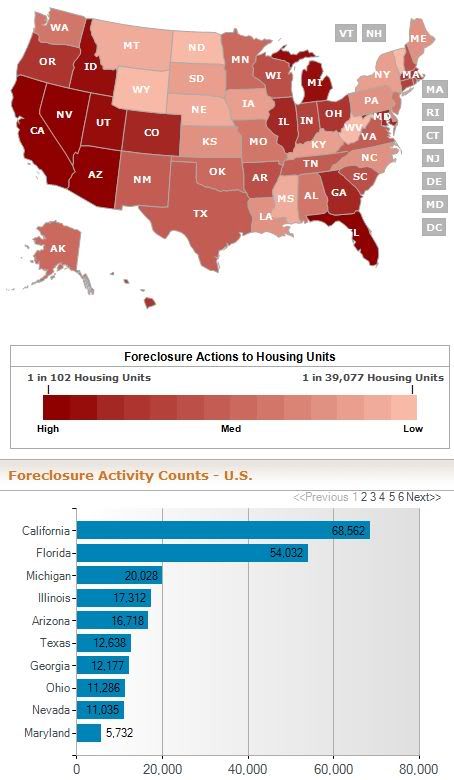
meanwhile, one in every 418 housing units (for a total of 2,082,945) in the u.s. received a foreclosure notice in the month of february 2010...


Photobucket

and over a QUADRILLION dollars worth of toxic derivatives remain off the books...
Today five US banks according to data in the just-released Federal Office of Comptroller of the Currency’s Quarterly Report on Bank Trading and Derivatives Activity, hold 96% of all US bank derivatives positions in terms of nominal values, and an eye-popping 81% of the total net credit risk exposure in event of default.

The five are, in declining order of importance: JPMorgan Chase which holds a staggering $88 trillion in derivatives (€66 trillion!). Morgan Chase is followed by Bank of America with $38 trillion in derivatives, and Citibank with $32 trillion. Number four in the derivatives sweepstakes is Goldman Sachs with a ‘mere’ $30 trillion in derivatives. Number five, the merged Wells Fargo-Wachovia Bank, drops dramatically in size to $5 trillion. Number six, Britain’s HSBC Bank USA has $3.7 trillion.

if and when those derivatives are declared and posted at their market value, the economic house of cards could and should collapse entirely...

Labels: , , , , , , , , ,

Submit To Propeller


[Permalink] 0 comments

Wednesday, March 24, 2010

The "recovery" marches on

to a new record low...
Sales of newly built U.S. single-family homes fell for a fourth straight month to a record low in February, a government report showed on Wednesday, heightening fears of renewed weakness in the housing market.

The Commerce Department said sales fell 2.2 percent to a 308,000 unit annual rate from an upwardly revised 315,000 units in January.

Analysts polled by Reuters had expected new home sales to edge up to a 320,000 unit annual pace from January's previously reported 309,000 units.

The data came on the heels of report on Tuesday showing existing home sales fell for a third straight month in February and a jump in the supply of houses on the market.

[...]

Sales have barely responded to the extension and expansion of a popular tax credit, which boosted purchases in the second half of 2009, raising concerns over the fragile housing market's recovery just as a key pillar of support is being dismantled.

The Federal Reserve will end purchases of mortgage-related securities next week, which had lowered the cost of home loans to record lows.

just wait 'til commercial real estate collapses...

Labels: , , , , ,

Submit To Propeller


[Permalink] 0 comments

Wednesday, February 17, 2010

2.4M forclosures predicted for 2010, up from 2.1M in 2009

feelin' that sweet, sweet "recovery" yet...? funny... neither am i...
BofA holds about 1 million mortgages that are at least 60 days delinquent. About 4 million homeowners nationwide are 90 days or more delinquent on their mortgages or in foreclosure proceedings, according to Moody's Economy.com, which analyzes data from credit reporting company Equifax Inc.

Trial modifications and other delays have kept many of those mortgages out of foreclosure, but by the end of this year, 2.4 million borrowers are expected to lose their homes, said Celia Chen, a housing economist at Economy.com.

That would be up from 2.1 million foreclosures and short sales last year and five times the annual numbers earlier in the decade.

It's unclear when those distressed properties would hit the market, but their large numbers are likely to push home prices back down this year, to a bottom in the fourth quarter, Chen said. And that would make things worse for the 25% of homeowners who already owe more on their mortgages than their houses are worth.

The biggest blows will be felt in California, Florida, Nevada and other states where home prices have dropped the most and the ranks of struggling homeowners have swelled.

As of December, 11.4% of California homeowners were 90 days or more late on their loans, according to First American CoreLogic, a Santa Ana real estate data firm. That compares with a delinquency rate of 8.4% nationwide.

so, if more homeowners, folks like my son and his wife, are forced even deeper underwater than they already are, dontcha think that's going to drive even more foreclosures... if you thought people were walkin' away now, just wait...

Labels: , , , ,

Submit To Propeller


[Permalink] 0 comments

Tuesday, February 02, 2010

The economic "recovery" continues...? Ya, right...!

if you belong to the super-rich elites, maybe... for the rest of us...
Study: Hunger in America jumps unprecedented 46 percent

70 percent of emergency food centers face threats to their survival

If there is any indicator of the toll that the Great Recession has taken on the public, it would be the statistics beginning to emerge about hunger in the US.

According to a study from the nation's largest food bank operator, the number of Americans in need of food aid has jumped 46 percent in three years, including a 50 percent jump in the number of children needing food assistance, and a 64 percent increase in hunger in senior citizens' homes.

The study, Hunger in America 2010, found that 37 million people, or roughly one in eight US residents, received food aid in 2009. That's a 46 percent jump from a similar survey carried out in 2006.

how 'BOUT that recovery...?

Labels: , , ,

Submit To Propeller


[Permalink] 0 comments

Sunday, November 29, 2009

The "recovery"...? HA...!! How about 36M folks on food stamps...

seeing light at the end of the tunnel...? me neither... guess it's probably because i'm not a member of the super-rich elite...

food stamps...

With food stamp use at record highs and climbing every month, a program once scorned as a failed welfare scheme now helps feed one in eight Americans and one in four children.

It has grown so rapidly in places so diverse that it is becoming nearly as ordinary as the groceries it buys. More than 36 million people use inconspicuous plastic cards for staples like milk, bread and cheese, swiping them at counters in blighted cities and in suburbs pocked with foreclosure signs.

Virtually all have incomes near or below the federal poverty line, but their eclectic ranks testify to the range of people struggling with basic needs. They include single mothers and married couples, the newly jobless and the chronically poor, longtime recipients of welfare checks and workers whose reduced hours or slender wages leave pantries bare.

[...]

From the ailing resorts of the Florida Keys to Alaskan villages along the Bering Sea, the program is now expanding at a pace of about 20,000 people a day.

There are 239 counties in the United States where at least a quarter of the population receives food stamps, according to an analysis of local data collected by The New York Times.

foreclosures...
The Obama administration on Monday plans to announce a campaign to pressure mortgage companies to reduce payments for many more troubled homeowners, as evidence mounts that a $75 billion taxpayer-financed effort aimed at stemming foreclosures is foundering.

“The banks are not doing a good enough job,” Michael S. Barr, Treasury’s assistant secretary for financial institutions, said in an interview Friday. “Some of the firms ought to be embarrassed, and they will be.”

Even as lenders have in recent months accelerated the pace at which they are reducing mortgage payments for borrowers, a vast majority of loans modified through the program remain in a trial stage lasting up to five months, and only a tiny fraction have been made permanent.

meanwhile, as citizen anger at the incredible amount of our money being thrown at those who already have way too much of it continues to grow, the likes of the fed's bernanke simply can't stop defending the very system that precipitated this hellish mess...
In a column published on The Washington Post’s Web site and scheduled to appear on the op-ed page on Sunday, the chairman, Ben S. Bernanke, sharply criticized a Senate provision that he said “would strip the Fed of all its bank regulatory powers” and a House provision to repeal a 30-year-old law “to protect monetary policy from short-term political influence.”

The Federal Reserve’s jurisdiction to regulate banks has come under increasing attack in Congress in recent months, reflecting the anger of voters at the huge taxpayer costs of the bailout of Wall Street.

Mr. Bernanke repeated, as he has many times before, that while some of the measures in response to the financial crisis were “distasteful and unfair,” they were necessary.

ol' ben is such an obvious tool... admitting that things are "distasteful and unfair" but still "necessary" is akin to the old parental adage - "this is going to hurt me more than it hurts you" - while strapping the hapless kid with the business end of a belt...

Labels: , , , , , , , , , ,

Submit To Propeller


[Permalink] 0 comments

Sunday, November 08, 2009

What a load of shit - "Despite the apparent end of the Great Recession" [UPDATE]

[BUMPED]

if it's all the same to you, nyt, i'd like to know just who the F-U-C-K this "Great Recession" has "apparently ended" FOR...?
The American unemployment rate surged to 10.2 percent in October, its highest level in 26 years, as the economy lost another 190,000 jobs, the Labor Department reported Friday.

The jump into the realm of double-digit joblessness — from 9.8 percent in September — provided a sobering reminder that, despite the apparent end of the Great Recession, economic expansion has yet to translate into jobs, leaving tens of millions of people still struggling.

it ain't over for you, it ain't over for me, and it sure as SHIT ain't over for those poor bastards desperate for work and not finding it...

[UPDATE]

oh, yeah, let's hear it for 17.5%... what a cool number...! much more mind-blowing than 10.2%, wouldn't you agree...?
For all the pain caused by the Great Recession, the job market still was not in as bad shape as it had been during the depths of the early 1980s recession — until now.

With the release of the jobs report on Friday, the broadest measure of unemployment and underemployment tracked by the Labor Department has reached its highest level in decades. If statistics went back so far, the measure would almost certainly be at its highest level since the Great Depression.

In all, more than one out of every six workers — 17.5 percent — were unemployed or underemployed in October. The previous recorded high was 17.1 percent, in December 1982.

kee-f'ing-rist... so much for that vaunted "recovery"...

Labels: , , ,

Submit To Propeller


[Permalink] 0 comments

Friday, October 02, 2009

More evidence that the economic "recovery" ain't a recovery at all for us average Joes

ya feelin' better about the economy yet...? me neither...
The unemployment rate rose to 9.8 percent in September, the highest since June 1983, as employers cut far more jobs than expected. The report is evidence that the worst recession since the 1930s is still inflicting widespread pain.

Persistently high unemployment could weaken the recovery as consumers, concerned about their jobs and incomes, restrain spending. Consumer spending accounts for about 70 percent of the nation's economy.

and as numerous writers on the economy far wiser than i have pointed out, that 9.8% figure is deliberately and artificially low given the way it's calculated to make a thoroughly dismal report less gagging than it really is...

Labels: , , ,

Submit To Propeller


[Permalink] 0 comments

Monday, August 03, 2009

When stocks rise on Wall Street, how does that benefit the average schmoe struggling with unemployment?

it doesn't...
Wall St rises on resources, banks, data

U.S. stocks extended gains on Monday, pushing major indexes up 1 percent as investors snapped up shares of natural resource companies and banks after fresh data pointed to signs of economic stabilization.

before we look at unemployment, let's look at what's happening with rental and homeowner vacancy rates...
In Kansas City, rental vacancy rates rose from 11.9% to 15% over the past year; homeowner vacancy rates nearly doubled, up from 2.1% to 3.8%. Comparatively, the average homeowner vacancy rate in the country's 75 largest metro areas improved slightly from 3% to 2.7%, while the rental vacancy rate edged up to 10.2% from 10% a year ago.

Kansas City isn't the only metro where rental and homeowner vacancy rates are rising in tandem. Second on our list is the San Francisco-Oakland metro, where high prices are pushing Bay Area residents out of the region. Third is Tucson, Ariz., where the aftermath of the housing boom has left a glut of inventory. The pair's predicament illustrates both sides of the vacancy coin.

[...]

Miami, which ranks No. 8, owns a whopping 12.7% rental vacancy rate, up from 11.4% a year ago; residential towers built in the final stages of the boom now stand as empty monuments to an over-hyped market downtown. Homeowner vacancy stands at 5.6%, up from 3.8% last year, thanks mostly to a spate of foreclosures. According to Trulia.com, 40% of the homes available in Miami's city limits are foreclosures.

now, how about that unemployment...
The U.S. unemployment rate may not peak until the second half of 2010, even as the broader economy shows signs of improvement, U.S. Treasury Secretary Timothy Geithner said.

[...]

Lawrence Summers, director of the White House National Economic Council, said that while the economy will resume growth in the second half of the year, the job picture “will be serious for some time to come.”

and what's going to make things all better...?
Much of the economic recovery will depend on the housing market, [former Fed Chairman Alan] Greenspan said.

oh, well then...

note to you average schmoes struggling with unemployment... the tradesters and banksters may be kissing the recession goodbye but, for the time being, you can kiss your ass goodbye...

Labels: , , , , , , , , ,

Submit To Propeller


[Permalink] 0 comments

Friday, March 27, 2009

What is likely to happen under the Geithner plan and what should be considered instead

informed insight and a set of reasonable (although undoubtedly bald-faced heresy to the banksters and super-rich elites) proposals...

james galbraith in washington monthly via alternet...

The most likely scenario, should the Geithner plan go through, is a combination of looting, fraud, and a renewed speculation in volatile commodity markets such as oil. Ultimately the losses fall on the public anyway, since deposits are largely insured. There is no chance that the banks will simply resume normal long-term lending. To whom would they lend? For what? Against what collateral? And if banks are recapitalized without changing their management, why should we expect them to change the behavior that caused the insolvency in the first place?

The oddest thing about the Geithner program is its failure to act as though the financial crisis is a true crisis -- an integrated, long-term economic threat -- rather than merely a couple of related but temporary problems, one in banking and the other in jobs. In banking, the dominant metaphor is of plumbing: there is a blockage to be cleared. Take a plunger to the toxic assets, it is said, and credit conditions will return to normal. This, then, will make the recession essentially normal, validating the stimulus package. Solve these two problems, and the crisis will end. That's the thinking.

But the plumbing metaphor is misleading. Credit is not a flow. It is not something that can be forced downstream by clearing a pipe. Credit is a contract. It requires a borrower as well as a lender, a customer as well as a bank. And the borrower must meet two conditions. One is creditworthiness, meaning a secure income and, usually, a house with equity in it. Asset prices therefore matter. With a chronic oversupply of houses, prices fall, collateral disappears, and even if borrowers are willing they can't qualify for loans. The other requirement is a willingness to borrow, motivated by what Keynes called the "animal spirits" of entrepreneurial enthusiasm. In a slump, such optimism is scarce. Even if people have collateral, they want the security of cash. And it is precisely because they want cash that they will not deplete their reserves by plunking down a payment on a new car.

The credit flow metaphor implies that people came flocking to the new-car showrooms last November and were turned away because there were no loans to be had. This is not true -- what happened was that people stopped coming in. And they stopped coming in because, suddenly, they felt poor.

Strapped and afraid, people want to be in cash. This is what economists call the liquidity trap. And it gets worse: in these conditions, the normal estimates for multipliers -- the bang for the buck -- may be too high. Government spending on goods and services always increases total spending directly; a dollar of public spending is a dollar of GDP. But if the workers simply save their extra income, or use it to pay debt, that's the end of the line: there is no further effect. For tax cuts (especially for the middle class and up), the new funds are mostly saved or used to pay down debt. Debt reduction may help lay a foundation for better times later on, but it doesn't help now. With smaller multipliers, the public spending package would need to be even larger, in order to fill in all the holes in total demand. Thus financial crisis makes the real crisis worse, and the failure of the bank plan practically assures that the stimulus also will be too small.

In short, if we are in a true collapse of finance, our models will not serve.

[...]

That being so, what must now be done? The first thing we need, in the wake of the recovery bill, is more recovery bills. The next efforts should be larger, reflecting the true scale of the emergency. There should be open-ended support for state and local governments, public utilities, transit authorities, public hospitals, schools, and universities for the duration, and generous support for public capital investment in the short and long term. To the extent possible, all the resources being released from the private residential and commercial construction industries should be absorbed into public building projects. There should be comprehensive foreclosure relief, through a moratorium followed by restructuring or by conversion-to-rental, except in cases of speculative investment and borrower fraud.

[...]

Second, we should offset the violent drop in the wealth of the elderly population as a whole. ... For an increasing number of the elderly, Social Security and Medicare wealth are all they have.

That means that the entitlement reformers have it backward: instead of cutting Social Security benefits, we should increase them, especially for those at the bottom of the benefit scale. Indeed, in this crisis, precisely because it is universal and efficient, Social Security is an economic recovery ace in the hole. Increasing benefits is a simple, direct, progressive, and highly efficient way to prevent poverty and sustain purchasing power for this vulnerable population. I would also argue for lowering the age of eligibility for Medicare to (say) fifty-five, to permit workers to retire earlier and to free firms from the burden of managing health plans for older workers.

[...]

Third, we will soon need a jobs program to put the unemployed to work quickly. Infrastructure spending can help, but major building projects can take years to gear up, and they can, for the most part, provide jobs only for those who have the requisite skills. So the federal government should sponsor projects that employ people to do what they do best, including art, letters, drama, dance, music, scientific research, teaching, conservation, and the nonprofit sector, including community organizing -- why not?

Finally, a payroll tax holiday would help restore the purchasing power of working families, as well as make it easier for employers to keep them on the payroll. This is a particularly potent suggestion, because it is large and immediate. And if growth resumes rapidly, it can also be scaled back. There is no error in doing too much that cannot easily be repaired, by doing a bit less.

oh, and about those banksters and super-rich elites...
As these measures take effect, the government must take control of insolvent banks, however large, and get on with the business of reorganizing, re-regulating, decapitating, and recapitalizing them. Depositors should be insured fully to prevent runs, and private risk capital (common and preferred equity and subordinated debt) should take the first loss. Effective compensation limits should be enforced -- it is a good thing that they will encourage those at the top to retire.

good riddance, i say...

Labels: , , , , , , , , , , , ,

Submit To Propeller


[Permalink] 0 comments