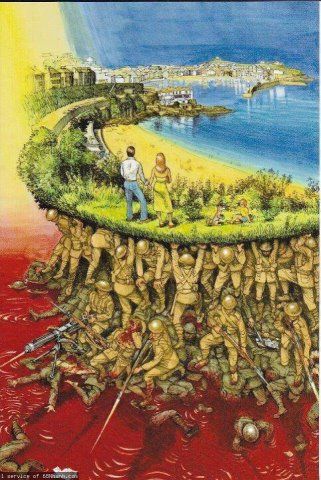
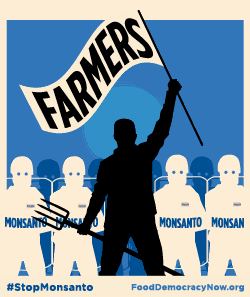
This isn't the kind of "freedom" we want

says a lot, doesn't it...?
Labels: 4th of July, Afghanistan, Afghanistan casualties, freedom
Submit To PropellerTweet
[Permalink] 0 comments
Labels: 4th of July, Afghanistan, Afghanistan casualties, freedom
Submit To PropellerThe Economic Elite have escalated their attack on US workers over the past few years, however, this attack began to build intensity in the 1970s. In 1970, CEOs made $25 for every $1 the average worker made. Due to technological advancements, production and profit levels exploded from 1970 - 2000. With the lion's share of increased profits going to the CEO's, this pay ratio dramatically rose to $90 for CEOs to $1 for the average worker.
As ridiculous as that seems, an in-depth study in 2004 on the explosion of CEO pay revealed that, including stock options and other benefits, CEO pay is more accurately $500 to $1.
Paul Buchheit, from DePaul University, revealed, "From 1980 to 2006 the richest 1% of America tripled their after-tax percentage of our nation's total income, while the bottom 90% have seen their share drop over 20%." Robert Freeman added, "Between 2002 and 2006, it was even worse: an astounding three-quarters of all the economy's growth was captured by the top 1%."
Due to this, the United States already had the highest inequality of wealth in the industrialized world prior to the financial crisis. Since the crisis, which has hit the average worker much harder than CEO's, the gap between the top one percent and the remaining 99% of the US population has grown to a record high. The economic top one percent of the population now owns over 70% of all financial assets, an all time record.
Labels: banksters, elites, executive compensation, freedom, income gap, middle class, super-rich
Submit To PropellerAmericans no longer have an understanding of what it means to be free, we’ve become so accustomed to big brother’s hand that torture, spying without warrants, and engaging in illegal wars of aggression are to be expected. Many of the candidates running for president campaigned hard on these issues, insisting that we would “remain on offense” in the propaganda-ridden war on terror. What Americans need now is a miracle, we need a hero or group of heroes to stand up in our legislature and fight for them. We don’t need more government parenting and rules that cater to corporations and fear.
Terrorism should be a tool that only the enemy is allowed to use. Illegal government activity should not be tolerated in its current form. Soon, we will lose a part of ourselves, the American spirit will die. This country is no longer FDR’s America, it isn’t JFK’s or Reagan’s America. It most definitely is not Bill Clinton’s America, yet his wife was curiously absent from the Senate floor on this most important matter. Unless our voters and elected officials stand up and fight for freedom, we’re going to lose this fight for our country. If you feel even a modicum of pride and love left for this nation that people the world over once admired, equip yourself with knowledge and do your part so that our country won’t slip away into the dark abyss of fascism.
Labels: constitutional crisis, FISA, freedom, retroactive immunity, telecommunications companies, terrorism, U.S. Constitution, US Senate
Submit To PropellerTony Judt is director of the Remarque Institute at New York University and the author of “Postwar: A History of Europe Since 1945.”
Yes, [the liberal hawks] concede, President Bush messed up his (our) war. But even if the war was a mistake, it was a brave and good mistake and we were right to make it, just as we were right to advocate intervention in Bosnia and Kosovo. (“The difference between Kosovo and Iraq isn’t between a country that wanted peace and one that didn’t,” the Slate editor and onetime war cheerleader Jacob Weisberg, now tells us. “It was a matter of better management and better luck.”) We were right to be wrong — and that’s why you should listen to us now.
[...]
[R]emember what Albert Camus had to say about his fellow intellectuals’ propensity for encouraging violence to others at a safe distance from themselves. “Mistaken ideas always end in bloodshed,” he wrote, “but in every case it is someone else’s blood. That is why some of our thinkers feel free to say just about anything.”
Labels: democracy, freedom, George Bush, Iraq, liberal hawks, military-industrial complex, neocons, war
Submit To Propelleri repeat, who woulda thunk it...?
- In the last 10 years, we've lost most of what we claim to be fighting for. We have a police state -- helicopters flying above houses, looking to see if they can see some marijuana. America has gone downhill.
- Radio doesn't want substance. If a song actually had an opinion, that's the first thing they'd throw in the trash.
- Anybody with the least bit of intelligence is going to say, "Maybe we need some diplomacy."
- [T]here are some conditions in the United States that don't resemble Americanism. Where are the people that care about freedom? We're overseas fighting for it and people are giving their life for it when it doesn't even exist here.
Labels: diplomacy, freedom, Merle Haggard, Police State
Submit To PropellerEnd of Dreams, Return of History
By Robert Kagan
Robert Kagan
Since the end of World War ii at least, American presidents of both parties have pursued a fairly consistent approach to the world. They have regarded the United States as the "indispensable nation" and the "locomotive at the head of mankind." They have amassed power and influence and deployed them in ever-widening arcs around the globe on behalf of interests, ideals, and ambitions, both tangible and intangible. Since 1945 Americans have insisted on acquiring and maintaining military supremacy, a "preponderance of power" in the world rather than a balance of power with other nations. They have operated on the ideological conviction that liberal democracy is the only legitimate form of government and that other forms of government are not only illegitimate but transitory. They have declared their readiness to "support free peoples who are resisting attempted subjugation" by forces of oppression, to "pay any price, bear any burden" to defend freedom, to seek "democratic enlargement" in the world, and to work for the "end of tyranny." They have been impatient with the status quo. They have seen America as a catalyst for change in human affairs, and they have employed the strategies and tactics of "maximalism," seeking revolutionary rather than gradual solutions to problems. Therefore, they have often been at odds with the more cautious approaches of their allies.
[...]
So long as Americans elect leaders who believe it is the role of the United States to improve the world and bring about the "ultimate good," and so long as American power in all its forms is sufficient to shape the behavior of others, the broad direction of American foreign policy is unlikely to change, absent some dramatic -- indeed, genuinely revolutionary -- effort by a future administration.
[...]
Six decades ago American leaders believed the United States had the unique ability and the unique responsibility to use its power to prevent a slide back to the circumstances that produced two world wars and innumerable national calamities. Although much has changed since then, America's responsibility has not.
Labels: American exceptionalism, Carnegie Endowment for International Peace, democracy, freedom, Robert Kagan, U.S. foreign policy, WWII
Submit To PropellerThe most powerful weapon in the struggle against extremism is not bullets or bombs -- it is the universal appeal of freedom. Freedom is the design of our Maker, and the longing of every soul. Freedom is the best way to unleash the creativity and economic potential of a nation. Freedom is the only ordering of a society that leads to justice. And human freedom is the only way to achieve human rights.
Expanding freedom is more than a moral imperative -- it is the only realistic way to protect our people in the long run. Years ago, Andrei Sakharov warned that a country that does not respect the rights of its own people will not respond to the rights of its neighbors. History proves him right. Governments accountable to their people do not attack each other. Democracies address problems through the political process, instead of blaming outside scapegoats. Young people who can disagree openly with their leaders are less likely to adopt violent ideologies. And nations that commit to freedom for their people will not support extremists -- they will join in defeating them.
For all these reasons, the United States is committed to the advance of freedom and democracy as the great alternatives to repression and radicalism. (Applause.) And we have a historic objective in view. In my second inaugural address, I pledged America to the ultimate goal of ending tyranny in our world. Some have said that qualifies me as a "dissident president." If standing for liberty in the world makes me a dissident, I wear that title with pride.
No man, for any considerable period, can wear one face to himself, and another to the multitude, without finally getting bewildered as to which may be the true.
What Did Mr. Bush’s 2nd Inaugural Address Really Mean?
Biblical Code Unraveled
Labels: Bush Doctrine, democracy, freedom, Inaugural address, liberty
Submit To Propeller