mirror effects
from The Seoul Times: "We Need a Moratorium on Agrofuels":
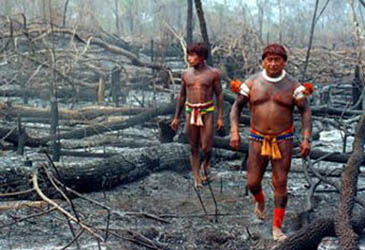 Caption: "Impact of Deforestation — Native indians walk through recently burnt rainforest in South America."
from UNHCHR - "The Rights of Indigenous Peoples":
following a government sanctioned pogrom at a 50-year-old Southern California nudist colony, I observed that pogroms and ethnic cleansing of peoples and tribes, no matter how obscure, seemed to have the almost immediate predictable results of spontaneously occurring elsewhere, as if by some connected hidden thread. I noted shortly after that time, that then New York City Mayor Rudolph Giuliani simply couldn't cleanse the New York City culture of adult theaters, newsstands and porno shops by a sweeping declaration of his "Broken Window Policy", in order to be rid of those cultures of which he disapproved. He could not do that anymore than others could wipe out a tribe in a rain forest, and not expect a similar event to break out almost spontaneously, elsewhere. He clearly got back his Broken Windows Policy, in spades, on 9/11/01.
Tweet

[Permalink] 0 comments
Caption: "Impact of Deforestation — Native indians walk through recently burnt rainforest in South America."With biofuels being touted as our best great hope to undo climate change, it would be easy to ask yourself, "What's not to like?" Biofuels, proponents claim, will counter our global dependence on fossil fuels and help curb carbon emissions. But this "greening" of our energy sources is not all that green. A growing group of human rights and environmental activists point to the dangers that biofuels pose to environmental sustainability and the livelihoods of communities around the world, and call for a major shift: a moratorium on biofuels.
Most of the policies being put forward envision substituting biofuels for fossil fuels without reducing our overall consumption of energy. These proposals are backed by agribusiness, biotech companies, and oil interests that are now investing billions in ethanol and biodiesel plants, plantations of soy, corn, sugarcane, and palm oil, as well as genetically engineered trees and microbes for future supplies of cellulosic ethanol."
from UNHCHR - "The Rights of Indigenous Peoples":
Indigenous peoples inhabit large areas of the earth's surface. Spread across the world from the Arctic to the South Pacific, they number, at a rough estimate, some 300 million. Indigenous or aboriginal peoples are so-called because they were living on their lands before settlers came from elsewhere; they are the descendants - according to one definition - of those who inhabited a country or a geographical region at the time when people of different cultures or ethnic origins arrived, the new arrivals later becoming dominant through conquest, occupation, settlement or other means.
Among many indigenous peoples are the Indians of the Americas (for example, the Mayas of Guatemala or the Aymaras of Bolivia), the Inuit and Aleutians of the circumpolar region, the Saami of northern Europe, the Aborigines and Torres Strait Islanders of Australia, and the Maori of New Zealand. These and most other indigenous peoples have retained social, cultural, economic and political characteristics which are clearly distinct from those of the other segments of the national populations.
Throughout human history, whenever dominant neighbouring peoples have expanded their territories or settlers from far away have acquired new lands by force, the cultures and livelihoods - even the existence - of indigenous peoples have been endangered. The threats to indigenous peoples' cultures and lands, to their status and other legal rights as distinct groups and as citizens, do not always take the same forms as in previous times. Although some groups have been relatively successful, in most part of the world indigenous peoples are actively seeking recognition of their identities and ways of life."
following a government sanctioned pogrom at a 50-year-old Southern California nudist colony, I observed that pogroms and ethnic cleansing of peoples and tribes, no matter how obscure, seemed to have the almost immediate predictable results of spontaneously occurring elsewhere, as if by some connected hidden thread. I noted shortly after that time, that then New York City Mayor Rudolph Giuliani simply couldn't cleanse the New York City culture of adult theaters, newsstands and porno shops by a sweeping declaration of his "Broken Window Policy", in order to be rid of those cultures of which he disapproved. He could not do that anymore than others could wipe out a tribe in a rain forest, and not expect a similar event to break out almost spontaneously, elsewhere. He clearly got back his Broken Windows Policy, in spades, on 9/11/01.
Labels: agrofuels, deforestation, nudism, rainforest, Rudy Giuliani
Submit To PropellerTweet
[Permalink] 0 comments
posted by mettle at
11/11/2007