Mr. Fish: The altruism and profound compassion of the 1%
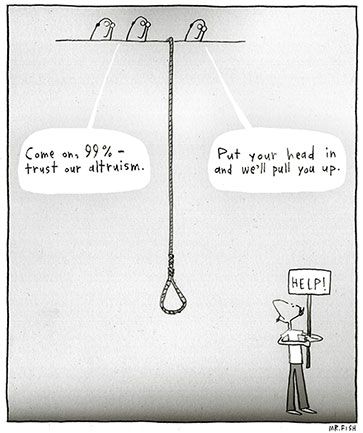
Labels: 1%, 99%, altruism, compassion, Mr. Fish, Truthdig
Submit To PropellerTweet

[Permalink] 0 comments
posted by profmarcus at
5/08/2012


Labels: 1%, 99%, altruism, compassion, Mr. Fish, Truthdig
Submit To Propellerposted by profmarcus at
5/08/2012
The breadth of this movement is one thing, its depth another. It has rejected not just the particulars of our economic system, but the whole set of moral and emotional assumptions on which it’s based. Take the pair shown in a photograph from Occupy Austin in Texas. The amiable-looking elderly woman is holding a sign whose computer-printed words say, “Money has stolen our vote.” The older man next to her with the baseball cap is holding a sign handwritten on cardboard that states, “We are our brothers’ keeper.”
The photo of the two of them offers just a peek into a single moment in the remarkable period we’re living through and the astonishing movement that’s drawn in… well, if not 99% of us, then a striking enough percentage: everyone from teen pop superstar Miley Cyrus with her Occupy-homage video to Alaska Yup’ik elder Esther Green ice-fishing and holding a sign that says “Yirqa Kuik” in big letters, with the translation -- “occupy the river” -- in little ones below.
The woman with the stolen-votes sign is referring to them. Her companion is talking about us, all of us, and our fundamental principles. His sign comes straight out of Genesis, a denial of what that competitive entrepreneur Cain said to God after foreclosing on his brother Abel’s life. He was not, he claimed, his brother’s keeper; we are not, he insisted, beholden to each other, but separate, isolated, each of us for ourselves.
Think of Cain as the first Social Darwinist and this Occupier in Austin as his opposite, claiming, no, our operating system should be love; we are all connected; we must take care of each other. And this movement, he’s saying, is about what the Argentinian uprising that began a decade ago, on December 19, 2001, called politica afectiva, the politics of affection.
If it’s a movement about love, it’s also about the money they so unjustly took, and continue to take, from us -- and about the fact that, right now, money and love are at war with each other. After all, in the American heartland, people are beginning to be imprisoned for debt, while the Occupy movement is arguing for debt forgiveness, renegotiation, and debt jubilees.
Labels: compassion, hearts and minds, Occupy, Rebecca Solnit, social darwinism
Submit To Propellerposted by profmarcus at
12/22/2011
In an academic version of a Depression-era Frank Capra movie, Keltner and co-authors of an article called “Social Class as Culture: The Convergence of Resources and Rank in the Social Realm,” published this week in the journal Current Directions in Psychological Science, argue that “upper-class rank perceptions trigger a focus away from the context toward the self….”
In other words, rich people are more likely to think about themselves. “They think that economic success and political outcomes, and personal outcomes, have to do with individual behavior, a good work ethic,” said Keltner, a professor of psychology at the University of California, Berkeley.
Because the rich gloss over the ways family connections, money and education helped, they come to denigrate the role of government and vigorously oppose taxes to fund it.
“I will quote from the Tea Party hero Ayn Rand: “‘It is the morality of altruism that men have to reject,’” he said.
[...]
According to Gallup, Americans earning more than $90,000 per year continued to increase their consumer spending in July while middle- and lower-income Americans remained stalled, even as the upper classes argue that they can’t pay any more taxes. Meanwhile, the gap between the wealthiest and the rest of us continues to grow wider, with over 80 percent of the nation’s financial wealth controlled by about 20 percent of the people.
Unlike the rich, lower class people have to depend on others for survival, Keltner argued. So they learn “prosocial behaviors.” They read people better, empathize more with others, and they give more to those in need.
Labels: Afghanistan, compassion, elites, empathy, income gap, super-rich, working poor
Submit To Propellerposted by profmarcus at
8/10/2011
This is my last column for The New York Times after an exhilarating, nearly 18-year run. I’m off to write a book and expand my efforts on behalf of working people, the poor and others who are struggling in our society. My thanks to all the readers who have been so kind to me over the years. I can be reached going forward at bobherbert88@gmail.com.
Welcome to America in the second decade of the 21st century. An army of long-term unemployed workers is spread across the land, the human fallout from the Great Recession and long years of misguided economic policies. Optimism is in short supply. The few jobs now being created too often pay a pittance, not nearly enough to pry open the doors to a middle-class standard of living.
Arthur Miller, echoing the poet Archibald MacLeish, liked to say that the essence of America was its promises. That was a long time ago. Limitless greed, unrestrained corporate power and a ferocious addiction to foreign oil have led us to an era of perpetual war and economic decline. Young people today are staring at a future in which they will be less well off than their elders, a reversal of fortune that should send a shudder through everyone.
The U.S. has not just misplaced its priorities. When the most powerful country ever to inhabit the earth finds it so easy to plunge into the horror of warfare but almost impossible to find adequate work for its people or to properly educate its young, it has lost its way entirely.
Nearly 14 million Americans are jobless and the outlook for many of them is grim. Since there is just one job available for every five individuals looking for work, four of the five are out of luck. Instead of a land of opportunity, the U.S. is increasingly becoming a place of limited expectations. A college professor in Washington told me this week that graduates from his program were finding jobs, but they were not making very much money, certainly not enough to think about raising a family.
There is plenty of economic activity in the U.S., and plenty of wealth. But like greedy children, the folks at the top are seizing virtually all the marbles. Income and wealth inequality in the U.S. have reached stages that would make the third world blush. As the Economic Policy Institute has reported, the richest 10 percent of Americans received an unconscionable 100 percent of the average income growth in the years 2000 to 2007, the most recent extended period of economic expansion.
Americans behave as if this is somehow normal or acceptable. It shouldn’t be, and didn’t used to be. Through much of the post-World War II era, income distribution was far more equitable, with the top 10 percent of families accounting for just a third of average income growth, and the bottom 90 percent receiving two-thirds. That seems like ancient history now.
The current maldistribution of wealth is also scandalous. In 2009, the richest 5 percent claimed 63.5 percent of the nation’s wealth. The overwhelming majority, the bottom 80 percent, collectively held just 12.8 percent.
This inequality, in which an enormous segment of the population struggles while the fortunate few ride the gravy train, is a world-class recipe for social unrest. Downward mobility is an ever-shortening fuse leading to profound consequences.
A stark example of the fundamental unfairness that is now so widespread was in The New York Times on Friday under the headline: “G.E.’s Strategies Let It Avoid Taxes Altogether.” Despite profits of $14.2 billion — $5.1 billion from its operations in the United States — General Electric did not have to pay any U.S. taxes last year.
As The Times’s David Kocieniewski reported, “Its extraordinary success is based on an aggressive strategy that mixes fierce lobbying for tax breaks and innovative accounting that enables it to concentrate its profits offshore.”
G.E. is the nation’s largest corporation. Its chief executive, Jeffrey Immelt, is the leader of President Obama’s Council on Jobs and Competitiveness. You can understand how ordinary workers might look at this cozy corporate-government arrangement and conclude that it is not fully committed to the best interests of working people.
Overwhelming imbalances in wealth and income inevitably result in enormous imbalances of political power. So the corporations and the very wealthy continue to do well. The employment crisis never gets addressed. The wars never end. And nation-building never gets a foothold here at home.
New ideas and new leadership have seldom been more urgently needed.
Labels: Barack Obama, Bob Herbert, compassion, corporate military industrial government complex, elites, endless war, General Electric, hypocrisy, Libya, NYT, off the rails, super-rich, unemployment
Submit To Propellerposted by profmarcus at
3/26/2011
"When it is all too much, when the news is so bad meditation itself feels useless, and a single life feels too small a stone to offer on the altar of peace, find a human sunrise. Find those people who are committed to changing our scary reality. Human sunrises are happening all over the earth, at every moment. People gathering, people working to change the intolerable, people coming in their robes and sandals or in their rags and bare feet, and they are singing, or not, and they are chanting, or not. But they are working to bring peace, light, compassion to the infinitely frightening downhill slide of human life".
Alice Walker
Labels: Alice Walker, compassion, Comunidades y Viviendas, world peace
Submit To Propellerposted by Anonymous at
8/27/2007
An alternative look at NEWS THAT MATTERS: current events, politics, opinion, perspective, discussion, analysis, issues, debate, and insight - national and global.
Reno |
London |



 |
 |