Blog Flux Directory Subscribe in NewsGator Online Subscribe with Bloglines http://www.wikio.com Blog directory
And, yes, I DO take it personally
Mandy: Great blog!
Mark: Thanks to all the contributors on this blog. When I want to get information on the events that really matter, I come here.
Penny: I'm glad I found your blog (from a comment on Think Progress), it's comprehensive and very insightful.
Eric: Nice site....I enjoyed it and will be back.
nora kelly: I enjoy your site. Keep it up! I particularly like your insights on Latin America.
Alison: Loquacious as ever with a touch of elegance -- & right on target as usual!
"Everybody's worried about stopping terrorism. Well, there's a really easy way: stop participating in it."
- Noam Chomsky
Send tips and other comments to: profmarcus2010@yahoo.com

And, yes, I DO take it personally

Friday, July 27, 2012

Glenn and Bruce Ackerman on the extreme advance of executive power under Obama

overreaching executive power and the virtually complete negation of constitutionally protected liberties lie at the heart of the choices we are being presented in the 2012 presidential election which, upon even cursory reflection, are no choices at all...

glenn ...
[Consider] the years-long screeching over President Bush’s mere eavesdropping and detentions without any judicial review or transparency — he’s assaulting the Constitution and Our Values! – compared with the reaction to Obama’s more extremist assassinations without any judicial review or transparency. Or consider how a high-level aide to John Ashcroft marveled with envy over Obama’s ability to prosecute whistleblowers with such abandon, noting to The New York Times that the Ashcroft DOJ was deterred by the prospect of a political storm that Obama simply does not face:  ”We,” lamented the Ashcroft aide, “would have gotten hammered for it.”

This was the same dynamic that led former Bush OLC official and current Harvard Law Professor Jack Goldsmith to explain quite presciently (and celebratorily) back in May, 2009, that Obama — by leading progressives and Democrats to support his embrace of Bush/Cheney Terrorism and civil liberties policies — was doing more to entrench those once-controversial policies as bipartisan consensus than Bush and Cheney themselves could ever have dreamt of doing:
The new administration has copied most of the Bush program, has expanded some of it, and has narrowed only a bit. Almost all of the Obama changes have been at the level of packaging, argumentation, symbol, and rhetoric. . . .
[...]

. . . Obama — as he has proven — can get away with far more aggression and belligerence by all but eliminating the pervasive political conflict that arises when done under a Republican President.

an interview on presidential power conducted by lane greene of the economist with bruce ackerman, sterling professor of law and political science at yale...

so, what are we supposed to do in november when facing that election booth handle...? continue to delude ourselves into thinking that we're participating in government by and for the people...? continue to believe that we actually have a choice when voting for president...? whoever occupies the oval office is and will continue to be the bought-and-paid for property of our global ruling elites who have demonstrated beyond a shadow of a doubt that they are the ones in charge of the world's economic and governmental systems...

Labels: , , , , , , , , , , ,

Submit To Propeller


[Permalink] 0 comments

Thursday, August 04, 2011

U.S. family indebtedness, U.S. national debt, country-by-country indebtedness

some highly illuminating graphics...

from a bankruptcy law firm...


America Is A Country In Debt

from u.s. debt kleptocracy...

A Visualization of U.S. Debt

from the economist...

World debt guide


although it took me a while to wake up to the fact, i've now known for some years that encouraging individuals, families, governments and nations to build up massive amounts of debt is really a strategy for enslavement - and our super-rich elites are no fools when it comes to strategies for enslavement...

all the solicitations for credit cards that poured in to our mailboxes by the bushel over the past twenty years, the endless stream of tv ads exhorting us to build up our credit ratings (turn on any channel to find the supremely odious ben stein shilling for a sleazy "free" credit score outfit), all the automobile and furniture commercials pushing no money down and no interest until some comfortably distant time in the future, are all calculated to extend and deepen our slavery...

we may think that slavery is a thing of the past but if we really stop to think about it, being in debt is very much the same as "being owned" by someone else... and the societal and legal penalties for reneging on debt are deliberately swift and harsh... after all, ya can't have the sheep straying too far from the herd... they might get to thinking they're not really sheep and god knows where THAT might lead...

Labels: , , , , , , ,

Submit To Propeller


[Permalink] 0 comments

Saturday, June 19, 2010

The BP defense vs. the huge and still-evolving massive scope of the disaster

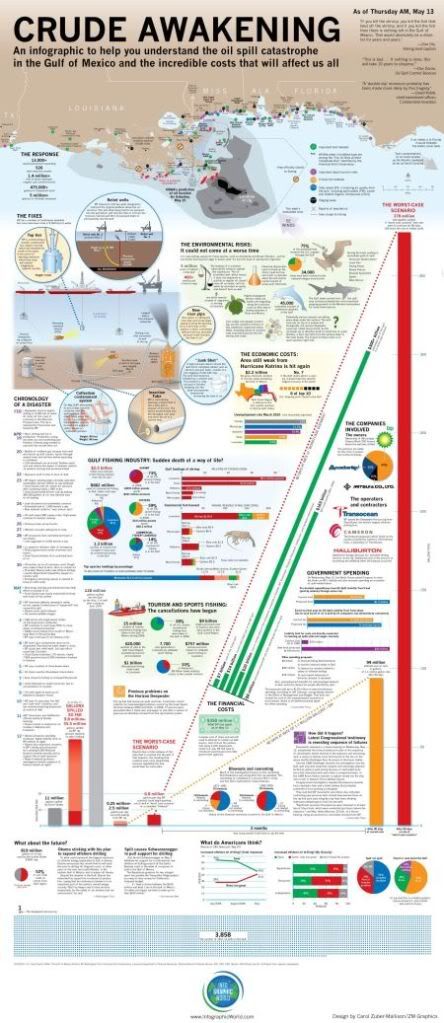
posting in justmeans, a site that focuses on corporate social responsibility, madeline ravich, a justmeans staff writer who has an interest in corporate social responsibility rating and ranking systems, offers her takeaway from the following graphic below...

Photobucket
(click on graphic for larger version)
The graphic touches on environmental risks, economic costs, impacts on local industries, the financial costs of cleanup, and expected government spending. Fine print at the bottom cites the references used for the graphic as including the U.S. Coast Guard, NOAA, The Gulf of Mexico Alliance, BP, Washington Post, American Bird Conservancy, Louisiana Department of Natural Resources, National Marine Fisheries Service, EPA, CNN, CBS, Reuters, Wall Street Journal, Washington Post, and regional newspapers. Below is a summary of what I learned about impacts:

Wildlife: Animals are dying. The Gulf Coast contains 5 million acres of habitat, and is home to 45,000 bottlenose dolphins and 34,000 birds. 75%of the waterfowl that traverse the U.S. migrate through the Gulf, as do 5 sea turtle species.

Food Prices: The spill will make seafood less available and/or more expensive. As a result of the spill, you can expect to pay more for shrimp and oysters until the Gulf recovers. As of 2008, the Gulf was home to 73% of all U.S. shrimp fishing and 59% of all U.S. oyster fishing. The initial cost estimate to the fishing industry was $2.5 billion.

Tourism: The spill is threatening livelihoods. At risk are the $9 million dollars in wages paid each year to tourism and recreation workers in the Gulf region, 620,000 jobs in the Gulf region provided by tourism and recreation, and 7,700 jobs generated in Louisiana by saltwater sport fishing.

Companies: The companies responsible for the spill will foot some or all of the $300+ billion estimated cost of the spill in a worst-case scenario. The license where the well was drilled is owned 65% by BP, 25% by Anadarka, and 10% by Mitsui & Co. and responsibility will be shared in those proportions. Less clear is the responsibility to be borne by operators and contractors Transocean, Cameron, and Halliburton. These companies have lost $20 billion in market value due to the spill and BP is already spending $6 million per day.

Americans: Today, 46% of Americans favor offshore drilling (down from 64% in July of 2008) and 41% think the risks are too great (up from 28% in July of 2008). Those who still favor it may be part of the 51% who view the spill as an isolated incident and those who don't may include the 14% who know little to nothing about the Gulf.

Oil supply: The spill has underscored how detrimental a spill in the Gulf region is to the U.S. oil supply. 52% of U.S. total crude oil comes from the Gulf region, and in a worst-case scenario, 6.8 million gallons could begin gushing out of the well each day (the U.S. consumes 819 million gallons of crude oil each day.)

and yet, here is what an individual from a corporate social responsibility rating and ranking organization has to say in defense of the high marks it awards bp...
Our rating system is broad and balanced. It is backward-looking--but incorporates enough data points to be a good estimate of recent reality. Much of our evaluation is comparative--a company is judged against the performance of others in its industry. We measure twelve subcategories of performance--plus more than a dozen special issues. So, a company that performs poorly in one area can redeem itself in the others.

If you look at BP, it has remarkably good scores for a major oil company. I've attached a screen shot of the data you'd see if you were a subscriber. You'll see several subcategory ratings above 70. It is pretty hard to get this good a score. We are tough enough that we don't hand out any "As" and very few "Bs!" The average score is in the mid 40s.

For instance, BP has excellent governance scores. Take a look at the attached report from Governance Metrics (the best source IMHO of governance info). BP has excellent scores for its handling of board and transparency issues--especially when you compare it to other oil industry companies. Regardless of how BP did with the oil spill disaster, it probably is a pretty well governed company, with a balanced and responsible board.

Similarly, if you look at our custom report from Asset4, you'll see that BP garnered 20 awards for its community service (one of the top numbers in our system). The organizations that granted their favor to BP were not all stupid, fooled, or swayed only by PR. They did real work to investigate and check on BP's performance. Of course, many may regret the honors they bestowed on BP and renounce them after the fact. We are certain to see a drop in BP's community scores, as we move forward.

Look at the other sources on our list. The Accountability list contains only 100 companies. It is hard to get on it. Universum says BP is great to black people. This is not what you'd expect from a bunch of red neck oil people! The Human Rights Council only has 100 companies on their list--and they check each carefully. BP joined BSR, UN Global Compact, and Carbon Disclosure Project. Joining these groups does not prove BP is good. But, it does say they care about transparency and communication--one valid component of social responsibility.

Someone using our system could knock BP for their involvement in military contracting or for their pollution problems. Some people will want to be anti any company that pumps oil or that does any kind of resource extraction. That is OK, because we are not saying there is a "right" overall number for BP or that they should always be a top company. However, looking at them broadly and fairly, they are not that bad--and they are certainly as good or better than most of the rest of the oil industry.

And based on that, he concluded: I don't think the mistakes they've made changed their intentions or erased the reality of the hundreds of positive programs and initiatives they put in place over the last twenty years.

(above courtesy of yves smith in naked capitalism...)

here's what robert reich has to say about bp and csr (corporate social responsibility)...
BP has been making public statements about its supposed corporate social responsibility for as many years as it’s behaved irresponsibly. It’s the poster child for PR masquerading as CSR.

[…]

Ad campaigns about corporate social responsibility are cheap. So are public scoldings by politicians about a corporation’s irresponsibility. Watch not what they say but what they do.

and bp, amazingly enough, still cannot seem to accept responsibility for its actions... even worse, the economist, that perennial ass-kisser of the super-rich elites, has the nerve to say this...
America’s justifiable fury with BP is degenerating into a broader attack on business.

[...]

Vilifying BP also gets in the way of identifying other culprits, one of which is the government. BP operates in one of the most regulated industries on earth with some of the most perverse rules, subsidies and incentives. Shoddy oversight clearly contributed to the spill, and an energy policy which reduced the demand for oil would do more to avert future environmental horrors than fierce retribution.

[...]

If [Mr. Obama] he sees any impropriety in politicians ordering executives about, upstaging the courts and threatening confiscation, he has not said so. The collapse in BP’s share price suggests that he has convinced the markets that he is an American version of Vladimir Putin, willing to harry firms into doing his bidding.

the following from the columbia journalism review is contained in a daily kos diary (which, btw, excerpts the full yves smith post referenced above)... i don't think any summary of the still-unfolding disaster could do a better job than this does...
So, it's in one of the most regulated industries, but at the same time, regulators are responsible for its actions because they didn't regulate? Huh?

[...]

You have a few drinks and are driving home at about 100 mph, when it starts to rain. You lose control, crash, taking out a bunch of other drivers and starting a fire which burns down a lot of the surrounding neighborhood. Your defense -- there were laws in place that should have prevented the accident. The fault lies with the cops who failed to stop you before the unfortunate accident which was triggered by an act of God (the rain).

kinda says it all, doesn't it...?

Labels: , , , , , , , ,

Submit To Propeller


[Permalink] 0 comments